In October 1916, as the presidential election campaign continues in the United States, no part of the world
is untouched by the war.A German U-Boat
pays a visit to Newport, Rhode Island, where it makes and receives
courtesy calls on American officers, then returns to sea and sinks nine
merchant ships off the North American coast.Six Americans are killed when a German submarine attacks an armed
British merchant ship in heavy seas off the coast of Ireland.On the Western Front, the French retake Fort Douaumont,
the first of the fortifications at Verdun
that fell to the Germans when they began their assault in February.On the Somme, bloody fighting continues without significant gains by either side. The Italian
Army launches the eighth battle of the Isonzo and attacks Austrian troops in
the mountains of the Trentino. Continuing
their offensive against Romania,
German armies force the Romanians to abandon all the gains they have achieved
since declaring war in August.
*****
President Wilson Campaigning in New Jersey This Month
The American presidential campaign is in full swing. President Wilson left Shadow Lawn on October 3 for a visit to Omaha to join in the semi-centennial celebration of Nebraska statehood. At the Omaha Auditorium on October 5, he told a capacity crowd that America has stayed out of the war "not because she was not interested, but because she wanted to play a different part." He said "there is as much fight in America as in any nation in the world, but she wants to know what for." On the same day Elihu Root, the former Secretary of State, Secretary of War and Senator from New York, addressed a Republican Club rally in Carnegie Hall. He said the Wilson administration had failed to impress its opponents, whether Germany, Mexico, or the railroad unions, with the true spirit of America, and that the Republican Party and its nominee Charles Evans Hughes represented patriotic Americanism. Back at Shadow Lawn on October 7, President Wilson attacked the Republican Party as one "with no proposals upon which all could unite," a disunited party which "cannot avow its purpose" and is "shot through with every form of bitterness, every ugly form of hate, every debased purpose of revenge, and every covert desire to recover secret power." Referring to former President Roosevelt, he warned that "if the Republican Party should succeed, one very large branch of it would insist upon what its leader has insisted upon, a complete reversal of policy ... [which] can only be a reversal from peace to war."
Hughes Campaign Button
In Louisville, Kentucky on October 12, Wilson's opponent Charles Evans Hughes answered a heckler by saying that if he had been president when Germany published its warning to Lusitania passengers he would have warned Germany that an attack on the ocean liner would have meant the immediate termination of diplomatic relations. Referring to the American response in February 1915 to Germany's declaration of unrestricted submarine warfare, Hughes accused President Wilson of not living up to his own strong words in response to the initial submarine threat. Hughes said that, unlike Wilson, "when I said 'strict accountability' every nation would have known that that was meant." On October 16 in Omaha, he responded to Wilson's charge that a victory of the Republican Party would mean the country would be ruled by "secret power" wielded by an "invisible government." He said it is not the Republicans but the Democratic administration of President Wilson that has been governed by "mysterious influences" that do not represent the desires or interests of the American people. In a reference to Colonel House, the president's unofficial but highly influential adviser, Hughes said "I desire government through two Houses and not three."
U53 in Newport Harbor
A German U-Boat, U53, made a surprise visit to the United States on October 7, entering Newport Harbor escorted by an American submarine it encountered as it approached Narragansett Bay. After being guided to an anchorage at the naval base, the German submarine captain exchanged courtesy calls with Admiral Austin Knight, commander of the Naval War College, and Admiral Albert Gleaves, commander of the destroyer forces, and delivered a letter addressed to German Ambassador Count Johann von Bernstorff. He told the American officers he had sufficient water, provisions and fuel, and was back at sea within a few hours. Within the next two days, U53 sank nine merchant ships off the coast of North America. Last May's Sussex Pledge to observe "cruiser rules" was obeyed in every case, and all those aboard the merchant ships were rescued. After conferring with Secretary of State Lansing, President Wilson has decided to take no action.
Ambassador Gerard
The presence of U53 in American waters coincided with a visit to the United States by the American ambassador to Germany, James W. Gerard. On October 10, within a few hours after his arrival in New York on the Scandinavian-American liner Frederick VIII, he met with Secretary of State Lansing at Colonel House's residence in New York. The Secretary then departed for Shadow Lawn, President Wilson's summer residence at Long Branch, New Jersey, where he conferred with the president about reports that the German government is under pressure to resume unrestricted submarine warfare against merchant and passenger shipping.
On October 28, a German submarine torpedoed and sank two British steamships in heavy seas off the coast of Ireland. One of them, S.S. Marina of the Donaldson Line, was an armed merchant ship with 49 Americans aboard, six of whom were drowned. The attack appears to have been without warning, violating the Sussex Pledge.
General von Mackensen
War on the European continent continued on multiple fronts. On October 24, after a two-day artillery barrage, the French Army at Verdun recaptured Fort Douaumont, taking 6,000 German prisoners. On the Somme, the village of Le Sars,
recently captured by the British, was lost to a German counterattack and then
retaken five days later.The Italian Army advanced in the Trentino, regaining the northern slopes of Mount Pasubio, and launched another offensive at the Isonzo River, capturing some 5,000 Austrian prisoners. In the Balkans the offensive against Romania continued. On October 19, German Army troops under the command of General August von Mackensen broke through the Romanian defenses at Dobrudja, and three days later entered the port city of Constanta, erasing the gains of the Romanian Army since it entered the war.
October 1916 – Selected Sources and Recommended Reading
Contemporary Periodicals:
American Review of Reviews, November and December 1916
New York
Times, October 1916
Books and Articles:
A. Scott Berg, Wilson
Britain at War Magazine, The Third Year of the Great War: 1916
Winston S. Churchill, The World Crisis 1911-1918
John Milton Cooper, Jr., Woodrow Wilson: A Biography
John Milton Cooper, Jr., The Warrior and the Priest: Woodrow Wilson and
Theodore Roosevelt
Patrick Devlin, Too Proud to Fight: Woodrow Wilson's
Neutrality
John Dos Passos, Mr. Wilson's War
David Fromkin, A Peace to End All Peace: Creating the Modern Middle East, 1914-1922
Martin Gilbert, Churchill: A Life
Martin Gilbert, The First World War: A Complete History
Martin Gilbert, A History of the Twentieth Century, Volume One: 1900-1933
Martin Gilbert, Winston S. Churchill Volume III: The Challenge of War, 1914-1916
Richard F. Hamilton and Holger H. Herwig, Decisions for War, 1914-1917
August Heckscher, Woodrow Wilson: A Biography
Godfrey Hodgson, Woodrow Wilson's Right Hand: The Life of Colonel Edward M. House
Paul Jankowski, Verdun: The Longest Battle of the Great War
Keith Jeffrey, 1916: A Global History
Roy Jenkins, Churchill: A Biography
John Keegan, The First World War
David M. Kennedy, Over Here: The First World War and American Society
Ian Kershaw, To Hell and Back: Europe 1914-1949
Nicholas A. Lambert, Planning Armageddon: British Economic Warfare and the First World War
Arthur S. Link, Wilson: Confusions and Crises, 1915-1916
Arthur S. Link, Woodrow Wilson and the Progressive Era,
1910-1917
G.J. Meyer, A World Undone: The Story of the Great War, 1914 to 1918
Merlo J. Pusey, Charles Evans Hughes
Jonathan Schneer, The Balfour Declaration: The Origins of the Arab-Israeli Conflict
J. Lee Thompson, Never Call Retreat: Theodore Roosevelt and the Great War
Adam Tooze, The Deluge: The Great War, America and the Remaking of the Global Order, 1916-1931
Barbara W. Tuchman, The Zimmermann Telegram
Geoffrey C. Ward and Ken Burns, The Roosevelts: An Intimate History
This post marks the fifth anniversary of my monthly Centennial Countdown blog, in which I review the events of the month a hundred years ago. All five years are available in the archive. I started the Countdown with September 1911 not because there's anything special about that date but because September 2011 was when the idea occurred to me. The project has been a learning experience for me as I hope it has been for you. I appreciate your interest, and in particular the comments and suggestions (and occasional corrections) the blog has inspired.
#######
In September 1916, the presidential campaign in the United States begins in earnest. The Democrats formally notify President Wilson of his nomination and a Democratic Congress swiftly passes his pro-labor railroad bill, averting a threatened nationwide rail strike. Wilson tells suffragists that their cause will triumph with or without a constitutional amendment. He administers a brutal public rebuff to an Irish-American critic and lays claim to the label "progressive." David Lloyd George warns America not to interfere with Great Britain's war. At the Somme, tanks are used in battle for the first time and Prime Minister Asquith's son is killed in action. Romania may be rethinking its decision to join the Allies, as Bulgaria declares war and joins German forces in a two-pronged attack.
*****
The Democratic Party Notification Ceremony at Shadow Lawn
Traditionally, the presidential campaign begins in September. This year the Republicans held their notification ceremony a month early to give their nominee, former New York Governor and Supreme Court Justice Charles Evans Hughes, time for an extended campaign swing through the midwestern and western states. The Democrats nominated President Wilson for reelection. Because his normal duties keep him in the news and provide the occasion for regular speeches on questions of public policy, there was no need to hold the Democratic notification ceremony any earlier than usual. This summer, without waiting for the formal start of the campaign, the president dedicated the new American Federation of Labor building, signed rural credits and child labor legislation, and spent much of the month of August in meetings with railroad executives and union leaders trying to avert a railroad strike. At the end of August he asked Congress to resolve the railroad impasse by enacting the unions' demands into law. On Saturday, September 2, his campaign began with the Democrats' official notification ceremony at Shadow Lawn, this year's "Summer White House" on the New Jersey shore.
Representative Adamson
President Wilson is spending as much time as possible at Shadow Lawn. While he was there for the notification ceremony, Congress passed the legislation he had requested, called the Adamson Act after its sponsor in the House of Representatives, Representative William C. Adamson (Dem., Ga.). The president signed it into law the next day in his railroad car before leaving for Kentucky for a ceremony dedicating Abraham Lincoln's birthplace. On September 4 his Republican opponent addressed a mostly pro-Wilson crowd in solidly Democratic Memphis, Tennessee, in which he attacked Wilson and the Democratic Congress for the Adamson Act, arguing that it sacrificed principle to political expediency and failed to stand up to special interests. The Republicans are expected to make this a major issue. Back in Washington on Tuesday, September 5, Wilson signed the bill a second time to foreclose any legal argument that it had not become law because it was signed on a Sunday.
Carrie Chapman Catt
President Wilson traveled to Atlantic City on September 8 to address the National American Woman Suffrage Association. Attempting to recover ground lost to Hughes on the woman suffrage issue, he restated his support for woman suffrage without mentioning that, unlike Hughes, he opposed making it the law of the land by amending the Constitution. Calling the woman suffrage movement "one of the most astonishing tides in modern history," he told his audience that they "need not be afraid that it will not come to its flood. We feel the tide; we rejoice in the strength of it, and we shall not quarrel in the long run as to the method of it." Addressing this group was an unusual experience for him, he said, because unlike most of his trips to Atlantic City, this time he had come "not to fight anybody, but with somebody." He concluded his address by saying "I have not come to ask you to be patient, because you have been, but I have come to congratulate you that there was a force behind you that will, beyond any peradventure, be triumphant and for which you can afford a little while to wait." Apparently satisfied, Mrs. Carrie Chapman Catt, the president of the Association, replied to the president's speech by saying "you touched our hearts and won our fealty when you said you had come here to fight with us."
Jeremiah O'Leary
The American Truth Society was founded in 1912 to promote
independence for Ireland.
Since the outbreak of the war in Europe, its
membership has grown to include German-Americans and others who oppose what
they perceive as the pro-Allied policy of the American government. Its
founder and president, Jeremiah O'Leary, sent a telegram to President Wilson on
September 29 in which he accused the president of "truckling to the British
Empire" and presidential "dictatorship over Congress, and warned that
"your foreign policies, your failure to secure compliance with all
American rights, your leniency with the British Empire, your approval of war
loans, the ammunition traffic, are issues in this campaign." Wilson replied the same
day and sent copies of both telegrams to the newspapers. His reply read:
"Your telegram received. I would feel deeply mortified to have you
or anybody like you vote for me. Since you have access to many disloyal
Americans and I have not, I ask you to convey this message to them."
President Wilson at Shadow Lawn
In a speech at Shadow Lawn on September 30, Wilson attacked the Republican Party and laid claim to the "progressive" label. Addressing a group of young Democrats, he abandoned his usual professorial speaking style and adopted the fiery rhetoric of a political campaign. He asked "If [the Republicans] are going to change our foreign policy, in what direction are they going to change it? There is only one choice against peace and that is war! The certain prospect of the success of the Republican Party is that we shall be drawn in one form or another into the embroilments of the European war." He praised the Progressives of 1912 who left the Republican Party and said "the progressive voters of this country all put together outnumber either party." He advised his listeners to "throw in your fortunes with the party of which the progressives have the control" and said "I am a progressive. I do not spell it with a capital P, but I think my pace is just as fast as those who do."
A British View of the American Presidential Campaign
Reports circulated this month that Germany might suggest to President Wilson that he offer to act as mediator in an effort to bring an end to the war, and that Germany was also considering the resumption of unrestricted submarine warfare, thus revoking the "Sussex Pledge" made in May. In an apparent effort to head off any move by President Wilson to involve himself in peace negotiations, British Secretary of State for War David Lloyd George gave an interview to an American correspondent on September 28. He said "The fight must be to the finish -- to a knock-out ... Neutrals of the highest purposes and humanitarians with the best motives must know that there can be no outside interference at this stage. Britain asked no intervention when she was not prepared to fight. She will tolerate none now ...." On the same day German Chancellor Bethmann-Hollweg spoke in the Reichstag, denouncing Great Britain as an unscrupulous foe against whom Germany was justified in using "all suitable weapons."
A "Tank" in Action at Flers-Courcelette
A new weapon was used in battle for the first time on the Somme battlefield on September 15. Allied forces attacked German positions south of the Albert-Bapaume road using "battle tanks," armored vehicles designed to carry firepower over barbed wire and through opposing trenches and machine guns. Of the forty-nine machines that took part in the attack, ten were hit by artillery fire and fourteen suffered mechanical breakdowns or failed to advance for other reasons. The others advanced over a mile, capturing High Wood and the nearby villages of Flers, Courcelette and Martinpuich.
Raymond Asquith
Among the Allied casualties in the battle of Flers-Courcelette was Lieutenant Raymond Asquith of the Guards Division, who was mortally wounded as he led his men forward.. After being shot, he nonchalantly lit a cigarette as he was carried off the field to encourage his men to continue the attack. Asquith, a barrister who was regarded as a promising future politician before the war, was Prime Minister Herbert Asquith's eldest son.
Zeppelin SL11
On the night of September 2-3 Germany mounted the largest Zeppelin raid of the war. Sixteen airships attacked eastern England, of which ten reached London. On the return flight one of them, the SL11, was attacked and brought down by a British aircraft piloted by Lieutenant William Leefe Robinson using the new incendiary bullets. The fiery crash was witnessed for miles around, and thousands of Britons poured into the streets to celebrate the first destruction of a German airship on British soil. Lieutenant Robinson was promoted to captain and awarded the Victoria Cross.
The Germans also have their aerial heroes. One of them is Baron Manfred von Richthofen, recently transferred from the Eastern Front where he engaged in bombing missions against Russian targets. On September 17 on the Western Front, he won his first aerial duel when he shot down a British aircraft flown by pilot Lieutenant Lionel Morris and observer Captain Tom Rees. Both of the British aviators were killed.
Romanian Troops in Transylvania
Romania's successful prosecution of its war against Austria, which began on August 28 with an offensive through the Carpathian Mountain passes, has stalled. Bulgaria declared war on September 1 and attacked across the Danube on September 3 as the German Army under the command of General von Falkenhayn attacked from the north and Bulgarian aircraft attacked Bucharest from the air. On September 26 Falkenhayn advanced into Transylvania and recaptured Hermannstadt.
September 1916 – Selected Sources and Recommended Reading
Contemporary Periodicals:
American Review of Reviews, October and November 1916
New York
Times, September 1916
Books and Articles:
A. Scott Berg, Wilson
Howard Blum, Dark Invasion, 1915: Germany's Secret War and the Hunt for the First Terrorist Cell in America
Britain at War Magazine, The Third Year of the Great War: 1916
Winston S. Churchill, The World Crisis 1911-1918
John Milton Cooper, Jr., Woodrow Wilson: A Biography
John Milton Cooper, Jr., The Warrior and the Priest: Woodrow Wilson and
Theodore Roosevelt
Patrick Devlin, Too Proud to Fight: Woodrow Wilson's
Neutrality
John Dos Passos, Mr. Wilson's War
David Fromkin, A Peace to End All Peace: Creating the Modern Middle East, 1914-1922
Martin Gilbert, Churchill: A Life
Martin Gilbert, The First World War: A Complete History
Martin Gilbert, A History of the Twentieth Century, Volume One: 1900-1933
Martin Gilbert, Winston S. Churchill Volume III: The Challenge of War, 1914-1916
Richard F. Hamilton and Holger H. Herwig, Decisions for War, 1914-1917
August Heckscher, Woodrow Wilson: A Biography
Godfrey Hodgson, Woodrow Wilson's Right Hand: The Life of Colonel Edward M. House
Paul Jankowski, Verdun: The Longest Battle of the Great War
Keith Jeffrey, 1916: A Global History
Roy Jenkins, Churchill: A Biography
John Keegan, The First World War
David M. Kennedy, Over Here: The First World War and American Society
Ian Kershaw, To Hell and Back: Europe 1914-1949
Nicholas A. Lambert, Planning Armageddon: British Economic Warfare and the First World War
Arthur S. Link, Wilson: Confusions and Crises, 1915-1916
Arthur S. Link, Woodrow Wilson and the Progressive Era,
1910-1917
G.J. Meyer, A World Undone: The Story of the Great War, 1914 to 1918
Merlo J. Pusey, Charles Evans Hughes
Jonathan Schneer, The Balfour Declaration: The Origins of the Arab-Israeli Conflict
J. Lee Thompson, Never Call Retreat: Theodore Roosevelt and the Great War
Adam Tooze, The Deluge: The Great War, America and the Remaking of the Global Order, 1916-1931
Barbara W. Tuchman, The Zimmermann Telegram
Geoffrey C. Ward and Ken Burns, The Roosevelts: An Intimate History
It's August 1916. The second anniversary of the outbreak of the World War coincides with the beginning of the American presidential campaign. Charles Evans Hughes, the Republican nominee, spends the month of August touring the western United States. He is well-received in most states but encounters bitter intraparty infighting in California, where his attempt to avoid taking sides backfires. Former President Roosevelt, meanwhile, overcomes his disappointment at being denied the nomination and comes out strongly for Hughes. In the war, both sides suffer heavy losses on the Somme, an Italian battleship is destroyed by a mysterious explosion, and the Italian Army mounts another attack on the Isonzo. Over a year after declaring war on Austria-Hungary, Italy declares war on Germany. On the Eastern Front, the Brusilov Offensive makes gains in Galicia, and Romania enters the war on the side of the Allies. Pro-Allied Greeks in Salonika proclaim a provisional government. The Kaiser replaces his top army commander. Great Britain tightens its blockade of Germany and hangs Sir Roger Casement for treason. The United States agrees to buy the Danish West Indies (soon to be renamed the U.S. Virgin Islands) from Denmark. President Wilson, frustrated in his attempt to mediate a railroad labor dispute, asks Congress to resolve it by legislation.
*****
Charles Evans Hughes on His Western Tour
Attempting to get a head start on the 1916 presidential campaign, Republican nominee Charles Evans Hughes spent the month of August on a speaking tour of the Western United States. He left New York shortly after his formal acceptance of the nomination at Carnegie Hall on July 31, but not before sending a telegram to Senator George Sutherland (Rep., Utah), a Senate sponsor of the proposed woman suffrage amendment to the Constitution, declaring his support for the measure. Hughes sent the telegram on August 1 in response to a letter from Senator Sutherland asking that he clarify his position, since the Republican platform was silent on the issue. That evening he elaborated on his position in an address to women's groups at the Hotel Astor. This places him in opposition to (or at least ahead of) President Wilson, who recently announced his support for the enactment of woman suffrage by the states but repeated his opposition to a constitutional amendment.
Hughes began his western tour in Detroit. After addressing a friendly crowd of some 10,000 working men, he attended a baseball game, where he shook hands with the players and chatted with Tigers center fielder Ty Cobb. As his train continued to the west coast, Hughes delivered several speeches a day, addressing enthusiastic crowds at Chicago, St. Paul, Minneapolis, Fargo, Helena, Spokane, Tacoma, Seattle, and numerous stops in between, some scheduled and some not. Continuing down the coast to California, he confronted the major challenge of his trip. The feud between the Old Guard and Progressive branches of the Republican Party, resolved with varying degrees of lingering hostility in most states, is still white-hot in California. As Hughes entered the state, the Republican primary campaign for the U.S. Senate was in its final days. Governor Hiram Johnson, Roosevelt's running mate on the Progressive ticket in 1912 and the Progressive Party's choice for the Senate this year, was also seeking the Republican nomination. He was strongly opposed by the regular Republicans, led by California's Republican National Committeeman William H. Crocker and Republican State Chairman Francis V. Keesling, who supported Johnson's opponent Willis Booth. Hughes's visit, far from healing the party's rift, made things worse. The representatives of the Old Guard insisted on taking the leading role in all the events at which Hughes appeared and the Progressives refused to attend under those circumstances. Hughes tried to assume a stance of neutrality, but his unwillingness either to exclude the Republican Party leaders from his rallies or to compel the Progressives to attend them allowed the impression to build that he favored the Old Guard establishment. The impression was heightened on August 19 when he was the guest of honor at a luncheon at the Commercial Club in San Francisco. Waiters in the city were on strike, and the union refused to make an exception for the luncheon, so it was served by strike breakers. The next day Hughes visited a hotel in Long Beach without knowing Johnson was present in the same building, leading Johnson and his followers to think he was being deliberately snubbed. Hughes left California on August 29, the day of the Republican primary. When the votes were counted, Johnson was an easy winner, leaving him in firm control of both the Republican and Progressive Parties in the state. In the general election he will face the Democratic nominee, Mayor George S. Patton of San Marino, whose son is an Army officer serving in Mexico with General Pershing.
It seems that Hughes would have been well advised to wait until after the primary to campaign in California. Governor Johnson still nominally supports Hughes, who like Johnson has both parties' nominations. His support is at best lukewarm, however, and the rift in the state party is wider than ever, with Hughes on the wrong side of it despite his progressive credentials. Hughes's visit to California, in short, may have done his presidential campaign more harm than good.
Roosevelt Speaking to Visitors at Sagamore Hill
Former President Roosevelt's presence at Hughes's notification ceremony on the last day of July was also his first appearance at a Republican Party event since he left the Party four years ago, and his presence arguably attracted more attention than the speech itself. On August 31, as Hughes was on his way back from California, Roosevelt began his campaign for Hughes with a speech at City Hall Auditorium in Lewiston, Maine. Scoffing at the Democrats' claim that President Wilson "kept us out of war," Roosevelt said that this was true only if one believed, as Wilson apparently does, that "deeds are nothing, and words everything." He pointed out that more Americans had died in the undeclared war in Mexico than in the declared Spanish-American War, and that although more Americans were lost in the attack on Veracruz than in the capture of Manila, Wilson abandoned Veracruz while President McKinley did not abandon Manila. The only difference between the undeclared war in Mexico and the declared war against Spain, Roosevelt argued, was that the former was "entered into pointlessly and abandoned ignobly." After Pancho Villa's attack on Columbus, New Mexico, the president sent American troops into Mexico with the mission of capturing Villa "dead or alive," but that mission too has been abandoned. Wilson, Roosevelt charged, is pursuing a Mexican policy "between feeble peace and feeble war." Turning to the European war and Germany's invasion of Belgium, Roosevelt said that Wilson's policy of neutrality "in fact as well as in name, in thought as well as in action," has been compared to that of Pontius Pilate, but that this was "unjust to Pontius Pilate, who at least gently urged moderation on the wrongdoers."
A frequently heard theme in this campaign is criticism of "hyphenated Americans," meaning those Americans who are inclined to place their loyalty to their country of origin ahead of loyalty to the United States. No candidate for public office wants to defend those kinds of "hyphenates," but neither does either party want to offend the substantial voting blocs of German- and Irish-Americans. In Lewiston, Roosevelt avoided using the term "hyphenated," but denounced "professional German-Americans who in our politics act as servants or allies of Germany," adding that "I would condemn just as quickly English-Americans or French-Americans or Irish-Americans who acted in such manner." "During the last two years," he said, "we have seen an evil revival in this country of non-American and anti-American division along politico-racial lines." He blamed President Wilson who, he said, "has lacked the courage and the vision to lead this nation in the path of high duty." Wilson's record, he said, has combined "grace in elocution with futility in action." Against Wilson's record of "words unbacked by deeds or betrayed by deeds," Roosevelt pointed to Hughes's "rugged and uncompromising straightforwardness of character and action in every office he has held."
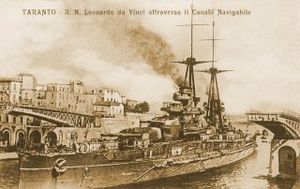
The Leonardo da Vinci in Taranto
The war in Europe continues without respite. In the Allied offensive on the Somme, the British Fourth Army on August 8 attacked the village of Guillemont, on the right flank of the British sector. The Germans counterattacked on August 18 from their positions in Leuze Wood. Both attacks were turned back with heavy losses. In the early morning hours of August 3, in the harbor of Taranto in the
Adriatic, a magazine explosion sank the Italian battleship Leonardo da
Vinci. Austrian sabotage is suspected. The next day Italy mounted its
sixth offensive of the war on the Isonzo Front. Two weeks later the
Italian Army had advanced three to four miles along a fifteen-mile front and
entered the town of Gorizia, but at the cost of some 50,000
casualties. On August 27, Italy declared war on Germany. On the Eastern Front, the Russian offensive commanded by General Brusilov resulted in the capture of Stanislau in Eastern Galicia on August 7. Encouraged by the Russian success, Romania joined the war on the side of the Allies, declaring war on Austria-Hungary on
August 27 and invading Hungary the next day. By August 30 the Romanian Army had seized five Carpathian passes and occupied Kronstadt and Hermannstadt, two major cities in Transylvania. The German Army got a new commander on August 28 when the Kaiser
appointed Field Marshal Paul von Hindenburg to the position of Chief of
the General Staff, replacing General Erich von Falkenhayn. In Greece, King Constantine remains determined to adhere to a neutrality favoring the Central Powers, while Prime Minister Eleftherios Venizelos wants Greece to join the Allies. On August 30 Greek troops at Salonika loyal to Venizelos declared the formation of a provisional government and called on the Greek people to drive the Bulgarians out of Greece. On August 18 the British government moved to tighten its blockade of Germany. To solve the problem of shipments to neutral Sweden being reexported to Germany, all exports to Sweden will now be prohibited other than by special license.
Sir Roger Casement On His Way to the Gallows
Great Britain is still feeling the aftershocks of the Easter Rising in Dublin. The ringleaders were tried by court martial and executed by firing squad in Dublin shortly after the rebellion was put down. (See the April and May 1916 installments of this blog.) Sir Roger Casement, who was arrested on the eve of the uprising on the coast of Ireland after being put ashore by a German submarine with a cache of weapons and explosives, was taken to London where he was tried and convicted of treason in June. Judicial appeals and diplomatic appeals for clemency were denied, and Casement, stripped of his knighthood, was hanged on August 3 in Pentonville Prison. The brutal response to the Easter Rising has added one more source of friction to Britain's relations with the United States.
Signing of the Treaty
In New York on August 4, Secretary of State Lansing and Constantin Brun, the Danish minister to the United States, signed a treaty providing for the purchase by the United States of the Danish West Indies (St. Thomas, St. Croix and St. John), a group of islands lying between the Atlantic and Caribbean east of Porto Rico. The agreed price is $25,000,000. The treaty also provides for protection of Danish business interests on the islands and for the United States' recognition of Denmark's exclusive interests in Greenland. The islands occupy a strategically important position, and the harbor on St. Thomas is admirably suited for naval and military operations. Perhaps of more importance, the acquisition of the islands by the United States will foreclose the possibility of their control by another European power. The treaty will now be submitted to the United States Senate and the Danish Parliament for ratification. Ratification by the United States is considered certain. Ratification by Denmark, while probable, is somewhat less certain, due to possible opposition by Germany or other European nations with strategic interests in the West Indies.
President Wilson Addressing Congress
After trying unsuccessfully to mediate a labor dispute between the railroads and the railway unions, President Wilson addressed a joint session of Congress on August 29, asking for legislation giving the unions essentially everything they have wanted and been willing to go on strike for: a standard eight-hour day for railroad workers with mandatory overtime pay for additional hours worked. The Adamson Act is opposed by most Republicans and some Democrats, who object to what they regard as an abject surrender to special interests and the threat of force. It is the most radical legislation affecting labor relations that has ever been proposed in the United States, and coming in the midst of a hard-fought presidential campaign it will inevitably be a major political issue. President Wilson and his supporters no doubt calculate that there are more votes to be gained by supporting labor's demands than by opposing them.
August 1916 – Selected Sources and Recommended Reading
Contemporary Periodicals:
American Review of Reviews, September and October 1916
New York
Times, August 1916
Books and Articles:
A. Scott Berg, Wilson
Howard Blum, Dark Invasion, 1915: Germany's Secret War and the Hunt for the First Terrorist Cell in America
Britain at War Magazine, The Third Year of the Great War: 1916
Winston S. Churchill, The World Crisis 1911-1918
John Milton Cooper, Jr., Woodrow Wilson: A Biography
John Milton Cooper, Jr., The Warrior and the Priest: Woodrow Wilson and
Theodore Roosevelt
Patrick Devlin, Too Proud to Fight: Woodrow Wilson's
Neutrality
John Dos Passos, Mr. Wilson's War
David Fromkin, A Peace to End All Peace: Creating the Modern Middle East, 1914-1922
Martin Gilbert, Churchill: A Life
Martin Gilbert, The First World War: A Complete History
Martin Gilbert, A History of the Twentieth Century, Volume One: 1900-1933
Martin Gilbert, Winston S. Churchill Volume III: The Challenge of War, 1914-1916
Richard F. Hamilton and Holger H. Herwig, Decisions for War, 1914-1917
August Heckscher, Woodrow Wilson: A Biography
Godfrey Hodgson, Woodrow Wilson's Right Hand: The Life of Colonel Edward M. House
Paul Jankowski, Verdun: The Longest Battle of the Great War
Keith Jeffrey, 1916: A Global History
Roy Jenkins, Churchill: A Biography
John Keegan, The First World War
David M. Kennedy, Over Here: The First World War and American Society
Ian Kershaw, To Hell and Back: Europe 1914-1949
Nicholas A. Lambert, Planning Armageddon: British Economic Warfare and the First World War
Arthur S. Link, Wilson: Confusions and Crises, 1915-1916
Arthur S. Link, Woodrow Wilson and the Progressive Era,
1910-1917
G.J. Meyer, A World Undone: The Story of the Great War, 1914 to 1918
Merlo J. Pusey, Charles Evans Hughes
Jonathan Schneer, The Balfour Declaration: The Origins of the Arab-Israeli Conflict
J. Lee Thompson, Never Call Retreat: Theodore Roosevelt and the Great War
Adam Tooze, The Deluge: The Great War, America and the Remaking of the Global Order, 1916-1931
Barbara W. Tuchman, The Zimmermann Telegram
Geoffrey C. Ward and Ken Burns, The Roosevelts: An Intimate History
By July 1916, the warring nations have abandoned all pretense of a war that is less than total. In an attempt to divert the relentless German attacks at Verdun, the Allies follow their massive artillery barrage at the Somme with an equally massive infantry assault and meet unexpectedly strong German defenses. Furious battles are now raging on multiple fronts in Europe. The German occupiers of Belgium forbid celebration of Belgian independence. A British ferry captain is captured and executed for trying to ram a German U-Boat. In the United States, the presidential election campaign gets under way and Congress passes preparedness legislation for the Army and Navy. Bombs go off in San Francisco and New York Harbor; the perpetrators are unknown but American anarchists and German saboteurs are on the list of suspects. Anglo-American relations are strained by Great Britain's inclusion of American firms on its "Black List."
*****
British Infantry Preparing to Attack
The Allied offensive on the Somme entered a new phase on July 1 with a massive infantry assault. Little effort was made to conceal preparations for the offensive, and the Germans took advantage of the opportunity to strengthen their defenses. The attacking forces relied on a week-long artillery bombardment, followed by the detonation of ten huge mines under the German trenches two minutes prior to the advance, to weaken the German positions, and told their infantry to expect little if any resistance. They were wrong: well-protected and concealed artillery, machine guns and barbed wire cut down the advancing infantry as fast as they came into view. At the end of the first day, almost 20,000 British soldiers lay dead and over 30,000 were wounded, missing or taken prisoner. None of the first day's objectives had been achieved.
Delville Wood
The Allied offensive on the Somme continued throughout the month with bitter fighting resulting in high casualties and temporary victories that gained possession of small woods and villages only to be followed by retreats in the face of German counter-attacks. The village of Contalmaison was captured on July 7, lost to a counterattack that evening, and recaptured July 10. On July 12 the British finally succeeded in taking Mametz Wood, a short distance from their starting point eleven days earlier. A major assault on July 14 broke through the German line at High Wood but a German counterattack restored the line before reinforcements could arrive. The next day the South African Brigade attacked nearby Delville Wood (Bois d'Elville, nicknamed "Devil's Wood" by the troops), a German position that threatened an Allied salient. A diversionary attack by Australian troops on Fromelles to the north on July 19 was a costly failure, but another Australian attack three days later succeeded in capturing the crossroads village of Pozieres, from which attacks continue on a tactically important German trench system the British call the O.G. (for "Old German") Lines.
Fort Souville In the Aftermath of the German Attack
One of the objectives of the Somme offensive is to relieve the German pressure on Verdun, and in this it has succeeded to some degree. Two infantry divisions, comprising tens of thousands of German troops and sixty heavy guns, have been transferred from Verdun to the Somme sector. On July 12 the Germans mounted what may be their last attempt to break through the French defenses at Verdun. Another attack on Fort Souville using phosgene gas and flamethrowers inflicted severe casualties on the French garrison and resulted in the temporary occupation of the fort's outer walls, but the Germans were driven back and Fort Souville remains in French hands.
Russian Soldiers Advancing
On
the Eastern Front, the Brusilov offensive continued its advance against
Austrian and German forces in Galicia. In an attempt to halt the
Russians' progress, German Generals Hindenburg and Ludendorff were assigned to
command large sections of the front in the last week of July. The
success of Brusilov's offensive has had the additional benefit for the
Allies of limiting the ability of Germany and Austria-Hungary to move
reinforcements into other areas of combat, including Verdun and the Somme on the Western Front and the Isonzo Front in Italy. It may also encourage Romania, which has thus far
remained neutral, to join the Allies.
German Soldiers in Brussels
July 21 was the 85th anniversary of Belgian independence. The German Army forbade all demonstrations, but large numbers of Belgians wore green ribbons as they went about their daily routine. That evening, citizens of Brussels applauded Archbishop Cardinal Mercier, who had called on Belgians to resist the German occupiers, as he entered a car to travel to his home in Malines. For these unwelcome displays of patriotism the citizens of Brussels were fined one million marks.
Captain Fryatt
As
an employee of the Great Eastern Railway, Captain Charles Fryatt
commanded cross-channel ferries on regular runs between Rotterdam, in
the neutral Netherlands, and ports on the east coast of England. He had
two encounters in March with German submarines. In the first he
managed to outrun the U-Boat and in the second he defied an order to
stop and ran straight at the enemy submarine, forcing it into an
emergency dive. For each of those actions, Fryatt was awarded a gold
watch and hailed as a hero by the British public. Last month as his
ferry departed Dutch waters it was captured by German destroyers and
taken to Bruges in German-occupied Belgium. He was taken to Berlin, where on July 27 he was tried before a
naval court-martial, convicted of being a franc-tireur, and sentenced to death. The
Kaiser promptly confirmed the sentence, and Fryatt was executed by a
German firing squad that evening. British Prime Minister Asquith
told the House of Commons that "Captain Fryatt has been murdered by the
Germans. His Majesty's Government have heard with the utmost
indignation of this atrocious crime against the laws of nations and the
usages of war." He said "it shows that the German High Command, under
the stress of military defeat, have renewed their policy of terrorism."
*****
Senator Harding
In the United States, the presidential campaign began on July 31 with the Republican Party's ceremony giving formal notice to Charles Evans Hughes of his nomination. Notification ceremonies mark the beginning of the presidential campaign and typically take place around Labor Day. The Republicans are holding theirs earlier this year to allow for an August tour of the western United States by Hughes so that he can concentrate on the populous eastern states in the fall. Notification ceremonies are often held outdoors, but the Republicans held theirs this year on the hottest day of the year in the sweltering heat of Carnegie Hall. A capacity crowd of 3,000 cheered the nominee and, with equal fervor, former President Roosevelt who was also in attendance. Senator Warren G. Harding of Ohio, the Chairman of the Notification Committee and of last month's Republican National Convention, introduced Hughes and formally notified him of his nomination. The nominee, borrowing President Wilson's "America First" theme, titled his address "America First and America Efficient." He criticized President Wilson's policies, especially in international affairs, focusing on his treatment of the Mexican situation and his record of dealing with the warring powers of Europe. Adopting a proposal advanced by former President Taft's League to Enforce Peace, he advocated the creation of an international court and the formation of an international organization to keep the peace. He was critical of President Wilson's late conversion to the cause of preparedness, reminding his audience that "about a year and a half ago we were told that the question of preparedness was not a pressing one" and that only "later, under the pressure of other leadership, this attitude was changed." As Hughes referred to "other leadership," he turned to look at Roosevelt, causing an outbreak of prolonged cheering and applause.
Major General Hugh Scott, Army Chief of Staff
While most politicians running for office in the United States support "preparedness," there remains a strong anti-preparedness body of opinion, especially in the Midwest and West, led by isolationist senators such as George W. Norris (Rep., Neb.) and Robert M. LaFollette (Rep., Wisc.) and by Governor Hiram Johnson of California, Roosevelt's 1912 Progressive Party running mate who is seeking both the Republican and Progressive Party nominations for the Senate this year. Even among its supporters, the word preparedness has different meanings. President Wilson, following his conversion to the cause earlier this year, toured the Midwest advocating preparedness but emphasizing that it was meant only for defense and not for war. (See the January 1916 installment of this blog). Not long after, Secretary of War Lindley Garrison resigned when his proposal for the creation of a Continental Army was rejected by the President, who preferred legislation authorizing a modest increase in the Regular Army and bringing the National Guard of the states under federal control. (See the February 1916 installment of this blog). The Hay-Chamberlain Army Reorganization Bill, supported by President Wilson and new Secretary of War Newton D. Baker, was passed in May and signed into law last month. It was denounced as inadequate by former President Roosevelt and other advocates of a more assertive foreign policy, and welcomed as a victory by most isolationists.
Admiral William S. Benson, Chief of Naval Operations
Advocates of naval preparedness have been more successful, largely because the idea of a strong Navy is less objectionable to isolationists than that of a large standing Army. Most of the immediate threats to American lives and commerce come from the sea, so the Navy can be seen as a protector of neutrality rather than a threat to it. Last month the House of Representatives approved a watered-down version of a bill submitted by Secretary of the Navy Josephus Daniels that provided for a five-year naval building program. The Senate, more sympathetic than the House to the Navy's needs, passed a bill on July 21 appropriating over 588 million dollars for the largest naval building program in the nation's history. It provides for construction of 157 vessels, including four dreadnoughts, four battle cruisers, four cruisers, twenty destroyers and thirty submarines, and stipulates that the entire program is to be under way within three years rather than the five originally proposed. The vote was 71 to 8. Other important features of the bill include construction of a government-owned armor-plate plant, substantial increases in the number of enlisted men in the Navy and Marine Corps, enlargement of Navy yards and of the Navy's air arm, and a provision for cooperation between the Coast Guard and the Navy in time of war. The bill has gone to a Conference Committee, where it has encountered some resistance from the House members. On July 27 President Wilson invited the House conferees to a meeting at the White House, where he urged them to agree to the Senate bill.
Just Before the Bomb Exploded
Some anti-preparedness Americans carry their opposition to extremes. Suspected anarchists protesting a preparedness parade in San Francisco on July 22 exploded a bomb concealed in a suitcase at the corner of Steuart and Market Streets as the parade passed by. At least six people were killed and twenty-five seriously injured. A Finnish sailor was arrested as he stood near the bodies after the explosion and made a speech praising anarchism. Suspicions of a higher-level conspiracy have focused on known anarchists and radical labor leaders, including the leadership of International Workers of the World (IWW, known as the "Wobblies").
Location of the Black Tom Munitions Depot
After the Explosion
A few days after the bomb exploded in San Francisco, another explosion three thousand miles away rocked New York Harbor. Black Tom Island, in Jersey City near the Statue of Liberty, is the home of the largest munitions depot in the country, where railroad lines from all over the country converge and unload their cargo to await loading onto ships for the hazardous voyage across the Atlantic. On the weekend of July 29-30 the Black Tom depot was filled as usual with enormous quantities of weapons and ammunition. Shortly after midnight Sunday morning several fires broke out. The Jersey City Fire Department was called, but about two hours later there was a huge explosion that lit the sky for miles around, sending bullets flying through the air and embedding pieces of shrapnel in the Statue of Liberty. The shock, which was felt nearly 100 miles away, broke water mains, flooded streets, and blew out windows as far away as the Public Library at Fifth Avenue and Forty-Second Street in Manhattan. At least two people are known to have been killed, and several more are missing, a toll that would certainly have been much higher if the explosion had taken place during a work day. It appears that the first fire began on a barge that was moored at a warehouse pier contrary to applicable safety regulations. Responsible officials of the National Dock & Storage Company, the Lehigh Valley Railroad and the Johnson Lighterage & Towing Company have been arrested and charged with manslaughter. So far there is no indication of an alien plot, but there is little doubt that news of the explosion is being cheered in Berlin.
Lord Robert Cecil
A tool Great Britain has employed in its economic warfare with Germany, in addition to the interception and search of merchant ships, is the adoption of a "Black List" of neutral firms with which British citizens are forbidden to do business under the terms of Britain's Trading with the Enemy Act. Because of Britain's dominant naval power and its control of worldwide port facilities and coal supplies, inclusion on the Black List means a virtual exclusion from international trade. When it was first compiled earlier this year it included no American names, but on July 18 a new and expanded list was published that contains the names of eighty-five American companies. This has caused a political uproar in the United States, leading to a vigorous note of protest from the United States to Great Britain arguing that its action violates international law by interfering with the right of American firms to conduct business with other neutral countries. On July 25 Lord Robert Cecil, who as Under Secretary of State for Foreign Affairs is the cabinet member responsible for compiling and publishing the Black List, told the House of Commons that the intent of the list is only "to declare that British shipping, British goods, and British credit should not be used for the support and enrichment of those who are actively assisting our enemies."
*****
July 1916 – Selected Sources and Recommended Reading
Contemporary Periodicals:
American Review of Reviews, August and September 1916
New York
Times, July 1916
Books and Articles:
A. Scott Berg, Wilson
Howard Blum, Dark Invasion, 1915: Germany's Secret War and the Hunt for the First Terrorist Cell in America
Britain at War Magazine, The Third Year of the Great War: 1916
Winston S. Churchill, The World Crisis 1911-1918
John Milton Cooper, Jr., Woodrow Wilson: A Biography
John Milton Cooper, Jr., The Warrior and the Priest: Woodrow Wilson and
Theodore Roosevelt
Patrick Devlin, Too Proud to Fight: Woodrow Wilson's
Neutrality
John Dos Passos, Mr. Wilson's War
David Fromkin, A Peace to End All Peace: Creating the Modern Middle East, 1914-1922
Martin Gilbert, Churchill: A Life
Martin Gilbert, The First World War: A Complete History
Martin Gilbert, A History of the Twentieth Century, Volume One: 1900-1933
Martin Gilbert, Winston S. Churchill Volume III: The Challenge of War, 1914-1916
Richard F. Hamilton and Holger H. Herwig, Decisions for War, 1914-1917
August Heckscher, Woodrow Wilson: A Biography
Godfrey Hodgson, Woodrow Wilson's Right Hand: The Life of Colonel Edward M. House
Paul Jankowski, Verdun: The Longest Battle of the Great War
Keith Jeffrey, 1916: A Global History
Roy Jenkins, Churchill: A Biography
John Keegan, The First World War
David M. Kennedy, Over Here: The First World War and American Society
Ian Kershaw, To Hell and Back: Europe 1914-1949
Nicholas A. Lambert, Planning Armageddon: British Economic Warfare and the First World War
Arthur S. Link, Wilson: Confusions and Crises, 1915-1916
Arthur S. Link, Woodrow Wilson and the Progressive Era,
1910-1917
G.J. Meyer, A World Undone: The Story of the Great War, 1914 to 1918
Merlo J. Pusey, Charles Evans Hughes
Jonathan Schneer, The Balfour Declaration: The Origins of the Arab-Israeli Conflict
J. Lee Thompson, Never Call Retreat: Theodore Roosevelt and the Great War
Adam Tooze, The Deluge: The Great War, America and the Remaking of the Global Order, 1916-1931
Barbara W. Tuchman, The Zimmermann Telegram
Geoffrey C. Ward and Ken Burns, The Roosevelts: An Intimate History
In June 1916, both American political parties (all three if you count the Progressives) hold their presidential nominating conventions. Supreme Court Justice Charles Evans Hughes (future Secretary of State and Chief Justice) is the Republicans' choice; the Democrats nominate President Woodrow Wilson for a second term. To the dismay of many Progressives, former President Theodore Roosevelt rejoins the Republican Party. Without asking President Wilson's opinion, the Democrats give him the slogan "he kept us out of war." But he almost gets into war with Mexico, as General Pershing's pursuit of Pancho Villa leads to armed conflict with the Mexican Army. Justice Louis Brandeis is confirmed by the Senate. Musical revues are the rage this year on Broadway. The Great War escalates in Europe, as major offensives are mounted by the British at the Somme and by the Russians in Eastern Europe. Arab tribes raise the standard of revolt in the Middle East. General von Moltke dies in the Reichstag, and Field Marshal Lord Kitchener dies when the cruiser taking him to Russia strikes a mine off the coast of Scotland. Sir Ernest Shackleton makes it back to civilization after being marooned with his crew in Antarctica for over a year. China has a new president, but the warlords are in control.
*****
Republicans Gathering at the Chicago Coliseum
The Republican Party approached its 1916 presidential nominating convention with the wounds of 1912 far from healed. Old Guard Republicans and Progressives alike realize that the election of Woodrow Wilson, only the second Democrat elected president since the Civil War, was made possible if not inevitable by former President Theodore Roosevelt's decision to lead the Progressives out of the Republican Party when he failed to defeat incumbent President Taft in the contest for the party's nomination (see the April through August 1912 installments of this blog). Both factions of the party were eager to repair the split if possible, but only on their own terms, and this year both sides' terms revolved around a single personality: Roosevelt himself, and his desire to return to the White House. Most of the Republicans who assembled at the Chicago Coliseum on June 7 regarded Roosevelt's actions in 1912 as a betrayal, and were adamantly opposed to his candidacy. Many of them preferred leaders who had remained with the party and supported President Taft in 1912, such as former Senator and Secretary of State Elihu Root and Iowa Senator Albert Cummins. Representatives of the two factions held meetings but failed to reach agreement, and by the time Ohio Senator Warren G. Harding gaveled the convention to order on June 7 sentiment was building in favor of Supreme Court Justice Charles Evans Hughes, a moderately progressive former governor of New York who, having been appointed to the Court in 1910, had stayed clear of the 1912 split. Hughes was nominated on the third ballot, and former Vice President Charles W. Fairbanks was chosen as his running mate.
Victor Murdock
The Progressive Party, meeting nearby at the Auditorium Theatre, had gone to Chicago hoping to use its leverage to persuade the Republicans to reunite the party under Roosevelt's leadership. When they received word that Hughes's nomination was imminent, they held a vote and nominated Roosevelt as the Progressive Party's candidate. To their intense disappointment, Roosevelt immediately sent a telegram to the convention saying he "cannot accept [the nomination] at this time" because "I do not know the position of the candidate of the Republican Party on the vital questions of the day." He asked that his "conditional refusal to run be placed in the hands of the Progressive National Committee," and that if the Committee was satisfied with Mr Hughes' statements "when he makes them," it should "act accordingly and treat my refusal as definitely accepted." Even if the convention had been inclined to consider other candidates, Roosevelt's "conditional refusal" effectively foreclosed both his own nomination and that of anyone else. Two weeks later, in a letter to the Progressive National Committee, Roosevelt endorsed Hughes, saying that a third party campaign would be fruitless and "a move in the interest of the election of Mr.Wilson." On June 26, at a meeting in Chicago, after six hours of sometimes bitter debate, the Committee gave Hughes its official endorsement. The vote was 32 in favor of endorsing Hughes, six opposed, and nine not voting. A motion to substitute former Representative Victor Murdock of Kansas as the Progressive Party's presidential nominee was defeated by a vote of 32 to 15.
The events of this month are widely regarded as sounding the death knell of the Progressive Party as a political force separate from the Republicans. Also dead, at least for the time being, is the hope expressed by some of establishing "a second white man's party" in the South as a counterweight to the Democrats, who have dominated the politics of that region since the end of Reconstruction. For years the Republican Party in the South has been made up largely of Negroes, who are unable to vote due to restrictive state laws but remain a force to be reckoned with at Republican conventions. Roosevelt, in his pursuit of the Republican nomination in 1912, led an unsuccessful effort to seat "lily-white" delegations from Southern states, which he argued would more accurately represent actual Republican voters, rather than the "black and tan" delegations that supported President Taft. (Democratic Party conventions, of course, have always been "lily-white"). The demise of the Progressive Party this year removes a threat to Democratic hegemony in the South, leaving the politics of the region largely unchanged.
Justice Brandeis
On June 1, by a vote of 47 to 22, the Senate confirmed the nomination of Louis D. Brandeis to fill the vacancy created by the death of Justice Joseph R. Lamar earlier this year. Justice Brandeis's confirmation brings the first Jewish justice to the Court and ends a four-month confirmation battle in which Brandeis was fiercely opposed by business interests and other conservative forces who feared his reputation as an advocate for progressive causes. Brandeis, who is known as the "peoples' attorney," has become famous for his use of the "Brandeis brief," in which he relies less on legal analysis than on data and opinions found in professional journals, treatises and statistical compilations, presented to show the social desirability of the result he is advocating.
Justice Hughes resigned from the Supreme Court on June 10 to accept the Republican nomination for president. President Wilson now has another vacancy to fill.
*****
Governor Martin Glynn
The week after the Republicans nominated Hughes, the Democratic Party held its convention at the St. Louis
Coliseum. Unlike the Republicans, who entered their convention with
several viable candidates, and very unlike the Democrats' own convention four years ago which held a record 46 ballots before nominating Woodrow
Wilson, there was no suspense this year regarding the party's nominee. President
Wilson entered the convention with no opposition to his renomination,
the only question being how the party and its president would be portrayed
to the nation as they entered the general election. The main threat to Wilson's reelection seemed to be summed up by the Republican
convention's emphasis on Americanism, and on Roosevelt's criticism of Wilson
for being too weak on preparedness and too timid in defending American
interests -- that he was indeed "too proud to fight." To counter that
criticism, the organizers of the convention had decorated the hall with hundreds of American flags and advised the
delegates and speakers to emphasize patriotism at every
opportunity. The keynote speaker, former Governor Martin Glynn of New
York, went to the podium on June 14 intending to do just that. To respond to the Republican
criticism that Wilson had failed to stand up for America's interests abroad, he was also armed with a number of examples from American history in which the United States had been challenged and
even humiliated by other nations and resisted the temptation to resort to military force. Glynn intended to cite one or two of those cases as
precedents before moving on to the patriotism theme, but his speech soon took an unexpected turn. His first example was an 1873 incident in which Spain seized
an American ship en route to Cuba and executed its captain and many of its crew. Then he cited an 1891 attack on American sailors in Valparaiso, Chile, and numerous violations of American rights by European governments during the Civil
War, adding in each case that none had led to war. The delegates and spectators in the auditorium cheered each example lustily. When he said he had more examples but would move on, the crowd insisted that he recite them all, and even made him repeat some of their favorites. Responding to the mood of his audience he obliged, and as
he described each such incident the crowd shouted "What did we do?" His
answer in each case, greeted by ecstatic cheers, was "We didn't go to
war!" Every mention of patriotism, in contrast, was greeted only with polite applause.
Senator James Firing Up the Democrats in St. Louis
With Glynn's speech, to the discomfort of President Wilson in Washington and the party leadership in St. Louis, the theme of the convention shifted from patriotism to pacifism. The next day, it was the turn of the convention's permanent chairman to speak. Senator Ollie James of Kentucky, taking his cue from his audience's reaction to Glynn's address the day before, roused the convention again with a stem-winding tribute to the president's avoidance of war: "Tonight twenty million American fathers will gather around an unbroken family fireside with their wives at their sides and their children around their knees and contrast that with the Old World, the world of broken firesides and gloom and mourning upon every hand. If that is evil and vacillating, may God prosper it and teach it to the rulers of the Old World." The climax of his speech brought the convention to its feet with cheers so loud the delegates insisted he repeat it, which he did to another round of tumultuous cheers: "Without orphaning a single American child, without widowing a single American mother, without firing a single gun or shedding a single drop of blood, he wrung from the most militant spirit that ever brooded above a battlefield the concession of American demands and American rights."
Bryan and His Wife In New York Last Year
Former presidential candidate and Secretary of State William Jennings Bryan was in attendance at the convention as a reporter. After Senator James's speech, the convention voted unanimously to suspend the rules and invite Bryan to the podium. He told them "I join the American people in thanking God that we have a President who does not want this nation plunged into this war." The next day the convention nominated President Wilson and Vice President Marshall by acclamation. Then it adopted a platform written by President Wilson himself, to which the Platform Committee had added a single sentence: "In particular, we commend to the American people the splendid diplomatic victories of our great President, who has preserved the vital interests of our Government and its citizens, and kept us out of war."
Americanism, patriotism, preparedness and opposition to "hyphenated" Americans still seem to be themes that all candidates agree upon. Hughes, in a statement made on June 13 to newspaper men in New York in response to questions raised by his endorsement by the German-American Association, said "my attitude is one of undiluted Americanism, and anybody who supports me is supporting an out-and-out American and an out-and-out American policy and nothing else." The same day, in an address to the graduating class at West Point, President Wilson said he believes the great majority of foreign-born citizens are loyal, and that those "who have loved other countries more than they have loved the country of their adoption" are relatively few in number.
*****
Ambassador Arredondo
As his fellow Democrats were praising him for keeping the United States out of the war in Europe, President Wilson was on the brink of war with Mexico. In its note delivered May 31, the de facto Mexican government led by Venustiano Carranza accused the United States of bad faith and demanded immediate withdrawal of American troops, saying that otherwise the Mexican government would have "no further recourse than to defend its territory by an appeal to arms." The American reply was delivered by Secretary of State Lansing to Mexican Ambassador Eliseo Arredondo on June 20. It rejected the Mexican demands, stating that United States troops were sent into Mexican territory for the limited purpose of protecting American lives and property, and only because the de facto government had failed to fulfill its international obligation to do so. It warned that if the Carranza regime continued to ignore that obligation and carry out its threat of an "appeal to arms," it would "lead to the gravest consequences." Delivering copies of the note to other Latin American envoys in Washington the next day, Lansing assured them that the United States had no territorial ambitions or desire to interfere in Mexico's domestic affairs, and that it was taking this position only "to end the conditions which menace our national peace and the safety of our citizens."
Captain Boyd
The very day that those assurances were being made and the contents of the American note were appearing in newspapers in the United States and Mexico, the most serious military confrontation of the expedition was taking place in Carrizal, a small town near Villa Ahumada, about 100 miles south of El Paso and 90 miles east of General Pershing's headquarters at Colonia Dublan, in the Mexican State of Chihuahua. Pershing had sent two troops of the Negro 10th Cavalry to Villa Ahumada under the command of Captain Charles Boyd to investigate reports that Mexican troops were concentrating there. Because General Trevino, the Mexican commander in Chihuahua, had advised Pershing that he was under orders to resist the movement of American troops in any direction other than north, Pershing instructed Boyd to gather information but to avoid a fight. As the American troops neared Carrizal, the local Mexican commander General Felix Gomez advised Boyd that any attempt to proceed through Carrizal and into Villa Ahumada would be resisted. Boyd, ignoring this threat as well as his orders to avoid a fight, ordered his troops to proceed. A firefight ensued, in which fourteen Americans and thirty Mexicans were killed, including Captain Boyd and General Gomez. The Americans were turned back and twenty-five American soldiers were captured.
June 26 Anti-War Newspaper Advertisement
When it received word of the battle in Carrizal, the Wilson Administration prepared to take aggressive military action to protect American troops in Mexico and recover the American prisoners. By June 28, President Wilson had drafted a message to Congress reporting on the situation in Mexico and asking for authorization to use the armed forces as he deemed necessary to protect the border and ensure the establishment in Mexico of a constitutional government able and willing to preserve order. Before the message was delivered, however, the facts changed. That evening, news reports arrived in Washington that General Trevino had ordered the release of the American prisoners and arranged for their transportation to the border. Meanwhile a pacifist group, the American Union Against Militarism, had published an advertisement in major newspapers throughout the United States arguing that Mexican resistance to the American incursion into Mexican territory was not a valid excuse for war. The White House was inundated with hundreds of telegrams, increasing in number with the news that the American prisoners had been released and running ten to one against taking military action against Mexico. President Wilson signaled a change of course when he addressed the Associated Advertising Clubs in Philadelphia on June 29 and the New York Press Club on June 30. In his impromptu talk at the Advertising Clubs he said that America should be ready "to vindicate at whatever cost the principles of liberty, of justice, and of humanity to which we have been devoted from the first." Responding to cheers, he said "You cheer the sentiment, but do you realize what it means? It means that you have not only got to be just to your fellow men, but as a nation you have got to be just to other nations. It comes high. It is not an easy thing to do." In his prepared speech at the Press Club the next day he asked "Do you think the glory of America would be enhanced by a war of conquest in Mexico? Do you think that any act of violence by a powerful nation like this against a weak and distracted neighbor would reflect distinction upon the annals of the United States?" He was greeted with enthusiastic applause when he said "I have constantly to remind myself that I am not the servant of those who wish to enhance the value of their Mexican investments, that I am the servant of the rank and file of the people of the United States." Referring to the many letters he had received in recent days, he said "there is but one prayer in all of these letters: 'Mr. President, do not allow anybody to persuade you that the people of this country want war with anybody.'"
For the time being, it appears that the threat of another Mexican War has receded.
*****
The Winter Garden Theatre
Musical
revues have become annual summer events on Broadway. The Ziegfeld
Follies of 1916 opened at the New Amsterdam Theatre on June 12. It
included music by Jerome Kern and Irving Berlin; featured players
included Fanny Brice, Marion Davies and Bert Williams. Uptown at the
Winter Garden Theatre, The Passing Show of 1916, produced by Lee and
Jacob Shubert, opened on June 22. The most popular of the many songs in
the production is Pretty Baby, performed here by Billy Murray (click to
play):
*****
General Brusilov
The war in Europe is reaching new levels of intensity and slaughter. At Verdun the Germans captured Fort Vaux, on the east bank of the Meuse, on June 7 after a three-month siege. They followed that success on June 23 with an attack on the French defenses in the nearby sector from Fleury to Souville, this time using a new poison gas, phosgene. As the attack intensified, the Commander of the French Second Army, General Robert Nivelle, ended an Order of the Day with the exhortation "They shall not pass!" The Germans took Fleury, but were turned back short of Fort Souville, one of two forts between the German Army and the city of Verdun that remain in French hands. As the struggle between the German and French armies continues at Verdun, major offensives have begun on other fronts. On June 24, in an operation designed in part to relieve the pressure on Verdun, an Allied offensive under British General Sir
Douglas Haig began on June 24 with a 1,500-gun artillery barrage at the River Somme. At
month's end the bombardment was still under way in preparation for an
infantry assault. On the Eastern Front, a Russian army commanded by General Aleksei Brusilov began a major offensive on June 4 against Austria-Hungary. Among its strategic goals is to draw Austrian forces away from the Italian Front. It began with a massive artillery bombardment along a 200-mile front on the eastern frontier of the Austro-Hungarian Empire from the Pripet Marshes to the Bukovina, followed a few hours later by a swift advance that captured 26,000 Austrian troops. Lutsk fell to the Russians on June 8, Czernowitz on June 17.
*****
Sharif Hussein
The Ottoman Empire, like other empires, includes a number of nationalities that chafe under a rule they consider alien. Among those are the Arab tribes in the Hejaz, who view the outbreak of the Great War as an opportunity to escape the rule of the Turkish Sultan. On June 5, under the leadership of Sharif Hussein of Mecca, they mounted an attack on Ottoman forces in Medina. Although the attack was unsuccessful, Hussein declared the independence of the Hejaz two days later. On June 11 British seaplanes and cruisers attacked the port city of Jeddah, on the Red Sea. Mecca, about forty miles inland from Jeddah, fell to the Arab insurgents on June 13 and Jeddah followed on June 16.
Lord Kitchener
Field Marshal Herbert Horatio Kitchener, First Earl Kitchener of Khartoum, joined the British cabinet as Secretary of State for War shortly after the war began. In response to an invitation from Tsar Nicholas II last month to confer in person on war strategy, Kitchener departed King's Cross Station on June 4 for a journey to Russia. After arriving by train in Thurso, on the north coast of Scotland, he boarded a destroyer that carried him across Pentland Firth to Scapa Flow, the anchorage of the Grand Fleet. There he lunched with Admiral Jellicoe aboard his flagship and boarded the cruiser H.M.S. Hampshire for the trip to Russia. The planned route was north and east along the Arctic coast of Norway and Russia, through the Barents Sea to the port of Archangel on the White Sea, and thence by rail to Petrograd. Shortly after getting under way, Hampshire was struggling through heavy weather along the west coast of the Orkney Islands when it struck a mine, one of a number laid a week earlier by a German submarine. Almost everyone on board, including Kitchener and his staff, went down with the ship. Great Britain is in mourning for the loss of a universally admired war hero and symbol of the nation. David Lloyd George, the Minister of Munitions, has been named to succeed Kitchener as Secretary of State for War.
General von Moltke
General Helmuth von Moltke was Chief of the German General Staff at the outbreak of the war. After the failure of the German armies to achieve a breakthrough at the Marne, he was replaced in September 1914 by General Erich von Falkenhayn. Moltke died of a heart attack on June 18 during a memorial service in the Reichstag for General Colmar Freiherr von der Goltz, the commander of Ottoman troops in Mesopotamia who died in April shortly before the British surrender at Kut Al Amara.
Launching the James Caird
Antarctic explorer Sir Ernest Shackleton, who departed South Georgia Island on December 5, 1914, on an expedition to traverse the Antarctic continent from the Weddell Sea to McMurdo Sound by way of the South Pole, arrived at Port Stanley, Falkland Islands, on June 1. In January 1915, before his ship, the Endurance, could reach Antarctica, it was frozen in the ice in the Weddell Sea. In February, with the Antarctic winter approaching, Shackleton ordered his crew to convert Endurance to a winter station and wait for spring. When spring came, however, the movement of the ice began to crush the ship's hull, and on October 24 she had to be abandoned. Shackleton and his party camped on a large ice floe, hoping it would drift toward land. In April of this year the ice floe broke in two and Shackleton ordered his crew into lifeboats. Five days later they reached Elephant Island. He decided that his crew's only hope of rescue was to get back to South Georgia Island, 700 miles away across the Southern Ocean. He took the strongest of the lifeboats, named the James Caird after one of the expedition's sponsors, strengthened it further for the ocean voyage, and set sail with five of his crew. After fifteen days of remarkable seamanship and skillful navigation through frigid and stormy seas they reached the uninhabited southern coast of South Georgia Island. Rather than risk a further voyage around rocky shores and dangerous seas to the north side of the island, Shackleton decided to travel by land with two of his crew across the mountain ridges, glaciers and snow fields of the island's interior, a feat no one had previously attempted. Thirty-six hours later they reached the whaling station at Stromness, where they were greeted by the manager. Shackleton's first question was "Tell me, when was the war over?" The manager replied "The war is not over. Millions are being killed.
Europe is mad. The world is mad."
After he reached the Falklands, Shackleton moved immediately to rescue the twenty-two men left behind on Elephant Island. He attempted to reach the island on a steamer placed at his disposal by the government of Uruguay, but was forced to turn back by extreme ice conditions. At month's end he is back in Port Stanley planning another rescue attempt, this time with an ice breaker. He is optimistic that the men on Elephant Island can survive on short rations, supplemented by the many penguins that inhabit the island.
Li Yuan-Hung
In March of this year, Yuan Shih-Kai abandoned last year's declaration of the Chinese Empire and abdicated his title of Emperor. He tried to maintain control of the government as President, but faced increasing opposition, with several southern provinces declaring their independence. On June 6 Yuan died in Peking after a brief illness. Vice-President Li Yuan-Hung has succeeded to the presidency, and some of the rebellious provinces have rescinded their declarations of independence and declared their loyalty to the new government. Real power, however, appears to lie with regional warlords.
June 1916 – Selected Sources and Recommended Reading
Contemporary Periodicals:
American Review of Reviews, July and August 1916
New York
Times, June 1916
Books and Articles:
Caroline Alexander, The Endurance: Shackleton's Legendary Antarctic Expedition
A. Scott Berg, Wilson
Britain at War Magazine, The Third Year of the Great War: 1916
Winston S. Churchill, The World Crisis 1911-1918
John Milton Cooper, Jr., Woodrow Wilson: A Biography
John Milton Cooper, Jr., The Warrior and the Priest: Woodrow Wilson and
Theodore Roosevelt
Patrick Devlin, Too Proud to Fight: Woodrow Wilson's
Neutrality
John Dos Passos, Mr. Wilson's War
David Fromkin, A Peace to End All Peace: Creating the Modern Middle East, 1914-1922
Martin Gilbert, Churchill: A Life
Martin Gilbert, The First World War: A Complete History
Martin Gilbert, A History of the Twentieth Century, Volume One: 1900-1933
Martin Gilbert, Winston S. Churchill Volume III: The Challenge of War, 1914-1916
Richard F. Hamilton and Holger H. Herwig, Decisions for War, 1914-1917
August Heckscher, Woodrow Wilson: A Biography
Godfrey Hodgson, Woodrow Wilson's Right Hand: The Life of Colonel Edward M. House
Paul Jankowski, Verdun: The Longest Battle of the Great War
Keith Jeffrey, 1916: A Global History
Roy Jenkins, Churchill: A Biography
John Keegan, The First World War
David M. Kennedy, Over Here: The First World War and American Society
Nicholas A. Lambert, Planning Armageddon: British Economic Warfare and the First World War
Arthur S. Link, Wilson: Confusions and Crises, 1915-1916
Arthur S. Link, Woodrow Wilson and the Progressive Era,
1910-1917
G.J. Meyer, A World Undone: The Story of the Great War, 1914 to 1918
Merlo J. Pusey, Charles Evans Hughes
Jonathan Schneer, The Balfour Declaration: The Origins of the Arab-Israeli Conflict
J. Lee Thompson, Never Call Retreat: Theodore Roosevelt and the Great War
Barbara W. Tuchman, The Zimmermann Telegram
Geoffrey C. Ward and Ken Burns, The Roosevelts: An Intimate History