Saturday, June 30, 2012

June 1912


1912 is shaping up as the most contentious, and the most consequential, election year in the United States since Abraham Lincoln's election fifty-two years ago propelled the country into the Civil War.  Both major political parties held their presidential nominating conventions this month, and both conventions included more than the usual amount of drama.


 Republicans Arriving at the Chicago Coliseum, June 1912

The Republicans went first, gathering at the Chicago Coliseum on June 18.  The campaign for the nomination was unprecedented in pitting a former president against an incumbent president of his own party.  Former President Roosevelt’s challenge to President Taft was hard-fought up to and through the convention, and now appears to be continuing into the general election contest.  As the convention began, Roosevelt had won most of the primaries, including most impressively in Taft’s home state of Ohio.  Most delegates, however, were chosen not in primaries but in conventions.  The outcome of the conventions varied from state to state, but most were controlled effectively by the party machinery favoring the incumbent president.  In some states insurgent factions supporting Roosevelt named rival slates of delegates, most of which were “lily-white” delegations in southern states that challenged the "black and tan" delegations named by the state party machines.  (For more about this, see the April 1912 installment of this blog).  The challenges were presented this month to the Republican National Committee, which met in Chicago prior to the convention.  Of 254 contested seats, the Committee awarded 235 to Taft and 19 to Roosevelt.


 Roosevelt as Bull Moose

Departing from the custom that candidates for the nomination do not attend the convention, Roosevelt traveled to Chicago, announcing on the way that he now supports women's suffrage.  He arrived two days before the convention opened, telling reporters he felt “as strong as a bull moose,” an image since picked up by his supporters and the press as the symbol of his campaign.  Addressing a group of his supporters in Chicago, he denounced the National Committee’s decision to award most of the disputed delegates to Taft and, for the first time, threatened to bolt the party:  “The parting of the ways has come … We fight in honorable fashion for the good of mankind; fearless of the future; unheeding of our individual fates; with unflinching hearts and undimmed eyes; we stand at Armageddon, and we battle for the Lord!”


Senator Elihu Root

As the convention opened, the first order of business was the selection of a chairman.  Senator Elihu Root was Taft’s choice.  Root was a long-time supporter of both Taft and Roosevelt.  He was Secretary of War under President William McKinley and continued in that position under Roosevelt, who appointed him Secretary of State in 1905 to succeed the late John Hay.  In 1909, as Roosevelt’s term ended, the New York legislature named Root to represent the state in the United States Senate.  Like Henry Cabot Lodge and many other establishment Republicans, Root supported Roosevelt during his tenure as president but has declined to support his attempt this year to deny the nomination to an incumbent Republican president.  The convention selected Root over Governor Francis McGovern of Wisconsin, the choice of the Roosevelt delegates, by a vote of 558 to 501.


 Governor Herbert Hadley

The convention then took up the Roosevelt forces’ challenge to 72 of the Taft delegates seated by the National Committee and confirmed by the Credentials Committee.  Governor Herbert Hadley of Missouri, a Roosevelt supporter, asked the chairman for a ruling that those 72 delegates could not vote on their own qualifications.  Root ruled that each of the challenged delegates would be voted on separately, and that while no delegate could vote on his own qualifications, each could vote on the qualifications of the other 71.  This ruling effectively ensured that the Taft delegates would be seated.


Vice President Sherman

As Root ruled in favor of the Taft forces and the challenges to the disputed Taft delegates were defeated, cries of “steamroller!” interspersed with “toot-toot!” and “choo-choo!” from the Roosevelt delegates echoed through the hall.  Roosevelt released a statement, which was read to the convention, accusing the Taft forces of theft.  His statement asserted that “the convention as now composed has no claim to represent the voters of the Republican Party” and that no one accepting the nomination under such circumstances could “ask the support of any honest man.”  As most Roosevelt delegates left the convention hall or refused to vote, the convention adopted the platform proposed by the Taft delegates and nominated Taft for president on the first ballot.  Vice President James S. (“Sunny Jim”) Sherman was also nominated for a second term.  Meanwhile, Roosevelt delegates gathered across town in Orchestra Hall and nominated Roosevelt for president. Roosevelt appeared and promised to “make the fight … even if only one state should support me.”


 Democrats arriving at the Fifth Regiment Armory, June 1912

As the Republican convention drew to a close, delegates to the Democratic convention were assembling in Baltimore, their optimism enhanced by the reports from Chicago.  One of the delegates, in fact, had observed the Republican convention first-hand.  William Jennings Bryan, three-time presidential nominee of the Democratic Party, had covered the Republican convention as a correspondent for the New York World.  When he arrived in Baltimore on June 23 as a member of the Nebraska delegation, he had plans to play a major role in his party's deliberations.  He had, in fact, already made his first move.


 Judge Alton B. Parker

Before leaving Chicago, Bryan had learned of the decision of the Committee on Arrangements to recommend Judge Alton B. Parker of New York as temporary chairman of the convention, a position that includes delivery of the keynote address.  Parker, a leader of the northern conservative faction of the party, was the party’s unsuccessful candidate for president in 1904, the only election of the last four in which Bryan was not the nominee.  When Bryan learned of the Committee’s recommendation, he sent identical telegrams to the two leading candidates for the nomination, Speaker Champ Clark and Governor Woodrow Wilson, in which he denounced the choice of Parker and asked for the candidates' support in opposing him.  (Both Wilson and Clark had claimed the progressive label and sought Bryan’s endorsement for the nomination; Bryan had made it clear that the conservative candidates Harmon and Underwood were unacceptable).  Clark, a long-time supporter of Bryan who was trying to remain on good terms with all factions in the party, sent Bryan a cordial but noncommittal reply; Wilson, a more recent convert to the progressive cause, replied with a strong endorsement of Bryan’s position.


 Inside the Armory as the Convention Opened

The convention was called to order on June 25.  At the outset, it was clear that no candidate had the support of the 728 delegates (two-thirds of the total) necessary for the nomination.  Based on his primary victories and his success in a number of state party conventions, Clark appeared to have the advantage.  His reply to Bryan’s telegram was typical of Clark’s approach, in which his main goal was to avoid alienating any potential supporters.  In the floor contest between Parker and Bryan for the temporary chairmanship, Parker narrowly prevailed, but Wilson’s forthright support of Bryan would pay dividends.  The Wilson forces prevailed in two other preliminary votes, one that struck down unit rules imposed by state conventions on delegates selected by primaries (the only state affected was Ohio, in which a minority of the delegates wished to vote for Wilson) and one that seated Wilson rather than Clark delegates from South Dakota.  At this point Bryan stirred the pot again.  He introduced a resolution declaring the convention’s opposition “to the nomination of any candidate for president who is the representative of or under obligation to J. Pierpont Morgan, Thomas F. Ryan, August Belmont, or any other member of the privilege-hunting or favor-seeking class” and demanding the withdrawal from the convention of any delegate “constituting or representing the above-named interests.”  After the pandemonium subsided, Bryan withdrew the latter language (demanding withdrawal of delegates) and the resolution passed easily (even the Virginia delegation, of which Thomas F. Ryan was a member, voted for it).


 Clark Supporters Demonstrating In Support of His Nomination

The stage was now set for the balloting.  Because Clark had a substantial lead in pledged delegates, Wilson’s immediate challenge was to prevent Clark’s nomination on an early ballot.  The Texas delegation, which was solidly for Wilson thanks to the preliminary work of Colonel Edward M. House and other Wilson men in the state, began working the Underwood delegations from the Deep South states, promising Texas’s vote for Underwood if Wilson should begin to falter in return for those delegations’ promise not to vote for Clark as long as Wilson remained viable.  When the balloting began, Clark got off to a strong start, leading Wilson by about 100 votes on each of the first nine ballots.  Then Tammany Hall, which controlled New York’s 90 votes and had been casting them for Governor Harmon, decided that the psychologically auspicious time had come.  On the tenth ballot it threw its support to Clark.  With Tammany’s switch, Clark had the votes of a majority of the delegates, but still less than the necessary two-thirds.  No candidate since the Civil War who received a majority vote had failed to win the party's nomination.  Nevertheless, the two-thirds rule gives the South an effective veto, and at this point the delegations from the Deep South, honoring their deal with the Texas delegation and still hoping for their candidate’s nomination, exercised that veto by continuing to cast their votes for Underwood.  Ironically, Wilson had become the beneficiary of the same two-thirds rule that he had earlier opposed and had attempted, unsuccessfully, to persuade the Democratic National Committee to repeal.


 Bryan Addressing the Convention

Four ballots later, Bryan moved another obstacle into Clark’s path to the nomination.  As a member of the Nebraska delegation, he was committed to vote for Clark on the early ballots, and he had done so.  But when the roll call reached Nebraska on the fourteenth ballot, he rose and asked for permission to explain his vote.  Striding to the podium, he told the convention he was switching his vote from Clark to Wilson.  He explained that, because Tammany Hall had now given its support to Clark, Clark’s nomination would be tainted by having been brought about by “the interests,” and told the delegates that, as long as New York continued to vote for Clark, he would refuse to cast his vote for the speaker.  Bryan’s pledge was less than an unqualified endorsement of Wilson, since it would presumably also require him to oppose Wilson should he receive New York’s vote.  More likely, Bryan had in mind a possible convention deadlock, creating the possibility that it might turn for a fourth time to Bryan himself.  The immediate effect, however, was to begin a gradual slippage of votes in Wilson's favor.  On the twentieth ballot Kansas switched its votes from Clark to Wilson. Massachusetts abandoned Clark for a favorite son on the twenty-second ballot, and on the twenty-fourth ballot Wilson’s vote total topped 400 for the first time.  At the end of the day on Saturday, June 29, the twenty-sixth ballot still had Wilson trailing, 407 ½ votes to Clark’s 463 ½.  The following day being Sunday, the convention took the day off, and the month of June ended with the nomination still in doubt as an alarmed Speaker Clark rushed to Baltimore to rally his supporters.  While the trend at month's end seemed to favor Wilson, he was still a long way from a majority, let alone the two-thirds vote necessary to prevail.

*****

USS Constitution Defeating HMS Guerriere in the War of 1812

On June 17, the United States observed the one hundredth anniversary of the War of 1812.  Congress declared war on Great Britain on that date in 1812 and President James Madison signed the declaration the following day. The cause of the war was the repeated infringement of America’s neutral rights by Great Britain during the massive struggle taking place in Europe between the British and the French empire of Napoleon; and it ended only after Napoleon’s defeat and exile to Elba in 1814.  The land war between the United States and Great Britain was mostly inconclusive, and the war at sea hardly threatened Britain's overall maritime dominance.  The war did, however, demonstrate the prowess of the infant U.S. Navy, most impressively in the defeat of several British warships by USS Constitution (“Old Ironsides”).  This month’s centennial of the War of 1812 may serve as a reminder that America’s isolation from conflicts in Europe is not absolute, and that an American declaration of neutrality in a major European war is not a guarantee of non-involvement.


The Presidential Yacht Mayflower Carrying President Taft to SMS Moltke, 
Flagship of the German Battleship Squadron


President Taft Boarding SMS Moltke

For the time being, however, the United States appears to be on good terms with nations throughout the world.  This month the German Navy paid a visit to the United States.  A German battleship squadron arrived at Hampton Roads on June 2, where it was greeted in person by President Taft, who visited the German admiral aboard the squadron's flagship, calling it "one of the finest ships I've ever seen."  The president cabled the kaiser saluting the cordial relations between the two countries, and the kaiser cabled his thanks to the president for the warm welcome.


The Mayor's Committee Aboard SMS Moltke

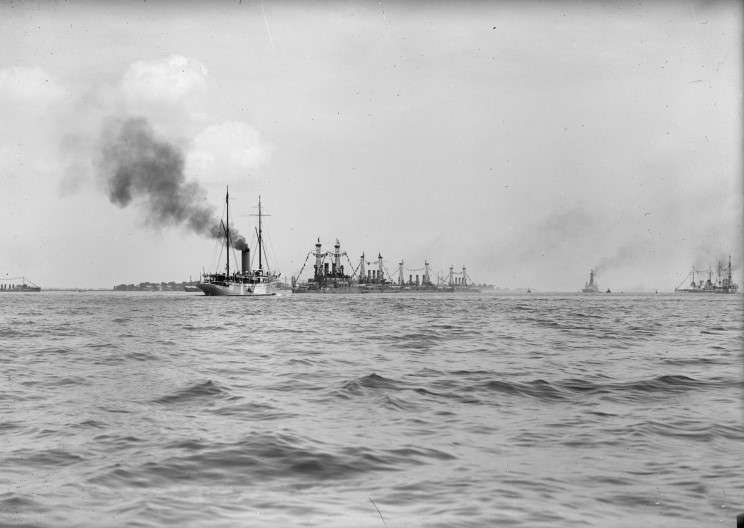
On June 9 the German battleship squadron proceeded to New York, escorted by U.S. Navy battleships and torpedo-boat destroyers.  As they entered New York Harbor, the German and American ships were greeted by salutes from cannons on Governor's Island and by welcoming throngs of New Yorkers, many of German origin or descent, waiting at the Battery.  Thousands more cheered them as they cruised majestically up the Hudson and dropped anchor in line along the New Jersey shore, across the river from West 79th Street to Grant's Tomb.  A delegation sent by Mayor Gaynor boarded the Moltke to extend the City's official welcome, and the following day the Mayor entertained German and American officers at a banquet at the Waldorf-Astoria.


 Zeppelin III in Flight

On June 1, the new German dirigible Zeppelin III made its maiden voyage from Friedrichshaven to Hamburg, a distance of 450 miles.  The next day it flew non-stop from Hamburg to Bremen and back to Hamburg.

*****
 

Harry Lauder

Blackface minstrelsy is not the only kind of ethnic entertainment that is immensely popular these days.  Vaudeville could hardly exist without acts performed in German, Jewish, Irish, Swedish and other dialects.  One of the most popular entertainers of the last several years on both sides of the Atlantic is Scotsman Harry Lauder, who performs in Scottish highland dress and sings his songs in a rollicking Scottish accent.  This year his "Roamin' in the Gloamin'" is one of the most popular songs in both the United States and Great Britain (click to play):


*****


President Gomez

Racial disturbances in Cuba have endangered the government of President Jose Miguel Gomez and have caused the United States to send Navy and Marine contingents to protect American citizens and property.  The marines landed at Daiquiri on May 31, and the battleships Ohio and Minnesota arrived at the U.S. naval base at Guantanamo Bay on June 7.  At President Gomez's request, the Cuban Congress has suspended constitutional guarantees.  Government forces defeated the insurgents in several engagements near Santiago from June 12 to 14, and in another engagement near Santiago on June 27 insurgent leader Everisto Estenoz was killed.


 Unveiling of the Columbus Memorial, Washington, D.C.

In other developments around the world, serious disturbances in Belgium followed in the wake of parliamentary elections held June 2, which resulted in an increased majority for the Clerical Party.  In the United States, President Taft attended a ceremony on June 8 on the plaza in front of Washington, D.C.'s new Union Station, where the Italian ambassador unveiled a monument to Christopher Columbus.  Responding to the tragic loss of life on the Titanic in April, the American Secretary of Commerce and Labor on June 14 approved new regulations requiring lifeboat accommodations for all persons on board ocean liners.  In the Italo-Turkish War, the Italian government reported victories over combined Turk and Arab forces at Homs on June 12 and Sidi Said on June 28.  A six-power consortium of international bankers agreed on June 20 on the terms of a $300,000,000 loan to the new Chinese republic, but the proposed terms were promptly rejected by the Chinese government.  In England, suffragists Mrs. Pankhurst and Mrs. Pethick-Lawrence were released on June 24 after serving one month of their nine-month sentences.  On June 25, Pascual Orozco offered to surrender to government troops in Mexico in return for amnesty for himself and his followers.


June 1912 – Selected Sources and Recommended Reading
Contemporary Records and Periodicals:
American Review of Reviews, July and August 1912
Democratic National Convention, 1912, Official Report of Proceedings
New York Times, June 1912
Republican National Convention, 1912, Official Report of Proceedings

Books:
William J. Bryan, A Tale of Two Conventions
James Chace, 1912: Wilson, Roosevelt, Taft & Debs -- the Election That Changed the Country
Champ Clark, My Quarter Century of American Politics
Josephus Daniels, The Wilson Era
Lewis L. Gould, Four Hats in the Ring: The 1912 Election and the Birth of Modern American Politics
Lewis L. Gould, The William Howard Taft Presidency
Edmund Morris, Colonel Roosevelt
William G. McAdoo, The Crowded Years
Patricia O'Toole, When Trumpets Call: Theodore Roosevelt After the White House
Henry F. Pringle, The Life and Times of William Howard Taft
Joseph Tumulty, Woodrow Wilson As I Know Him


Thursday, May 31, 2012

May 1912


Roosevelt campaigning in Sandusky, Ohio, May 1912
 
The American presidential campaign is growing in intensity as the major parties’ national conventions approach, both now less than a month away.  On the last day of April, President Taft's efforts in Massachusetts were rewarded with his first primary win in a large state.  After the results were in, consistent with his advocacy of primaries, Roosevelt released the Massachusetts delegates at large, previously pledged to him, to cast their votes for Taft.  Taft’s success in Massachusetts was shortly overshadowed, however, by an embarrassing loss three weeks later in his home state of Ohio.  He made a major effort in that state, and predicted victory right up until the day of the primary, when Ohio Republicans voted overwhelmingly for Roosevelt.  A week later, Roosevelt followed up with another victory in New Jersey.


Charles Murphy

On the same day as Roosevelt’s stunning win in the Ohio Republican primary, the Democrats of that state cast their lot with their governor Judson Harmon.  Harmon, who is considered the favorite candidate of the northern conservative faction of the Democratic Party, is also expected to receive the votes of most if not all of the New York delegation, controlled by Charles Murphy’s Tammany Hall.  Champ Clark continued to add to his delegate total with a primary win in California on May 14 while picking up convention victories on May 16 in Maryland and Iowa.  Woodrow Wilson won the endorsement of the Democratic convention in South Carolina on May 16 and in Texas on May 26.

Speculation continues about the possibility of major defections in both parties.  Despite their professions of party loyalty, both Roosevelt and Bryan have been outspoken in their opposition to leading candidates of their respective parties.  Former President Roosevelt is an announced candidate for the Republican nomination, and his denunciations of the incumbent president have grown more strident as the Chicago convention draws nearer.  In the Democratic Party, three-time nominee Bryan has made no secret of his opposition to Governor Harmon and Representative Underwood.  Champ Clark's attempt to avoid making enemies has caused Bryan to begin to question his progressive credentials.  Bryan and Woodrow Wilson appear for the moment to have patched up their differences, but Wilson's opposition to Bryan in his earlier campaigns remains a possible source of friction (unlike Wilson, Clark supported Bryan in those campaigns).  Bryan denies any interest in seeking a fourth nomination, but few doubt that he would happily accept if the opportunity presented itself, and the possibility that he might bolt the party and mount an independent run cannot be wholly discounted.  In short, this year's presidential campaign is shaping up as one of the most contentious in American history, made more so by the possibility that either or both of the major parties' leading figures may refuse to support his party's nominee.


The Socialist Party Ticket

One third party is already in the race.  The Socialist Party, which has been growing in strength in recent years, held its national convention in Indianapolis on May 17.  It nominated Eugene V. Debs of Indiana for president and Emil Seidel of Wisconsin for vice-president.  Debs is a founder and leader of the party, and has been its presidential candidate in every election since 1900.  Before entering politics, Debs led the American Railway Union in a strike against the Pullman Sleeping Car Company.  The strike, which brought railway commerce to a virtual halt, was broken when President Grover Cleveland sent federal troops to enforce an injunction against the strike and Debs was imprisoned for contempt of court for disobeying the injunction.  In 1905, Debs was one of the founders of the Industrial Workers of the World (the IWW, or “Wobblies”).


Earl Rogers

Clarence Darrow, who rose to prominence as Debs's lawyer in the Pullman strike litigation, is now himself on trial, charged with attempting to bribe a juror when he represented the McNamara Brothers at their trial last December for dynamiting the Los Angeles Times building.  Darrow's trial began May 15 in Los Angeles.  He is represented by Earl Rogers, one of the few lawyers in the United States who may be better known than Darrow himself.


Opening Ceremony of the 1912 Olympics

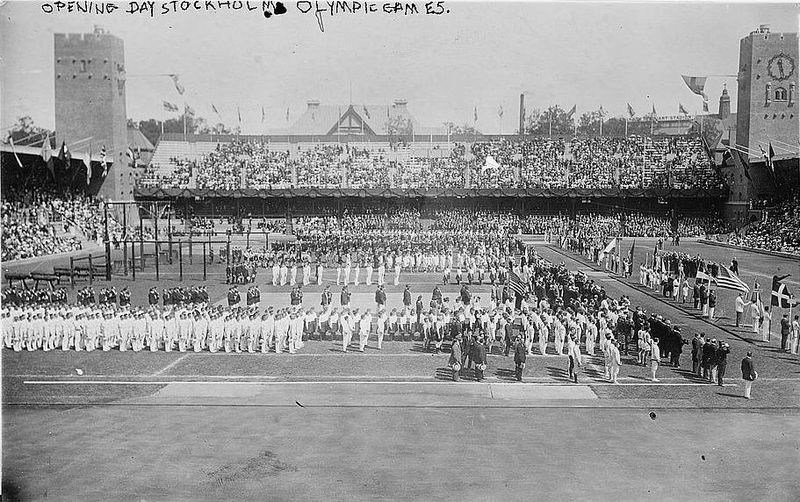
The 1912 Olympic Games were officially opened in Stockholm, Sweden on May 5 by King Gustav V.  So far the only competition has been in tennis, but other events are scheduled throughout the summer.  The modern games began in Athens in 1896 and have been held every four years since.  The games this year, however, will be the sixth:  In addition to those held in Paris in 1900, St. Louis in 1904 and London in 1908, another set of games was held, again in Athens, in 1906, with the intent of returning to Athens every four years thereafter.

The games have had to deal with their share of difficulties over the years.  The plan to hold games in Athens every four years was abandoned in 1910 due to political turmoil in Greece.  Chicago was originally chosen for the 1904 Olympics, but when the organizers of the Louisiana Purchase Exposition in St. Louis refused to change their plans, the Olympic games were moved to St. Louis, where they became essentially a sideshow to the World's Fair.  Four years later, the 1908 Olympics were relocated from Rome to London after the city of Naples was devastated by the eruption of Mount Vesuvius in 1906.


Launching of the U.S.S. Texas

The new battleship U.S.S. Texas (BB-35) was launched May 18.  The latest member of the New York class of battleships, it will be the largest ship in the U.S. Navy.  Apparently unimpressed, the House of Representatives on May 28 passed a naval appropriations bill with no provision for new battleships.


The Gatun Lock Under Construction in March 1912

The Panama Canal, which is nearing completion, will enable merchant ships as well as naval vessels like the Texas to transit with relative ease between the Atlantic and Pacific Oceans.  On May 23, the House of Representatives passed the Panama Canal Bill, which provides for free passage through the canal by American vessels en route from one U.S. port to another.  Because the canal, the most ambitious engineering project in history, has been an entirely American project, Congress's desire to favor American shipping interests is understandable.  This is likely to cause diplomatic difficulties with Great Britain, however, because of the Hay-Pauncefote Treaty of 1901, in which the British agreed to abandon their right to share control of an isthmus canal (based on the Clayton-Bulwer Treaty of 1850) in return for the United States' commitment to grant passage through the canal to ships of all nations on equal terms.

President Roosevelt became the first president to leave the United States while in office when he traveled to Panama in 1905 to view the progress of the canal's construction.  This film, shot during Roosevelt's visit, gives an idea of the scale of the project  (click to play):

 The Panama Canal Under Construction During President Roosevelt's 1905 Visit


*****


John Charles Bigham, 1st Viscount Mersey

The Senate Special Committee on the Titanic released its report on May28.  Senator Smith, the chairman of the committee, summed up its findings, noting the Titanic's excessive speed through the ice field, the lack of discipline among the crew during the emergency, the insufficient number of lifeboats and the fact that many were lowered before they were filled.  The committee's most scathing criticism was reserved for Captain Lord of the Californian, whose failure to go to the Titanic's assistance, or even to arouse his ship's wireless operator to investigate the reason for the emergency flares seen on the horizon, was found responsible for the deaths of most if not all of those lost on the Titanic.  The committee also criticizes lax regulation and hasty inspection by the British government authorities.  This will be a major focus of the British investigation conducted by Lord Mersey, which began May 2 and is under way at month's end.


Captain Rostron and Mrs. Brown

The senate report praises the actions of Arthur Henry Rostron, the captain of the Carpathia, who at risk to his own ship's safety raced at top speed through the ice field to the Titanic's assistance.  The Carpathia, the first ship on the scene, arrived too late to save those on the Titanic or in the water, but rescued hundreds in the lifeboats.  On May 29 a committee of Titanic survivors represented by Mrs. J.J. ("Molly") Brown presented a loving cup to Captain Rostron in appreciation of his efforts.


Wilbur Wright

Wilbur and Orville Wright, brothers from Dayton, Ohio, are credited with the invention of the powered, heavier-than-air aeroplane.  On May 30, Wilbur Wright, aged 45, died unexpectedly of typhoid fever.


The First Flight (Orville airborne, Wilbur earthbound)

The Wright Brothers' first sustained and controlled flight took place at Kitty Hawk, North Carolina, on December 17, 1903.  Since then the brothers have been active in improving the design of flying machines and promoting aviation to the general public, as well as defending their numerous patents against challenges by Glenn Curtiss and others. The aeroplane's potential in military operations has only begun to be demonstrated.


Sheriff Carl Hayden

On May 13, Congress proposed an amendment to the Constitution providing for the popular election of United States senators.  The amendment has much popular support, and on May 22 Massachusetts became the first state to ratify it.  Unless and until it is ratified by three-fourths of the states, the provision of Article I, Section 3 of the Constitution that senators are selected by their state legislatures remains in effect.  In Arizona, the latest state admitted to the Union, the state legislature has selected Henry F. Ashurst and Marcus A. Smith, both Democrats, as the state’s first senators.  Arizona's lone member of the House of Representatives is Democrat Carl Hayden, formerly the sheriff of Maricopa County, who won an election held last year in anticipation of statehood.  One of Arizona’s first acts as a state after its admission to the Union was to ratify another amendment to the Constitution, this one authorizing a federal income tax.

Arizona is the newest state, and ragtime music is all the rage.  The two have been combined in this new popular song, recorded last month at the Victor Talking Machine Company's recording studio in Camden, New Jersey (Click to play):


Ragtime Cowboy Joe (sung by Bob Roberts)


*****

Commander Charles Samson flying from the deck of HMS Hibernia, May 1912

In Britain, the King looked on with First Lord of the Admiralty Winston Churchill and thousands of spectators as the Royal Navy conducted a naval review in Weymouth from May 7 to May 11.  Hundreds of warships participated, demonstrating the latest advances in naval gunnery and tactics, including the first take-off of an aeroplane from the deck of a ship under way.  Not to be outdone, the German Reichstag voted on May 10 and 14 to increase the size of the army and navy.


Emmeline Pankhurst

Woman suffrage in Britain continues to make the news.  On May 22, Mrs. Emmeline Pankhurst, the founder and leader of the Women's Social and Political Union who is believed to have been involved in the recent window-smashing in London, and Mr. and Mrs. Frederick Pethick-Lawrence, editors of Votes for Women, were found guilty of conspiracy at the Old Bailey and sentenced to nine months in prison.  In other news from Great Britain, Irish home rule took a step closer to reality when on May 9 the Government of Ireland Bill passed its second reading in the House of Commons.


In Mexico, insurgent threats to the government of Francisco Madero continue.  Emiliano Zapata leads revolutionary forces in the south, while Pascual Orozco leads rebels in the north.  On May 4, former Interior Minister Emilio Vasquez Gomez returned to Juarez from the United States, seeking to join forces with Orozco.  He has proclaimed himself provisional president and has named Orozco his Minister of War.


May 1912 – Selected Sources and Recommended Reading
Contemporary Periodicals:
American Review of Reviews, June and July 1912
Literary Digest, May 1912
New York Times, May 1912

Books and Articles:
James Chace, 1912: Wilson, Roosevelt, Taft & Debs -- the Election That Changed the Country
Randolph S. Churchill, Winston S. Churchill: Young Statesman 1901-1914
Lewis L. Gould, Four Hats in the Ring: The 1912 Election and the Birth of Modern American Politics
Lewis L. Gould, The William Howard Taft Presidency
Lewis L. Gould, Grand Old Party, A History of the Republicans
Edmund Morris, Colonel Roosevelt
Patricia O'Toole, When Trumpets Call: Theodore Roosevelt After the White House
Henry F. Pringle, The Life and Times of William Howard Taft


Monday, April 30, 2012

April 1912

Major Butt

The new luxury liner RMS Titanic, owned and operated by the White Star Line, was en route from Southampton to New York on her maiden voyage when she struck an iceberg and sank off the coast of Newfoundland, taking with her some 1,500 passengers and crew, many of whom perished from exposure in the icy water after the ship went down.  Among the victims was Major Archibald Butt, President Taft's military aide, who was returning from a holiday with his brother who lives in England.  Survivors report that Major Butt acted heroically throughout the emergency, insisting that women and children be given priority and assisting them into the lifeboats. 


Isidor and Ida Straus

Isidor Straus, co-owner (with his brother) of Macy's Department Store, was also on the Titanic, and was lost along with his wife, who was urged to board a lifeboat but refused to leave her husband's side.  Two other wealthy Americans, J. Pierpont Morgan and Alfred G. Vanderbilt, had booked passage on the Titanic, but changed their plans at the last minute.


The Carpathia in New York, Lowering the Titanic's Lifeboats

The Titanic's collision with the iceberg happened late Sunday evening, April 14, and the ship sank bow first in the early morning hours of Monday the 15th.  The Cunard liner RMS Carpathia, en route from New York to Fiume, Austria-Hungary, received the Titanic's wireless distress signals and proceeded at high speed through the ice fields toward the Titanic's last reported location.  She reached the first lifeboats at about 4 o'clock Monday morning, picked up survivors, and returned to New York, arriving late Thursday night.  It appears that the nearest ship when the Titanic was sinking was not the Carpathia but the Leyland Line steamship SS Californian, en route from London to Boston with no passengers.  Although the Californian saw the Titanic's emergency flares, she did not respond at first, and arrived on the scene only after the Carpathia had rescued survivors. It appears that at least some of the lifeboats aboard the Titanic were lowered before they were filled, and that the capacity of the lifeboats was insufficient in any event.  This would have been less serious if the Californian had responded promptly and arrived while the Titanic was still afloat, enabling the lifeboats to ferry passengers and crew from the sinking ship.  As it was, the only survivors (about 700) were those who were in lifeboats when the Carpathia arrived, some two hours after the Titanic had disappeared beneath the surface of the North Atlantic.


 John Jacob Astor IV (left) waiting to board the train that will take him to the Titanic

Another prominent victim of the Titanic tragedy was New York millionaire John Jacob Astor IV, great grandson of the first John Jacob Astor and first cousin of William Waldorf Astor, who emigrated to England in 1891 and became a British subject in 1899.  The cousins' relationship was strained.  In 1890 William tore down his mansion at the corner of 33rd Street and Fifth Avenue, next to John's mother's house, and built a hotel, which he named the Waldorf.  John responded by persuading his mother to move uptown, then tearing down her house and building another, larger, hotel, which he called the Astoria.  The two hotels are now connected by a corridor called Peacock Alley and operated as a unit.


Senator Smith

The day after the Carpathia's arrival in New York, a Congressional hearing was convened to investigate the disaster.  It began, coincidentally, at the Waldorf-Astoria, and has since been moved to the Senate Office Building in Washington.  Senator William Alden Smith (Rep., Mich.), the chairman of the subcommittee conducting the hearing, issued subpoenas to ensure that testimony is obtained while survivors are still in the country and their memories fresh.  The senator has been accused of prolonging the hearings, and has drawn criticism for insensitivity in requiring survivors to remain in this country until the hearings are concluded.  By month's end his fellow committee members had prevailed on him to conclude the hearings in a day or two. The British inquiry, to be conducted by Lord Mersey, is scheduled to begin May 2.


J. Bruce Ismay

Among the survivors of the Titanic's sinking was J. Bruce Ismay, the chairman of the White Star Line, who was accompanying his firm's newest and largest vessel on her maiden voyage.  He testified that he stepped into the last lifeboat only when it was ready to be lowered away and he saw no women or children or other passengers on deck.

The Titanic and her sister ship, RMS Olympic, were launched about a year ago in the Belfast shipyards.  After fitting out, she conducted her sea trials on April 2, and departed April 4 for Southampton to board her first passengers.  Newsreel footage recorded the Titanic in Belfast before her departure for Southampton (click to play):


The Titanic's voyage was troubled from the beginning.  As she was getting under way at Southampton, she escaped a collision that could have brought her cruise to a premature end and thereby, ironically, have avoided her far more devastating collision with an iceberg a few days later.  On April 10, after she cast off from her berth in Southampton, the massive suction caused by her movement through the water put such a strain on the hawsers securing the nearby American liner New York to her berth that they parted, causing the New York to swing into the channel toward the Titanic.  A collision was narrowly averted as the Titanic rapidly reversed her engines and tugboats sprang into action to return the New York to her moorings.  The Titanic's ability to continue her voyage was greeted at the time with expressions of relief.

* * * * *
  
 The Greatest Show on Earth

While the Titanic disaster captured the headlines, the attention of the American political world remained fixed this month on the campaigns for the Republican and Democratic Parties' presidential nominations.  1912 is shaping up to be the most entertaining, though hardly the most edifying, political spectacle in many years.  An editorial cartoon in the Tacoma Ledger summed up the view of many.


 President Taft Speaking in Springfield, Massachusetts, April 25, 1912

After his primary defeat in New York, former President Roosevelt went on the offensive.  Charging that the state Republican machine had rigged the voting by leaving Roosevelt's name off ballots, not delivering ballots on time, barring Roosevelt's election inspectors from polling places, and other election chicanery, he denounced the results as "not only a farce, but a criminal farce."  This month, in the days before the Titanic drove politics off the front pages, Roosevelt swept primaries in Illinois and Pennsylvania, and the following week he added victories in Nebraska and Oregon.  Senator LaFollette, meanwhile, despite his apparent collapse in February, has apparently not abandoned the race after all.  Emboldened by last month's victory in North Dakota, he scored another victory on April 2 in his home state of Wisconsin.  President Taft's primary record has been less successful: he won the New Hampshire primary on April 23, but as the end of the month approached he was otherwise winless in primary contests.  In a major effort to win an important state, he traveled to Massachusetts several days before its April 30 primary, telling crowds he had come "to reply to an old and true friend of mine" and saying "I do not want to fight Theodore Roosevelt, but sometimes a man in a corner fights. I am going to fight."  He delivered a fighting speech in Boston, denying that he had abandoned his progressive principles and denouncing Roosevelt for abandoning his pledge not to seek a third term.  He pointed to his administration's enactment of federal employers liability and other progressive legislation and his strong record of enforcement of the Sherman Act, and criticized Roosevelt for his proposal to empower regulatory agencies to distinguish between "good trusts" and "bad trusts" rather than enforcing the Sherman Act against all "combinations in restraint of trade."

Because of his primary victories, Roosevelt now leads Taft in the number of committed delegates.  Primaries, however, will not be the deciding factor in either party's nominating contest this year because relatively few states have enacted the legislation necessary to conduct them.  Most states, including some that have primaries, ultimately choose their delegates by state conventions.  Many of those states will send uninstructed delegations to the national convention, and most will probably cast their votes for the president.  In New York, for example, last month's primary was followed this month by a state Republican convention, which left the delegation technically uninstructed but consisting mostly of machine-selected delegates who support Taft.  Roosevelt forces have mounted challenges to the party establishment in other state conventions, but the power of presidential incumbency has been difficult to overcome.  Through their control of federal patronage, Taft supporters have been able in most states to control the party machinery and thus the selection of delegates to the state conventions, which in turn select Taft delegates to the national convention.  Presidential control over the party is, ironically, a legacy of Roosevelt's presidency, established by Roosevelt himself and used effectively by him to secure Taft's nomination four years ago.  Roosevelt's attempts to counter Taft's organizational advantage this year have resulted in party turmoil and bitter disputes that will remain unresolved until the national convention in Chicago.  In Michigan, for example, where primary legislation was proposed but blocked by the party establishment, rival sets of delegates appeared at the state convention in Bay City and came to blows until order was restored by local police and the state militia.  Unable to resolve their differences, the opposing factions selected separate delegations to the national convention, where their competing claims to represent Michigan Republicans will be examined by the Credentials Committee.


Looking for a Reliable Driver

The increasingly bitter contest between Taft and Roosevelt for the Republican nomination has caused some to wonder if the party would be better off with another nominee.  The most frequently mentioned alternative is Supreme Court Justice and former New York Governor Charles Evans Hughes.  An editorial cartoon in the Globe and Commercial Advertiser captured the mood of many Republicans.

The struggle between Taft and Roosevelt supporters in state Republican conventions has been repeated in many states, particularly in the South.  In the states of the former Confederacy, where the Republicans are a small minority of voters, the Republican Party establishment has long been dominated by Negroes, federal office holders and seekers of federal patronage.  These "black and tan" Republicans have been challenged in several southern states by insurgent "lily-white" factions who claim to represent the majority of actual Republican voters.  This claim has validity only because Negroes in those states are denied access to the ballot under state laws that, by various means, limit the franchise to whites.  Because whites in those states vote overwhelmingly Democratic, the disfranchisement laws have the effect of solidifying the Democratic Party's control.  Despite the tiny number of Republican voters, southern states are fully represented in Republican conventions, with the result that their delegations wield influence far out of proportion to the number of voters they represent.  It has been estimated that, depending on the state, the convention vote of a southern Republican is equal to between ten and fifty northern Republicans' votes.  For example, Mississippi, which cast only 4,360 votes for Taft in the 1908 general election, will have twenty delegates at the 1912 convention (one for every 218 Republican voters), while Nebraska, which cast 127,000 votes for Taft in 1908, will have only sixteen delegates (approximately one for every 7,938 Republican voters).  For another example, each of the recent primary states of Illinois and Pennsylvania had more Republican voters in 1908 than all the states of the "Solid South" combined, but will have only a fraction of the convention votes.  Republicans, of course, deplore the southern states' denial of the vote to Negroes, but recognize there is little or nothing they can do about it: voting qualifications are essentially determined by state law, and it has been remarkably easy for state laws to circumvent the Fifteenth Amendment's prohibition of denial of the vote on the basis of race.  Some northern Republicans do, however, suggest that the convention representation of southern states should be reduced to reflect the small number of actual Republican voters.  Southern Republicans, of course, object to that proposal, but those who represent the "lily-white" factions argue that they simply recognize the reality that the Republicans who vote in their states, few as they are, are as white as the Democrats.  This year, as in prior election years, the Republican establishment in most southern states will support "black and tan" delegations that are expected to vote for the president's renomination.  Roosevelt's only hope of securing the nomination is to mount successful challenges in those states by supporting the insurgent "lily-white" delegations.  Those competing claims, like those in other states like Michigan, will be resolved by the Credentials Committee, where the outcome of the Republican convention is likely to be decided.


Representative George H. White

In Democratic conventions, as in Republican, the South exercises disproportionate control, though for a different reason.  The Democratic Party in the South openly advocates a policy of white supremacy, a policy that is supported by the vast majority of white southerners, to whom the idea of social, economic and political equality of former slaves and their descendants is unacceptable.  White men are, for all practical purposes, the only voters in the South.  State legislation with the avowed purpose and effect of denying the vote to Negroes (though stopping short of expressly targeting the Negro race in violation of the Fifteenth Amendment) was enacted in most southern states in the 1890's by Democratic legislatures and governors in response to the threat posed by Populist-Republican coalitions.  The result has been to eliminate the Negro vote and solidify Democratic Party control, control that is reflected not only in presidential elections but also in the make-up of Congress.  Between the Civil War and the turn of the century, twenty-three Negroes served as members of Congress, all from southern states and all Republicans.  The last one, George H. White (Rep., N.C.), was defeated in 1900 after North Carolina disfranchised its Negroes in 1899.  Because similar scenarios have played out in virtually every state with a substantial Negro population, it is unlikely that there will be another Negro in Congress in the foreseeable future.

The same history dictates the make-up of the Democratic convention.  The Democrats, unlike the Republicans, confront no racial divide when it comes to choosing delegates.  Although they do not use the expression, it is virtually certain that every delegation to the Baltimore convention this year, without exception, will be "lily-white," just as they have been in every other Democratic convention in history.


The Last Democratic Nominee from the South

The principal source of the power of southern states in Democratic conventions is the party's two-thirds rule.  By requiring a two-thirds vote of the delegates to select a presidential nominee, the party ensures that no nominee can be selected who is unacceptable to the South.  No Southerner since Tennessean James K. Polk in 1844 has actually received the party's nomination, but because of the two-thirds rule the South has always held effective veto power.  That this power is increasing rather than waning is shown by the fact that this year, for the first time since the Civil War, a Southerner is a serious candidate for the nomination: House Majority Leader Oscar W. Underwood is supported not only by his home state of Alabama but also by several other southern states.  And Woodrow Wilson, although he governs a northern state, was born in Virginia, spent his formative years in Georgia and South Carolina, and has much support in the South.  This support may be important or even decisive if no candidate secures the nomination in the early voting and Underwood fails to gain momentum.

The Democratic primaries this month have delivered a split verdict.  Underwood, who is not competing outside the South, carried his own state of Alabama on April 2.  Also on April 2, Governor Wilson scored a victory in Wisconsin, but a week later, in a surprising and impressive show of strength in Illinois, Champ Clark defeated Wilson in a landslide.  Wilson won Pennsylvania later that week, but at month's end Clark appears to be the leading candidate.  Three-time nominee William Jennings Bryan, who says he is not a candidate this year, has not endorsed anyone, but is said to be favorably disposed toward both Clark and Wilson.  He has been critical of Underwood, and is openly opposed to Ohio's conservative governor, Judson Harmon.

*****


Clara Barton

Three famous Americans other than the victims of the Titanic sinking died this month.  Clara Barton is known for her heroic work nursing soldiers during the Civil War and for founding the American Red Cross after the war.  She died on April 12 at the age of 90.  General Frederick Dent Grant, who also died April 12, was the son of Civil War hero General Ulysses S. Grant.  He was graduated from West Point in 1871 and served in the U.S. Army during the Indian and Spanish-American Wars and the Philippine Insurrection.  From 1889 to 1893 he was the United States Minister to Austria-Hungary.  Finally, Calbraith Perry Rodgers, who achieved fame last year as the first person to cross the United States by air, was killed April 3 when his aeroplane flew into a flock of seagulls and crashed off the California coast near Long Beach. Rodgers was a member of a distinguished naval family, one of whom was his ancestor and namesake Commodore Matthew Calbraith Perry, who led the squadron that opened Japan to American trade in 1853.

On April 3, shortly after becoming the 48th state, Arizona ratified the proposed sixteenth amendment to the Constitution authorizing Congress to assess and collect a tax on incomes.  Arizona is the 32nd state to do so; thirty-six are required to complete ratification.


Al Jolson

The latest Broadway sensation is a singer, comedian and all-around entertainer named Al Jolson, who opened at the new Winter Garden Theater last year and has played there since to sell-out crowds.  He performs most of his routines in blackface, a vaudeville convention that is a carry-over from the popular minstrel shows of the last century.  Jolson's first recording for RCA Victor was released this month (click to play):


"Snap Your Fingers"
(sung by Al Jolson)


*****


Lord Randolph Churchill

British Prime Minister Herbert Asquith introduced the Government of Ireland Act on April 11, and it passed its first reading in the House of Commons on April 16.  The bill, the third legislative attempt since the 1880's to achieve home rule for Ireland, would establish a separate two-house legislature in Dublin with power to legislate for the island, but with a number of exceptions.  The parliament in Westminster would retain control of the army and navy and all imperial affairs as well as matters relating to Irish land tenure and old age pensions and national insurance.  Control of the Irish Constabulary would be transferred to Ireland after six years.  The Irish parliament would have no authority to enact legislation establishing or preventing the free exercise of religion or giving preference to any religion.  Collection of taxes and customs duties would remain an imperial function and be paid into the imperial exchequer.  Ulster would have 59 of the 164 members of the new Irish House of Commons, and the number of Irish members in the imperial parliament would be reduced from 103 to 42.  As with earlier attempts to enact home rule for Ireland, this bill has excited strong feelings on both sides of the issue.  After 100,000 people demonstrated in support of the bill in Dublin on March 31, another 100,000 demonstrated against it in Belfast on April 9.  As he introduced the bill, the Prime Minister defended it from its Unionist detractors, arguing that many comparable examples were to be found in the British Empire:  "There are between twenty and thirty self-governing legislatures under allegiance to the Crown which have solved the problem of reconciliation and local autonomy.  Are we going to break up the empire by adding one more?"  The bill's second reading was moved on April 30.  In a touch of historical irony, the motion came from First Lord of the Admiralty Winston Churchill, whose father, Lord Randolph Churchill, led the fight against the first home rule bill in the 1880's with the warning "Ulster will fight, and Ulster will be right!"


Robert Falcon Scott

The Terra Nova, Captain Robert Falcon Scott's polar exploration ship, has arrived in Christchurch, New Zealand carrying a report from his expedition to the South Pole.  In a message sent back to McMurdo Sound on January 3, Captain Scott reported that he and his party were within 150 miles of the Pole and still advancing, and that he had decided to remain in Antarctica over another winter "in order to continue and complete my work."  It now appears certain that Captain Scott did not achieve his goal of reaching the South Pole before Norwegian Captain Roald Amundsen, who arrived last month in Hobart, Tasmania, reporting that he had successfully reached the Pole and returned, and that he had seen no sign of the Scott expedition.


 Italian forces landing in Rhodes

The Italian fleet has taken an increasingly active role in the war between Italy and the Ottoman Empire.  This month it seized a number of Turkish islands in the eastern Mediterranean, including the symbolically important island of Rhodes.  The captured islands are near enough to Turkey to pose a threat to the mainland, and on April 18, the opening day of the Turkish parliament, Italian ships shelled the entrance to the Dardanelles.  In response, Turkey closed the Dardanelles, increasing international pressure on the warring nations to reach a settlement.  The main obstacle to negotiation may be the recent Italian annexation of Tripoli, which has angered Arab Muslims.


*****
 

April 1912 – Selected Sources and Recommended Reading
Contemporary Periodicals:
American Review of Reviews, May and June 1912
Literary Digest, April 1912
New York Times, April 1912

Books and Articles:
James Chace, 1912: Wilson, Roosevelt, Taft & Debs -- the Election That Changed the Country
Randolph S. Churchill, Winston S. Churchill: Youth 1874-1900
Randolph S. Churchill, Winston S. Churchill: Young Statesman 1901-1914
Lewis L. Gould, Four Hats in the Ring: The 1912 Election and the Birth of Modern American Politics
Lewis L. Gould, The William Howard Taft Presidency
Lewis L. Gould, Grand Old Party, A History of the Republicans
Sherwood Harris, Coast to Coast in 12 Crashes, American Heritage, Vol. XV, No. 6 (Oct. 1964)
John A Kouwenhoven, The Columbia Historical Portrait of New York
Edmund Morris, Colonel Roosevelt
Patricia O'Toole, When Trumpets Call: Theodore Roosevelt After the White House
Michael Perman, Struggle for Mastery: Disfranchisement in the South 1888-1908
Henry F. Pringle, The Life and Times of William Howard Taft
Richard B. Sherman, The Republican Party and Black America from McKinley to Hoover 1896-1933
Hanes Walton, Jr. and C. Vernon Gray, Black Politics at the National Republican and Democratic Conventions, 1868-1972, Phylon (1960-), Vol. 36, No. 3 (3d Qtr. 1975)


Thursday, March 29, 2012

March 1912


Roosevelt in Columbus (not yet stripped to the buff)

Battle has been joined between President Taft and former President Roosevelt for the Republican Party nomination.  Last month, as he was responding to the plea of progressive Republican governors to make his intentions known, Roosevelt told reporters “My hat is in the ring.  The fight is on and I am stripped to the buff.”  Addressing a constitutional convention in Columbus, Ohio, he took on a subject he knew would draw fire from the president.  In a speech he labeled "A Charter of Democracy," he advocated the recall, not only of elected officials but also of judicial decisions and, “as a last resort,” of judges who have “grown so out of touch with social needs and facts” that they are “unfit to render good service on the bench.”  He made it clear that he does not regard the traditional remedies, legislation in the case of bad decisions and impeachment in the case of bad judges, sufficient for the modern age.

The reaction to Roosevelt’s speech has been swift.  Speaking at the same venue on March 8, Taft made clear his strong opposition to recall as applied to the judicial branch of government.  Without mentioning Roosevelt by name, he said that recall of judicial decisions by popular vote “lays the axe at the foot of the tree of well-ordered freedom and subjects the guarantees of life, liberty and property without remedy to the fitful impulse of a temporary majority of an electorate.”  Roosevelt replied in a speech at Carnegie Hall on March 20, arguing that the country is “today suffering from the tyranny of minorities” and that “[t]he great fundamental issue now before the Republican Party and before our people is, are the American people fit to govern themselves?  I believe they are.  My opponents do not.”

Roosevelt’s advocacy of judicial recall has cost him the support of his long-time friend and ally, Senator Henry Cabot Lodge.  In a statement to the press, Lodge said “I am opposed to the constitutional changes advocated by Colonel Roosevelt in his recent speech in Columbus … but I cannot personally oppose him who has been my lifelong friend, and for this reason I can take no part whatever in the campaign for the political nomination.”  In response to a reporter’s question, he said “The Colonel and I have long since agreed to disagree on a number of points.”


The Secretary of War

Not all Republicans, even those who consider themselves progressive, think Taft is a conservative.  One such progressive is Secretary of War Henry L. Stimson, who told a crowd in Chicago that the president is the true progressive in the race, and contrasted his policies with Roosevelt’s “fantastic radicalism.”  Meanwhile, Roosevelt has again challenged Taft to meet him in primary contests, and announced his intention to stump the country in support of his campaign.


The New Supreme Court (front row left to right: Justices Day and McKenna, Chief Justice White, Justices Holmes and Lurton; back row left to right: Justices Lamar, Hughes, Van Devanter and Pitney)

On March 13 the Senate confirmed Mahlon Pitney’s nomination to the Supreme Court by a vote of 50-26.  Taft’s five previous appointments (including the promotion of Justice Edward White to Chief Justice) were confirmed without opposition.  The unusual opposition to Pitney’s nomination came from Democrats and a few progressive Republicans.  Taft’s appointment of five new justices to the Supreme Court in a single term (not counting Justice White’s promotion to Chief Justice) is the most since the beginning of the Republic, when George Washington, starting with an empty bench, appointed eight justices in his first term.  It is perhaps appropriate that Taft should have a large role in shaping the Court.  As a former federal judge, he has taken a greater personal interest in the judiciary than any president in history.  Some suspect, indeed, that his ambition to lead the Supreme Court himself one day may not have vanished with his election to the presidency.  After Chief Justice Melville Fuller’s death in 1910, Taft appointed White, a 65 year old southern Democrat, to the post, rather than the much younger Charles Evans Hughes, a popular former Republican governor of New York whose appointment as an associate justice had just been confirmed by the Senate.  Taft’s choice of the older White over the younger Hughes may have been motivated in part by the thought that he himself might be in line for the post of Chief Justice should it become vacant in a future Republican administration.


Governor Burke

In an increasing number of states this year, convention delegates will be chosen, directly or indirectly, by primaries, the first of which was held March 19 in North Dakota.  The Democratic primary there was won by Governor John Burke, who will go to the convention as a favorite son but is known to be a supporter of Governor Wilson.  Senator LaFollette was the winner on the Republican side, despite having suspended his campaign last month.  In New York, primaries were held on March 26 in the first test of that state's new primary law.  Democrats chose delegates to their state convention, which will in turn select the state's delegates to the national convention, and where the principal concern is likely to be less the identity of the presidential nominee than the perennial fight for control of the party between Tammany Hall and upstate anti-Tammany Democrats.  In the Republican primary, in which voters selected delegates directly for the national convention, they dealt former president Roosevelt a stunning defeat in his home state: only seven of New York's 90 convention delegates will be for Roosevelt.  More primary elections are scheduled for April, beginning with Alabama and Wisconsin on April 2.


Champ Clark on the hustings

Campaign songs are hardly a new phenomenon.  Andrew Jackson, Abraham Lincoln, and “Tippecanoe and Tyler Too” are examples of successful presidential campaigns that have had rousing musical accompaniments.  Seldom, however, has the country been treated to a campaign ditty quite like this popular song, recently adopted as the campaign song of House Speaker Champ Clark (click to play):


The Missouri Dawg Song
(They Gotta Quit Kickin' My Dawg Aroun')
(sung by Byron Harlan)

*****

Henry Cabot Lodge

The general arbitration treaties with Great Britain and France, which were negotiated and submitted to the Senate last year, reflect the president’s firm belief in the efficacy of judicial-type process, even in the context of international disputes.  They ran into opposition, however, not only from Democrats but also from the president’s own party, which still controls the Senate.  The Senate ratified the treaties on March 7, but only after attaching reservations that render them little different from existing treaties.  The treaties establish a Joint High Commission of Inquiry, but as limited by the reservations they deny the Commission final power to decide whether particular disputes involving the United States are arbitrable, subjecting that decision to the Senate’s power of advice and consent.  The reservations also remove from the treaty’s scope all questions regarding immigration and the application of the Monroe Doctrine.  Almost all Senate Democrats supported the reservations, as did Republican followers of former President Roosevelt, who has been critical of the treaties from the beginning.  On this subject, Roosevelt and Lodge are in agreement.  As Chairman of the Senate Foreign Relations Committee, Lodge led Republican support for the reservations.


Albert Berry (right) with His Parachute

The aeroplane continues to demonstrate its potential.  On March 1, in France, Jules Vedrine broke his own speed record by flying his monoplane 101 2/3 miles in an hour.  On the same day, at the Jefferson Barracks Army Depot near St. Louis, U.S. Army Captain Albert Berry made what is believed to be the first parachute jump from an aeroplane.  After the machine had reached a level altitude of about 1,500 feet, Berry climbed out of his seat and suspended himself from a trapeze bar mounted underneath the aircraft.  The parachute, stowed in a conical container also attached to the bottom of the aeroplane, deployed behind Berry as he released himself from the bar and plunged earthward. 


U.S.S. Florida

Advancements in design and technology also continue in surface warfare.  On March 25, a new addition to the United States Navy, the U.S.S. Florida (BB-30), set a speed record for battleships by traveling 22.54 knots.  The Florida and her sister ship U.S.S. Utah (BB-31) are the new "Dreadnought" type battleships, named after the Royal Navy's H.M.S. Dreadnought, launched in 1906.  Dreadnoughts are characterized by their larger size, heavier armament, steam turbine propulsion, and more and larger guns (ten 12-inch guns in the case of the Florida).


U.S.S. Maine

An older and more famous veteran of the U.S. Navy, the U.S.S. Maine (ACR-1), whose destruction by a mysterious explosion in Havana Harbor in 1898 triggered the Spanish-American War, has finally been laid to rest.  Sometimes called a battleship, the Maine was officially classified as an armored cruiser.  On March 16 she was refloated, towed to the open sea, and sunk with appropriate ceremony.  The remains of the officers and men who went down with the ship were recovered and interred at Arlington National Cemetery on March 23.


Pascual Orozco

In Mexico, another former supporter of President Francisco Madero has mounted a revolutionary challenge to the government.  Pascual Orozco was a commander of the forces that toppled the government of Porfirio Diaz last year.  Disappointed by the new government’s failure to adopt the reforms he advocated, and perhaps even more disappointed by Madero's refusal to appoint him to an important position, Orozco declared his uprising on March 3.  President Taft has banned the shipment of war supplies to Mexico and is considering sending warships to Mexican ports to protect American citizens.


Turkish Photograph of Attack by Italian Airships

In Italy’s war with Turkey, the Italian government reports that 536 Italian soldiers have been killed and 324 are missing as of the end of February.  On March 4, in another demonstration of Italy’s naval superiority, an Italian cruiser bombarded the Arabian town of Dubab.  In the land war, a dirigible balloon was used as a weapon for the first time on March 6 when two Italian airships dropped bombs onto a Turkish camp at Zanzur.  Ten days later, Turks and Arabs attacked Italian positions in Tobruk, killing thirteen Italians and injuring seventy-three.  On the same day, back in Rome, three shots were fired at King Victor Emmanuel III as he rode through the streets.  The would-be assassin, a young anarchist, was arrested.  None of his shots found their mark.


 Damaged Shop Windows in London

English coal miners are on strike for a minimum daily wage, causing business disruptions and slowdowns throughout Britain.  Campaigners for woman suffrage have announced that they will follow the miners' example and call attention to their grievances by injuring business interests.  On March 1, they took their campaign to the streets, smashing shop windows around Trafalgar Square and along the Strand, Regent Street, Piccadilly and Oxford Street, where a number of fashionable jewelry and dry goods stores are located.  The demonstration was highly organized.  Well-dressed women arrived in cabs, from which in some cases they were assisted by the stores’ unwitting porters.  The damage was done and the women had melted into the crowds before the stores’ employees or the police were able to react.


Winston Churchill

In a speech to the House of Commons on March 18, First Lord of the Admiralty Winston Churchill announced that British policy is to maintain 60 percent superiority over Germany in battleships and battle cruisers of the Dreadnought type.  This replaces the previous policy of ensuring that British strength matches or exceeds that of the next two largest naval powers.  Responding to the German naval plan of building three Dreadnoughts a year, Churchill proposed the construction of twenty-one new Dreadnoughts in the next six years, alternating four one year and three the next.  He said the British building programme could be reduced if Germany reduces hers, adding that removing those ships from the Royal Navy by simply not building them would be as effective from Germany's point of view as sinking them in battle, and far more economical.  Despite the unassailable logic of Churchill's argument, most observers think Germany is unlikely to be persuaded.


Amundsen and His Crew in Tasmania

Roald Amundsen appeared in Hobart, Tasmania on March 7, announcing that his expedition had succeeded in reaching the South Pole.  There has been no word of the British expedition led by Robert Falcon Scott, which set out for the Pole at about the same time.


March 1912 – Selected Sources and Recommended Reading
Contemporary Periodicals:
American Review of Reviews, April and May 1912
The Literary Digest, April 1912
New York Times, March 1912

Books and Articles:
James Chace, 1912: Wilson, Roosevelt, Taft & Debs -- the Election That Changed the Country
Randolph S. Churchill, Winston S. Churchill: Young Statesman 1901-1914
Lewis L. Gould, Four Hats in the Ring: The 1912 Election and the Birth of Modern American Politics
Lewis L. Gould, The William Howard Taft Presidency
Stephen Howarth, To Shining Sea, A History of the United States Navy
Kermit L. Hall ed., The Oxford Companion to the Supreme Court of the United States
Robert K. Massie, Dreadnought: Britain, Germany, and the Coming of the Great War
Edmund Morris, Colonel Roosevelt
Patricia O'Toole, When Trumpets Call: Theodore Roosevelt After the White House
Henry F. Pringle, The Life and Times of William Howard Taft