Friday, August 31, 2012

August 1912

In August 1912 the Republicans and Democrats send committees to their presidential nominees to notify them of their nominations and hear their acceptance speeches. The new Progressive Party nominates Theodore Roosevelt for president, ensuring the defeat of President Taft and the election of the Democratic nominee, Woodrow Wilson. The Senate passes the Panama Canal Bill, guaranteeing a diplomatic confrontation with Great Britain, where opposition to Irish home rule is gaining momentum. A New York police lieutenant is arrested for murder, and Clarence Darrow is acquitted after a 3-month trial for jury tampering. The Woolworth Building is nearing completion.

*****


Republicans Notify President Taft of His Nomination

This month both major parties performed the traditional ritual of formally notifying their candidates of their nominations for the presidency.  On August 1, a delegation from the Republican nominating convention called on President Taft at the White House and notified him of his nomination for a second term. 


Democrats Notify Governor Wilson of His Nomination

The Democrats followed suit on August 7, when a delegation from the Baltimore convention traveled to the governor’s summer residence in Sea Girt, New Jersey, and gave Governor Wilson formal notification of his party’s nomination as the Democratic challenger.  In an innovation this year, Governor Wilson recorded his acceptance speech for distribution around the country during the campaign.  You can listen to part of it at http://www.woodrowwilsonhouse.org/Media/Wilson1912Speech.mp3.


Jane Addams (right) Campaigning for Woman Suffrage

As Wilson was accepting the Democratic nomination, the Progressive Party, which has come into existence only in the few weeks since the Republican convention in June, was assembling in Chicago.  The call to the new party's banner was answered by reformers from all sections of the country.  For the first time at a major party convention, there were women delegates.  The best known was Jane Addams, the moving spirit behind Hull House, the settlement house she founded in Chicago in 1889.  A delegate from Illinois, she was also chosen to give a speech seconding the nomination of the party's standard-bearer, former President Theodore Roosevelt.  The groundbreaking entry of women onto the political stage occasioned little if any controversy, but the same cannot be said of the decision regarding the racial make-up of the delegations from the southern states.  Still smarting from the role of southern "black and tan" delegations in denying him the Republican nomination, and eager to gain support for his new party among white southern Democrats, Roosevelt insisted that Negroes be excluded from the southern states' delegations.  As a result, the southern delegations to the Progressive Party convention this year were "lily-white," unlike the Republican convention in June and unlike every other Republican convention since the Civil War.  (Democratic Party conventions, in contrast to the Republicans, have never had Negro delegates from any state, north or south.)


 Roosevelt Addressing the Progressive Party Convention

Roosevelt broke with the tradition that nominees do not address the convention but wait demurely at home for the official notification ceremony.  In June, still hoping to be the Republican nominee, he had traveled to Chicago to rally his supporters during the Republican convention.  This month he returned to Chicago to attend the new party’s convention, which was held in the same Chicago Coliseum that had housed the Republican convention seven weeks earlier.  On Monday, August 5, the first day of the convention, the Coliseum rang with the voices of delegates singing "Onward, Christian Soldiers" and "The Battle Hymn of the Republic."  On the second day, Roosevelt appeared before the convention where he was greeted by an ovation lasting 57 minutes.  In his speech he repeated the call to arms he had first issued to the bolters from the Republican convention in June: “We stand at Armageddon and we battle for the Lord!”  The next day, August 7, the delegates voted unanimously to give him the party's nomination for president.  Governor Hiram Johnson of California was nominated for vice-president.


A British View of the Panama Canal Tolls Dispute

Ignoring the British government’s objections, the Senate passed the Panama Canal Bill on August 9.  By providing for free passage through the canal for American ships sailing between American ports, it gives those vessels a competitive advantage over ships of other nations (most objectionably from the British point of view those of Canada).  Congress takes the view that the United States is entitled to that advantage because it built the canal.  Great Britain bases its case on the provisions of the 1901 Hay-Pauncefote Treaty, in which Britain agreed to exclusive American control of an isthmian canal (abrogating the Clayton-Bulwer Treaty of 1850) in exchange for an American promise to grant access to the canal to ships of all nations on equal terms.  President Taft, who has supported the bill from its inception, signed it into law on August 24.  The British government is not likely to view this as the end of the matter.


Darrow Addressing the Jury

Clarence Darrow, the famous criminal defense lawyer who represented the McNamara brothers last year in their trial for dynamiting the Los Angeles Times building, has been on trial since May 15 for attempted bribery of George Lockwood, a prospective juror in that case.  On August 17, the jury returned a verdict of not guilty.  An indictment for attempting to bribe another juror is still pending, but may not go to trial.


Police Lieutenant Charles Becker

Captivating though the political developments have been this year, they have been overshadowed this month by the sensational arrest, on July 29, of New York City Police Lieutenant Charles Becker for the murder of Herbert Rosenthal, a small-time bookmaker who had been running illegal gambling halls in the Tenderloin District, apparently in partnership with Becker.  After a falling out, Rosenthal had gone to the New York World with the story of Becker's corruption, and shortly thereafter he was gunned down outside the Hotel Metropole by gangsters with connections to Becker.  Becker denies complicity in the murder, which appears to have been actually carried out by denizens of the underworld known as "Gyp the Blood", "Lefty Louie", "Whitey" Lewis, and "Dago Frank."  District Attorney Charles Whitman, who is known to have ambitions for higher office, had scheduled a meeting with Rosenthal after the World story appeared, a meeting that failed to take place because of the murder.  Whitman now appears determined to pursue Becker to the full extent of the law.


The Woolworth Building

When completed, the Woolworth Building will be the tallest office building in the world, exceeding the height of the Metropolitan Life Insurance Company Tower on Madison Square, which has been the tallest since its completion in 1909.  The Woolworth Building's steel skeleton now looks down on two of its other predecessors, the Singer Building a few blocks down Broadway, which held the title until 1909, and the Park Row Building across City Hall Park, which the Singer Building overtook in 1908.  "Skyscraper" buildings of such height have been made possible in recent years by the advent of steel frame construction.


Mr. Andrew Bonar Law (left) and Sir Edward Carson (center, preparing to speak) at Blenheim

Resistance to Irish home rule is growing.  Last month Prime Minister Asquith visited Dublin and made a well-received speech in support of home rule.  In response, Unionist politicians held a rally on July 27 at Blenheim Palace, ancestral home of the Duke of Marlborough, where they denounced the Home Rule Bill in the strongest terms.  The principal speakers were Sir Edward Carson and Mr. Andrew Bonar Law, who recently assumed the leadership of the Unionist Party.  Both speakers encouraged defiance of home rule by the Protestants of Ulster, and did not appear to draw the line at violence.  Mr. Bonar Law declared at the end of his address that "I can imagine no length of resistance to which Ulster can go in which I would not be prepared to support them, and in which, in my belief, they would not be supported by the overwhelming majority of the British people"; and Sir Edward in his speech stated that Unionists opposed to home rule will "shortly challenge the Government to interfere with us if they dare, and we will with equanimity await the result."  Liberal politicians and newspapers have charged that statements such as these border on sedition.


Major Darwin

The British Eugenics Society recently hosted the First International Eugenics Conference in London.  The President of the Society is Major Leonard Darwin, whose father Charles Darwin formulated the theory of natural selection.  Major Darwin and other Eugenicists believe that society should take steps to improve the genetic quality of the human race by cutting off inherited defects through compulsory sterilization laws and selective breeding measures.  The conference was attended by numerous dignitaries, including First Lord of the Admiralty Winston Churchill and former Prime Minister Arthur Balfour.


General William Booth

In other news, on August 19 Swiss aviator Edwin Audemars flew his aeroplane from Paris to Berlin, a distance of 530 miles, making four landings en route. On August 20, General William Booth died.  The founder of the Salvation Army in 1878, he was its commander in chief until his death.  It has been announced that his son Bramwell Booth will succeed him.  General Booth's funeral, which took place in London on August 28, was attended by more than 30,000 mourners.


August 1912 – Selected Sources and Recommended Reading
Contemporary Records and Periodicals:
American Review of Reviews, September and October 1912
Literary Digest, August 3, 17 and 24, 1912
New York Times, August 1912

Books and Articles:
James Chace, 1912: Wilson, Roosevelt, Taft & Debs -- the Election That Changed the Country
Randolph S. Churchill, Winston S. Churchill, Volume II, Young Statesman 1901-1914
Lewis L. Gould, Four Hats in the Ring: The 1912 Election and the Birth of Modern American Politics
Edmund Morris, Colonel Roosevelt
Patricia O'Toole, When Trumpets Call: Theodore Roosevelt After the White House
Hanes Walton, Jr. and C. Vernon Gray, Black Politics at the National Republican and Democratic Conventions, 1868-1972, Phylon (1960-), Vol. 36, No. 3 (3d Qtr. 1975)


Tuesday, July 31, 2012

July 1912

In July 1912, the Democrats finally nominate a candidate for president, and the split in the Republican Party widens when progressives issue a call for a separate convention. Meanwhile, a diplomatic crisis is unfolding between the United States and Great Britain over the soon-to-be-completed Panama Canal, British Prime Minister Asquith is defending Irish Home Rule, and the naval race between Great Britain and Germany is gathering momentum. Halfway around the world, with the death of the Meiji Emperor, a long and eventful era in Japan's history comes to an end.

*****


The Democrats' Vice-Presidential Nominee

On Monday, July 1, the Democratic convention in Baltimore resumed its attempt to nominate a candidate for the presidency.  On Saturday, the twenty-sixth ballot had found Speaker Champ Clark clinging to a narrow but diminishing lead over New Jersey Governor Woodrow Wilson.  On Monday morning the twenty-seventh ballot was uneventful, but on the next ballot Indiana switched its vote from Governor Thomas Marshall, its favorite son candidate, to Wilson.  Two ballots later, Wilson’s vote total passed Clark’s for the first time.  With the forty-third ballot Tuesday morning Wilson had a majority, and at 3:30 that afternoon the forty-sixth ballot gave him the nomination.  Oscar W. Underwood, whose delegations from the Deep South had blocked Clark’s nomination after Tammany's switch to Clark on the tenth ballot, was offered the vice-presidential nomination, but he declined it.  The nomination then went to Governor Marshall, whose switch to Wilson Monday morning gave his candidacy a badly needed boost at a critical moment.

Governor Wilson, Speaker Clark and other Democrats at Sea Girt, July 20, 1912

Governor Wilson had followed the proceedings in Baltimore from the governor’s summer residence in Sea Girt, New Jersey.  On July 20, his defeated adversary Speaker Champ Clark led a delegation of Democratic congressmen to Sea Girt to assure Wilson of their support in the general election.


Senator Dixon

The losers on the Republican side are less accommodating.  Progressive supporters of former President Roosevelt are making clear their adamant refusal to accept their party’s nomination of President Taft for another term.  On July 7 in New York City, sixty-three Republican leaders from forty states, led by Senator Joseph M. Dixon of Montana, issued a call for delegates to meet at a national Progressive convention in Chicago on Monday, August 5, for the purpose of nominating candidates for president and vice-president of the United States.


Harriet Quimby Preparing to Take Off on Her Ill-fated Flight, July 1, 1912

The inherent dangers of aviation were on vivid display this month.  On July 1, the popular aviatrix Harriet Quimby and her passenger were killed near Boston when a gust of wind flipped their aircraft throwing them out of their seats a thousand feet in the air.  Miss Quimby was the first woman in the United States to receive an aviator’s license, and earlier this year became the first woman to fly across the English Channel.  In another aerial mishap the next day, a privately built dirigible balloon, the Akron, exploded and crashed off the beach near Atlantic City, New Jersey, killing its builder and four crew members.  The explosion took place when a hot sun came out on a previously cloudy day, causing the hydrogen gas in the balloon to expand rapidly.  The balloon suddenly gained altitude and a flame appeared at the top, followed by the explosion.


Jim Thorpe Competing at the Olympics

The 1912 Olympic Games, which ended this month in Stockholm, went off without a hitch.  This was a welcome development after the recent history of the games, which have been marred by discord, confusion and tragedy since the modern games began in Athens in 1896.  Eight years ago the games were forced to accept a subordinate role with the World's Fair in St. Louis.  Four years ago the games were moved to London at the last minute after the eruption of Mount Vesuvius caused the Italian government to cancel plans to hold them in Rome, and two years later the Olympic Committee canceled plans to hold interim games in Athens every four years, half-way between the regular quadrennial games. This year's games ended with American athletes winning most of the medals.  Jim Thorpe, an American Indian from the Carlisle Indian School in Pennsylvania, turned in the most impressive performance, including gold medals in both the Decathlon and the Classic Pentathlon.  It is reported that when King Gustav congratulated him on being the best athlete in the world, Thorpe replied "Thanks, King."

Sir Edward Grey

The Panama Canal Bill, now pending before the Senate, provides for free passage for American ships sailing between American ports.  On July 11, the Senate received Great Britain’s formal objection to the bill.  The British government argues that the free passage provision violates the terms of the Hay-Pauncefote Treaty, which provides for nondiscriminatory access to the canal for ships of all nations.  Senators Elihu Root (Rep., N.Y.) and Theodore Burton (Rep., Ohio) urged amendment of the bill to comply with the terms of the treaty.  Sir Edward Grey, Britain’s Secretary of State for Foreign Affairs, outlined Britain’s position on the matter to the House of Commons on July 16. 


Admiral Sir Francis Bridgeman, First Sea Lord

A Royal Navy fleet review was held at Spithead on July 9.  Forty-four battleships, five battle cruisers and twenty-five armored cruisers were on display in a demonstration of British maritime power in response to the challenge presented by the new German Naval Law.  On July 22, First Lord of the Admiralty Winston Churchill delivered a speech in the House of Commons in which he presented a substantial upward revision of the Naval Estimates.

Dublin's Theatre Royal

Prime Minister Herbert Asquith, whose sponsorship of the Home Rule Bill has made him a popular man in the south of Ireland, received a warm welcome on a visit to Dublin July 18.  He told a capacity crowd at the Theatre Royal that the Home Rule Bill will pass the Commons and go to the Lords by Christmas of this year, and asserted that "[t]here is nothing incompatible between the vision of Ireland as a nation and loyalty to a United Kingdom in which Ireland is an integral and an enfranchised and self-governing part."  In other news from Great Britain, the results of the Board of Trade’s investigation into the Titanic disaster were made public in London on July 30.  The accident was said to be due to excessive speed, but no individuals were directly blamed.

Adolph Zukor

On July 12, the Famous Players Film Company, founded earlier this year in New York by Hungarian immigrant Adolph Zukor, released a 40-minute motion picture.  Called “Les Amours de la Reine Elisabeth” (“The Loves of Queen Elizabeth”) it was produced in France and stars the world-famous actress Sarah Bernhardt.  This is believed to be the first attempt to portray a full-length theatrical production through the medium of motion pictures (click to play a brief excerpt):


*****

Ahmed Mukhtar Pasha, the New Grand Vizier

On July 21, Ahmed Mukhtar Pasha succeeded Mehmed Said Pasha as Grand Vizier of the Ottoman Empire.  Tewfik Pasha, Turkish ambassador to Great Britain, was first offered the post, but declined.


Pascual Orozco With the Tools of His Trade

The Mexican revolution (or civil war if you prefer) continued this month.  On July 3, Mexican government troops under the command of General Victoriano Huerta decisively defeated rebel forces led by Pascual Orozco near Chihuahua, Mexico.  Few observers believe this is the end of armed resistance to the government of President Francisco Madero.
 

The Late Meiji Emperor

The Emperor Meiji (Mutsuhito) of Japan died July 30 after a reign of 45 years.  The Meiji Emperor (so named after the era of his reign) ruled over Japan during a significant period of Japanese history, having ascended to the Chrysanthemum Throne only a few years after Commodore Matthew Calbraith Perry’s 1853 expedition forced Japan to open its doors to world trade.  The period of his reign, referred to as the Meiji Restoration, saw an impressive surge in Japan’s international power and influence, punctuated in recent years by successful wars against China in 1894-95 and Russia in 1904-05.  The new emperor is the Meiji Emperor’s son, Crown Prince Yoshihito.  The new heir apparent is Yoshihito’s eleven year-old son Hirohito.


July 1912 – Selected Sources and Recommended Reading
Contemporary Records and Periodicals:
American Review of Reviews, August and September 1912
Democratic National Convention, 1912, Official Report of Proceedings
New York Times, July 1912

Books:
William J. Bryan, A Tale of Two Conventions
James Chace, 1912: Wilson, Roosevelt, Taft & Debs -- the Election That Changed the Country
Randolph S. Churchill, Winston S. Churchill, Volume II, Young Statesman 1901-1914
Champ Clark, My Quarter Century of American Politics
Josephus Daniels, The Wilson Era
Lewis L. Gould, Four Hats in the Ring: The 1912 Election and the Birth of Modern American Politics
Lewis L. Gould, The William Howard Taft Presidency
Edmund Morris, Colonel Roosevelt
William G. McAdoo, The Crowded Years
Patricia O'Toole, When Trumpets Call: Theodore Roosevelt After the White House
Earl of Oxford and Asquith, Memories and Reflections, 1852-1927
Henry F. Pringle, The Life and Times of William Howard Taft
Joseph Tumulty, Woodrow Wilson As I Know Him

Saturday, June 30, 2012

June 1912


1912 is shaping up as the most contentious, and the most consequential, election year in the United States since Abraham Lincoln's election fifty-two years ago propelled the country into the Civil War.  Both major political parties held their presidential nominating conventions this month, and both conventions included more than the usual amount of drama.


 Republicans Arriving at the Chicago Coliseum, June 1912

The Republicans went first, gathering at the Chicago Coliseum on June 18.  The campaign for the nomination was unprecedented in pitting a former president against an incumbent president of his own party.  Former President Roosevelt’s challenge to President Taft was hard-fought up to and through the convention, and now appears to be continuing into the general election contest.  As the convention began, Roosevelt had won most of the primaries, including most impressively in Taft’s home state of Ohio.  Most delegates, however, were chosen not in primaries but in conventions.  The outcome of the conventions varied from state to state, but most were controlled effectively by the party machinery favoring the incumbent president.  In some states insurgent factions supporting Roosevelt named rival slates of delegates, most of which were “lily-white” delegations in southern states that challenged the "black and tan" delegations named by the state party machines.  (For more about this, see the April 1912 installment of this blog).  The challenges were presented this month to the Republican National Committee, which met in Chicago prior to the convention.  Of 254 contested seats, the Committee awarded 235 to Taft and 19 to Roosevelt.


 Roosevelt as Bull Moose

Departing from the custom that candidates for the nomination do not attend the convention, Roosevelt traveled to Chicago, announcing on the way that he now supports women's suffrage.  He arrived two days before the convention opened, telling reporters he felt “as strong as a bull moose,” an image since picked up by his supporters and the press as the symbol of his campaign.  Addressing a group of his supporters in Chicago, he denounced the National Committee’s decision to award most of the disputed delegates to Taft and, for the first time, threatened to bolt the party:  “The parting of the ways has come … We fight in honorable fashion for the good of mankind; fearless of the future; unheeding of our individual fates; with unflinching hearts and undimmed eyes; we stand at Armageddon, and we battle for the Lord!”


Senator Elihu Root

As the convention opened, the first order of business was the selection of a chairman.  Senator Elihu Root was Taft’s choice.  Root was a long-time supporter of both Taft and Roosevelt.  He was Secretary of War under President William McKinley and continued in that position under Roosevelt, who appointed him Secretary of State in 1905 to succeed the late John Hay.  In 1909, as Roosevelt’s term ended, the New York legislature named Root to represent the state in the United States Senate.  Like Henry Cabot Lodge and many other establishment Republicans, Root supported Roosevelt during his tenure as president but has declined to support his attempt this year to deny the nomination to an incumbent Republican president.  The convention selected Root over Governor Francis McGovern of Wisconsin, the choice of the Roosevelt delegates, by a vote of 558 to 501.


 Governor Herbert Hadley

The convention then took up the Roosevelt forces’ challenge to 72 of the Taft delegates seated by the National Committee and confirmed by the Credentials Committee.  Governor Herbert Hadley of Missouri, a Roosevelt supporter, asked the chairman for a ruling that those 72 delegates could not vote on their own qualifications.  Root ruled that each of the challenged delegates would be voted on separately, and that while no delegate could vote on his own qualifications, each could vote on the qualifications of the other 71.  This ruling effectively ensured that the Taft delegates would be seated.


Vice President Sherman

As Root ruled in favor of the Taft forces and the challenges to the disputed Taft delegates were defeated, cries of “steamroller!” interspersed with “toot-toot!” and “choo-choo!” from the Roosevelt delegates echoed through the hall.  Roosevelt released a statement, which was read to the convention, accusing the Taft forces of theft.  His statement asserted that “the convention as now composed has no claim to represent the voters of the Republican Party” and that no one accepting the nomination under such circumstances could “ask the support of any honest man.”  As most Roosevelt delegates left the convention hall or refused to vote, the convention adopted the platform proposed by the Taft delegates and nominated Taft for president on the first ballot.  Vice President James S. (“Sunny Jim”) Sherman was also nominated for a second term.  Meanwhile, Roosevelt delegates gathered across town in Orchestra Hall and nominated Roosevelt for president. Roosevelt appeared and promised to “make the fight … even if only one state should support me.”


 Democrats arriving at the Fifth Regiment Armory, June 1912

As the Republican convention drew to a close, delegates to the Democratic convention were assembling in Baltimore, their optimism enhanced by the reports from Chicago.  One of the delegates, in fact, had observed the Republican convention first-hand.  William Jennings Bryan, three-time presidential nominee of the Democratic Party, had covered the Republican convention as a correspondent for the New York World.  When he arrived in Baltimore on June 23 as a member of the Nebraska delegation, he had plans to play a major role in his party's deliberations.  He had, in fact, already made his first move.


 Judge Alton B. Parker

Before leaving Chicago, Bryan had learned of the decision of the Committee on Arrangements to recommend Judge Alton B. Parker of New York as temporary chairman of the convention, a position that includes delivery of the keynote address.  Parker, a leader of the northern conservative faction of the party, was the party’s unsuccessful candidate for president in 1904, the only election of the last four in which Bryan was not the nominee.  When Bryan learned of the Committee’s recommendation, he sent identical telegrams to the two leading candidates for the nomination, Speaker Champ Clark and Governor Woodrow Wilson, in which he denounced the choice of Parker and asked for the candidates' support in opposing him.  (Both Wilson and Clark had claimed the progressive label and sought Bryan’s endorsement for the nomination; Bryan had made it clear that the conservative candidates Harmon and Underwood were unacceptable).  Clark, a long-time supporter of Bryan who was trying to remain on good terms with all factions in the party, sent Bryan a cordial but noncommittal reply; Wilson, a more recent convert to the progressive cause, replied with a strong endorsement of Bryan’s position.


 Inside the Armory as the Convention Opened

The convention was called to order on June 25.  At the outset, it was clear that no candidate had the support of the 728 delegates (two-thirds of the total) necessary for the nomination.  Based on his primary victories and his success in a number of state party conventions, Clark appeared to have the advantage.  His reply to Bryan’s telegram was typical of Clark’s approach, in which his main goal was to avoid alienating any potential supporters.  In the floor contest between Parker and Bryan for the temporary chairmanship, Parker narrowly prevailed, but Wilson’s forthright support of Bryan would pay dividends.  The Wilson forces prevailed in two other preliminary votes, one that struck down unit rules imposed by state conventions on delegates selected by primaries (the only state affected was Ohio, in which a minority of the delegates wished to vote for Wilson) and one that seated Wilson rather than Clark delegates from South Dakota.  At this point Bryan stirred the pot again.  He introduced a resolution declaring the convention’s opposition “to the nomination of any candidate for president who is the representative of or under obligation to J. Pierpont Morgan, Thomas F. Ryan, August Belmont, or any other member of the privilege-hunting or favor-seeking class” and demanding the withdrawal from the convention of any delegate “constituting or representing the above-named interests.”  After the pandemonium subsided, Bryan withdrew the latter language (demanding withdrawal of delegates) and the resolution passed easily (even the Virginia delegation, of which Thomas F. Ryan was a member, voted for it).


 Clark Supporters Demonstrating In Support of His Nomination

The stage was now set for the balloting.  Because Clark had a substantial lead in pledged delegates, Wilson’s immediate challenge was to prevent Clark’s nomination on an early ballot.  The Texas delegation, which was solidly for Wilson thanks to the preliminary work of Colonel Edward M. House and other Wilson men in the state, began working the Underwood delegations from the Deep South states, promising Texas’s vote for Underwood if Wilson should begin to falter in return for those delegations’ promise not to vote for Clark as long as Wilson remained viable.  When the balloting began, Clark got off to a strong start, leading Wilson by about 100 votes on each of the first nine ballots.  Then Tammany Hall, which controlled New York’s 90 votes and had been casting them for Governor Harmon, decided that the psychologically auspicious time had come.  On the tenth ballot it threw its support to Clark.  With Tammany’s switch, Clark had the votes of a majority of the delegates, but still less than the necessary two-thirds.  No candidate since the Civil War who received a majority vote had failed to win the party's nomination.  Nevertheless, the two-thirds rule gives the South an effective veto, and at this point the delegations from the Deep South, honoring their deal with the Texas delegation and still hoping for their candidate’s nomination, exercised that veto by continuing to cast their votes for Underwood.  Ironically, Wilson had become the beneficiary of the same two-thirds rule that he had earlier opposed and had attempted, unsuccessfully, to persuade the Democratic National Committee to repeal.


 Bryan Addressing the Convention

Four ballots later, Bryan moved another obstacle into Clark’s path to the nomination.  As a member of the Nebraska delegation, he was committed to vote for Clark on the early ballots, and he had done so.  But when the roll call reached Nebraska on the fourteenth ballot, he rose and asked for permission to explain his vote.  Striding to the podium, he told the convention he was switching his vote from Clark to Wilson.  He explained that, because Tammany Hall had now given its support to Clark, Clark’s nomination would be tainted by having been brought about by “the interests,” and told the delegates that, as long as New York continued to vote for Clark, he would refuse to cast his vote for the speaker.  Bryan’s pledge was less than an unqualified endorsement of Wilson, since it would presumably also require him to oppose Wilson should he receive New York’s vote.  More likely, Bryan had in mind a possible convention deadlock, creating the possibility that it might turn for a fourth time to Bryan himself.  The immediate effect, however, was to begin a gradual slippage of votes in Wilson's favor.  On the twentieth ballot Kansas switched its votes from Clark to Wilson. Massachusetts abandoned Clark for a favorite son on the twenty-second ballot, and on the twenty-fourth ballot Wilson’s vote total topped 400 for the first time.  At the end of the day on Saturday, June 29, the twenty-sixth ballot still had Wilson trailing, 407 ½ votes to Clark’s 463 ½.  The following day being Sunday, the convention took the day off, and the month of June ended with the nomination still in doubt as an alarmed Speaker Clark rushed to Baltimore to rally his supporters.  While the trend at month's end seemed to favor Wilson, he was still a long way from a majority, let alone the two-thirds vote necessary to prevail.

*****

USS Constitution Defeating HMS Guerriere in the War of 1812

On June 17, the United States observed the one hundredth anniversary of the War of 1812.  Congress declared war on Great Britain on that date in 1812 and President James Madison signed the declaration the following day. The cause of the war was the repeated infringement of America’s neutral rights by Great Britain during the massive struggle taking place in Europe between the British and the French empire of Napoleon; and it ended only after Napoleon’s defeat and exile to Elba in 1814.  The land war between the United States and Great Britain was mostly inconclusive, and the war at sea hardly threatened Britain's overall maritime dominance.  The war did, however, demonstrate the prowess of the infant U.S. Navy, most impressively in the defeat of several British warships by USS Constitution (“Old Ironsides”).  This month’s centennial of the War of 1812 may serve as a reminder that America’s isolation from conflicts in Europe is not absolute, and that an American declaration of neutrality in a major European war is not a guarantee of non-involvement.


The Presidential Yacht Mayflower Carrying President Taft to SMS Moltke, 
Flagship of the German Battleship Squadron


President Taft Boarding SMS Moltke

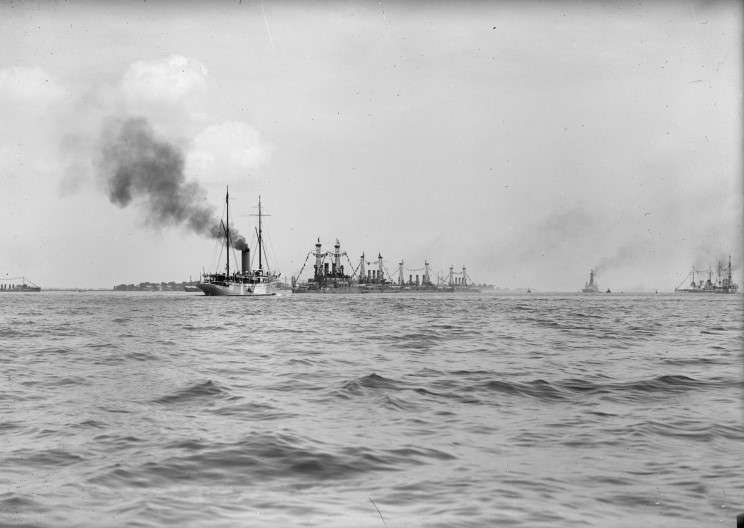
For the time being, however, the United States appears to be on good terms with nations throughout the world.  This month the German Navy paid a visit to the United States.  A German battleship squadron arrived at Hampton Roads on June 2, where it was greeted in person by President Taft, who visited the German admiral aboard the squadron's flagship, calling it "one of the finest ships I've ever seen."  The president cabled the kaiser saluting the cordial relations between the two countries, and the kaiser cabled his thanks to the president for the warm welcome.


The Mayor's Committee Aboard SMS Moltke

On June 9 the German battleship squadron proceeded to New York, escorted by U.S. Navy battleships and torpedo-boat destroyers.  As they entered New York Harbor, the German and American ships were greeted by salutes from cannons on Governor's Island and by welcoming throngs of New Yorkers, many of German origin or descent, waiting at the Battery.  Thousands more cheered them as they cruised majestically up the Hudson and dropped anchor in line along the New Jersey shore, across the river from West 79th Street to Grant's Tomb.  A delegation sent by Mayor Gaynor boarded the Moltke to extend the City's official welcome, and the following day the Mayor entertained German and American officers at a banquet at the Waldorf-Astoria.


 Zeppelin III in Flight

On June 1, the new German dirigible Zeppelin III made its maiden voyage from Friedrichshaven to Hamburg, a distance of 450 miles.  The next day it flew non-stop from Hamburg to Bremen and back to Hamburg.

*****
 

Harry Lauder

Blackface minstrelsy is not the only kind of ethnic entertainment that is immensely popular these days.  Vaudeville could hardly exist without acts performed in German, Jewish, Irish, Swedish and other dialects.  One of the most popular entertainers of the last several years on both sides of the Atlantic is Scotsman Harry Lauder, who performs in Scottish highland dress and sings his songs in a rollicking Scottish accent.  This year his "Roamin' in the Gloamin'" is one of the most popular songs in both the United States and Great Britain (click to play):


*****


President Gomez

Racial disturbances in Cuba have endangered the government of President Jose Miguel Gomez and have caused the United States to send Navy and Marine contingents to protect American citizens and property.  The marines landed at Daiquiri on May 31, and the battleships Ohio and Minnesota arrived at the U.S. naval base at Guantanamo Bay on June 7.  At President Gomez's request, the Cuban Congress has suspended constitutional guarantees.  Government forces defeated the insurgents in several engagements near Santiago from June 12 to 14, and in another engagement near Santiago on June 27 insurgent leader Everisto Estenoz was killed.


 Unveiling of the Columbus Memorial, Washington, D.C.

In other developments around the world, serious disturbances in Belgium followed in the wake of parliamentary elections held June 2, which resulted in an increased majority for the Clerical Party.  In the United States, President Taft attended a ceremony on June 8 on the plaza in front of Washington, D.C.'s new Union Station, where the Italian ambassador unveiled a monument to Christopher Columbus.  Responding to the tragic loss of life on the Titanic in April, the American Secretary of Commerce and Labor on June 14 approved new regulations requiring lifeboat accommodations for all persons on board ocean liners.  In the Italo-Turkish War, the Italian government reported victories over combined Turk and Arab forces at Homs on June 12 and Sidi Said on June 28.  A six-power consortium of international bankers agreed on June 20 on the terms of a $300,000,000 loan to the new Chinese republic, but the proposed terms were promptly rejected by the Chinese government.  In England, suffragists Mrs. Pankhurst and Mrs. Pethick-Lawrence were released on June 24 after serving one month of their nine-month sentences.  On June 25, Pascual Orozco offered to surrender to government troops in Mexico in return for amnesty for himself and his followers.


June 1912 – Selected Sources and Recommended Reading
Contemporary Records and Periodicals:
American Review of Reviews, July and August 1912
Democratic National Convention, 1912, Official Report of Proceedings
New York Times, June 1912
Republican National Convention, 1912, Official Report of Proceedings

Books:
William J. Bryan, A Tale of Two Conventions
James Chace, 1912: Wilson, Roosevelt, Taft & Debs -- the Election That Changed the Country
Champ Clark, My Quarter Century of American Politics
Josephus Daniels, The Wilson Era
Lewis L. Gould, Four Hats in the Ring: The 1912 Election and the Birth of Modern American Politics
Lewis L. Gould, The William Howard Taft Presidency
Edmund Morris, Colonel Roosevelt
William G. McAdoo, The Crowded Years
Patricia O'Toole, When Trumpets Call: Theodore Roosevelt After the White House
Henry F. Pringle, The Life and Times of William Howard Taft
Joseph Tumulty, Woodrow Wilson As I Know Him


Thursday, May 31, 2012

May 1912


Roosevelt campaigning in Sandusky, Ohio, May 1912
 
The American presidential campaign is growing in intensity as the major parties’ national conventions approach, both now less than a month away.  On the last day of April, President Taft's efforts in Massachusetts were rewarded with his first primary win in a large state.  After the results were in, consistent with his advocacy of primaries, Roosevelt released the Massachusetts delegates at large, previously pledged to him, to cast their votes for Taft.  Taft’s success in Massachusetts was shortly overshadowed, however, by an embarrassing loss three weeks later in his home state of Ohio.  He made a major effort in that state, and predicted victory right up until the day of the primary, when Ohio Republicans voted overwhelmingly for Roosevelt.  A week later, Roosevelt followed up with another victory in New Jersey.


Charles Murphy

On the same day as Roosevelt’s stunning win in the Ohio Republican primary, the Democrats of that state cast their lot with their governor Judson Harmon.  Harmon, who is considered the favorite candidate of the northern conservative faction of the Democratic Party, is also expected to receive the votes of most if not all of the New York delegation, controlled by Charles Murphy’s Tammany Hall.  Champ Clark continued to add to his delegate total with a primary win in California on May 14 while picking up convention victories on May 16 in Maryland and Iowa.  Woodrow Wilson won the endorsement of the Democratic convention in South Carolina on May 16 and in Texas on May 26.

Speculation continues about the possibility of major defections in both parties.  Despite their professions of party loyalty, both Roosevelt and Bryan have been outspoken in their opposition to leading candidates of their respective parties.  Former President Roosevelt is an announced candidate for the Republican nomination, and his denunciations of the incumbent president have grown more strident as the Chicago convention draws nearer.  In the Democratic Party, three-time nominee Bryan has made no secret of his opposition to Governor Harmon and Representative Underwood.  Champ Clark's attempt to avoid making enemies has caused Bryan to begin to question his progressive credentials.  Bryan and Woodrow Wilson appear for the moment to have patched up their differences, but Wilson's opposition to Bryan in his earlier campaigns remains a possible source of friction (unlike Wilson, Clark supported Bryan in those campaigns).  Bryan denies any interest in seeking a fourth nomination, but few doubt that he would happily accept if the opportunity presented itself, and the possibility that he might bolt the party and mount an independent run cannot be wholly discounted.  In short, this year's presidential campaign is shaping up as one of the most contentious in American history, made more so by the possibility that either or both of the major parties' leading figures may refuse to support his party's nominee.


The Socialist Party Ticket

One third party is already in the race.  The Socialist Party, which has been growing in strength in recent years, held its national convention in Indianapolis on May 17.  It nominated Eugene V. Debs of Indiana for president and Emil Seidel of Wisconsin for vice-president.  Debs is a founder and leader of the party, and has been its presidential candidate in every election since 1900.  Before entering politics, Debs led the American Railway Union in a strike against the Pullman Sleeping Car Company.  The strike, which brought railway commerce to a virtual halt, was broken when President Grover Cleveland sent federal troops to enforce an injunction against the strike and Debs was imprisoned for contempt of court for disobeying the injunction.  In 1905, Debs was one of the founders of the Industrial Workers of the World (the IWW, or “Wobblies”).


Earl Rogers

Clarence Darrow, who rose to prominence as Debs's lawyer in the Pullman strike litigation, is now himself on trial, charged with attempting to bribe a juror when he represented the McNamara Brothers at their trial last December for dynamiting the Los Angeles Times building.  Darrow's trial began May 15 in Los Angeles.  He is represented by Earl Rogers, one of the few lawyers in the United States who may be better known than Darrow himself.


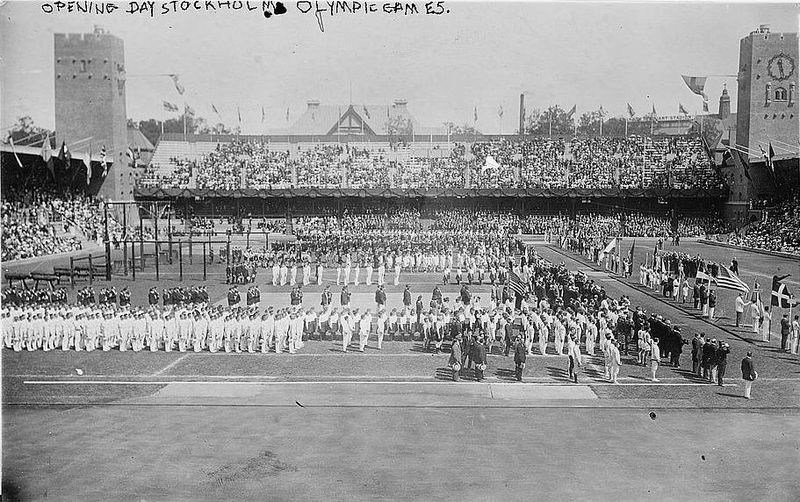
Opening Ceremony of the 1912 Olympics

The 1912 Olympic Games were officially opened in Stockholm, Sweden on May 5 by King Gustav V.  So far the only competition has been in tennis, but other events are scheduled throughout the summer.  The modern games began in Athens in 1896 and have been held every four years since.  The games this year, however, will be the sixth:  In addition to those held in Paris in 1900, St. Louis in 1904 and London in 1908, another set of games was held, again in Athens, in 1906, with the intent of returning to Athens every four years thereafter.

The games have had to deal with their share of difficulties over the years.  The plan to hold games in Athens every four years was abandoned in 1910 due to political turmoil in Greece.  Chicago was originally chosen for the 1904 Olympics, but when the organizers of the Louisiana Purchase Exposition in St. Louis refused to change their plans, the Olympic games were moved to St. Louis, where they became essentially a sideshow to the World's Fair.  Four years later, the 1908 Olympics were relocated from Rome to London after the city of Naples was devastated by the eruption of Mount Vesuvius in 1906.


Launching of the U.S.S. Texas

The new battleship U.S.S. Texas (BB-35) was launched May 18.  The latest member of the New York class of battleships, it will be the largest ship in the U.S. Navy.  Apparently unimpressed, the House of Representatives on May 28 passed a naval appropriations bill with no provision for new battleships.


The Gatun Lock Under Construction in March 1912

The Panama Canal, which is nearing completion, will enable merchant ships as well as naval vessels like the Texas to transit with relative ease between the Atlantic and Pacific Oceans.  On May 23, the House of Representatives passed the Panama Canal Bill, which provides for free passage through the canal by American vessels en route from one U.S. port to another.  Because the canal, the most ambitious engineering project in history, has been an entirely American project, Congress's desire to favor American shipping interests is understandable.  This is likely to cause diplomatic difficulties with Great Britain, however, because of the Hay-Pauncefote Treaty of 1901, in which the British agreed to abandon their right to share control of an isthmus canal (based on the Clayton-Bulwer Treaty of 1850) in return for the United States' commitment to grant passage through the canal to ships of all nations on equal terms.

President Roosevelt became the first president to leave the United States while in office when he traveled to Panama in 1905 to view the progress of the canal's construction.  This film, shot during Roosevelt's visit, gives an idea of the scale of the project  (click to play):

 The Panama Canal Under Construction During President Roosevelt's 1905 Visit


*****


John Charles Bigham, 1st Viscount Mersey

The Senate Special Committee on the Titanic released its report on May28.  Senator Smith, the chairman of the committee, summed up its findings, noting the Titanic's excessive speed through the ice field, the lack of discipline among the crew during the emergency, the insufficient number of lifeboats and the fact that many were lowered before they were filled.  The committee's most scathing criticism was reserved for Captain Lord of the Californian, whose failure to go to the Titanic's assistance, or even to arouse his ship's wireless operator to investigate the reason for the emergency flares seen on the horizon, was found responsible for the deaths of most if not all of those lost on the Titanic.  The committee also criticizes lax regulation and hasty inspection by the British government authorities.  This will be a major focus of the British investigation conducted by Lord Mersey, which began May 2 and is under way at month's end.


Captain Rostron and Mrs. Brown

The senate report praises the actions of Arthur Henry Rostron, the captain of the Carpathia, who at risk to his own ship's safety raced at top speed through the ice field to the Titanic's assistance.  The Carpathia, the first ship on the scene, arrived too late to save those on the Titanic or in the water, but rescued hundreds in the lifeboats.  On May 29 a committee of Titanic survivors represented by Mrs. J.J. ("Molly") Brown presented a loving cup to Captain Rostron in appreciation of his efforts.


Wilbur Wright

Wilbur and Orville Wright, brothers from Dayton, Ohio, are credited with the invention of the powered, heavier-than-air aeroplane.  On May 30, Wilbur Wright, aged 45, died unexpectedly of typhoid fever.


The First Flight (Orville airborne, Wilbur earthbound)

The Wright Brothers' first sustained and controlled flight took place at Kitty Hawk, North Carolina, on December 17, 1903.  Since then the brothers have been active in improving the design of flying machines and promoting aviation to the general public, as well as defending their numerous patents against challenges by Glenn Curtiss and others. The aeroplane's potential in military operations has only begun to be demonstrated.


Sheriff Carl Hayden

On May 13, Congress proposed an amendment to the Constitution providing for the popular election of United States senators.  The amendment has much popular support, and on May 22 Massachusetts became the first state to ratify it.  Unless and until it is ratified by three-fourths of the states, the provision of Article I, Section 3 of the Constitution that senators are selected by their state legislatures remains in effect.  In Arizona, the latest state admitted to the Union, the state legislature has selected Henry F. Ashurst and Marcus A. Smith, both Democrats, as the state’s first senators.  Arizona's lone member of the House of Representatives is Democrat Carl Hayden, formerly the sheriff of Maricopa County, who won an election held last year in anticipation of statehood.  One of Arizona’s first acts as a state after its admission to the Union was to ratify another amendment to the Constitution, this one authorizing a federal income tax.

Arizona is the newest state, and ragtime music is all the rage.  The two have been combined in this new popular song, recorded last month at the Victor Talking Machine Company's recording studio in Camden, New Jersey (Click to play):


Ragtime Cowboy Joe (sung by Bob Roberts)


*****

Commander Charles Samson flying from the deck of HMS Hibernia, May 1912

In Britain, the King looked on with First Lord of the Admiralty Winston Churchill and thousands of spectators as the Royal Navy conducted a naval review in Weymouth from May 7 to May 11.  Hundreds of warships participated, demonstrating the latest advances in naval gunnery and tactics, including the first take-off of an aeroplane from the deck of a ship under way.  Not to be outdone, the German Reichstag voted on May 10 and 14 to increase the size of the army and navy.


Emmeline Pankhurst

Woman suffrage in Britain continues to make the news.  On May 22, Mrs. Emmeline Pankhurst, the founder and leader of the Women's Social and Political Union who is believed to have been involved in the recent window-smashing in London, and Mr. and Mrs. Frederick Pethick-Lawrence, editors of Votes for Women, were found guilty of conspiracy at the Old Bailey and sentenced to nine months in prison.  In other news from Great Britain, Irish home rule took a step closer to reality when on May 9 the Government of Ireland Bill passed its second reading in the House of Commons.


In Mexico, insurgent threats to the government of Francisco Madero continue.  Emiliano Zapata leads revolutionary forces in the south, while Pascual Orozco leads rebels in the north.  On May 4, former Interior Minister Emilio Vasquez Gomez returned to Juarez from the United States, seeking to join forces with Orozco.  He has proclaimed himself provisional president and has named Orozco his Minister of War.


May 1912 – Selected Sources and Recommended Reading
Contemporary Periodicals:
American Review of Reviews, June and July 1912
Literary Digest, May 1912
New York Times, May 1912

Books and Articles:
James Chace, 1912: Wilson, Roosevelt, Taft & Debs -- the Election That Changed the Country
Randolph S. Churchill, Winston S. Churchill: Young Statesman 1901-1914
Lewis L. Gould, Four Hats in the Ring: The 1912 Election and the Birth of Modern American Politics
Lewis L. Gould, The William Howard Taft Presidency
Lewis L. Gould, Grand Old Party, A History of the Republicans
Edmund Morris, Colonel Roosevelt
Patricia O'Toole, When Trumpets Call: Theodore Roosevelt After the White House
Henry F. Pringle, The Life and Times of William Howard Taft