Thursday, February 28, 2013

February 1913


In February 1913, William Howard Taft is still the United States President, despite having suffered a landslide defeat in his bid for reelection almost four months earlier.  He's sent the Army and Navy to the border with Mexico, where the unstable rule of President Francisco Madero has come to a bloody end.  President-elect Woodrow Wilson is keeping his own counsel on developments in Mexico as well as the formation of a new government at home.  Grand Central opens in New York and the income tax amendment to the U.S. Constitution is ratified.  War resumes in the Balkans after a brief hiatus, and there's sad news from Captain Scott's Antarctic expedition.  Tensions between Great Britain and Germany are easing.  Or maybe not.

*****


Robert Falcon Scott

On February 10, the Terra Nova reached New Zealand with news that the bodies of Captain Robert Falcon Scott and his companions were found in the Antarctic in November.  According to the diaries found with the bodies, the five men who had made the final push for the South Pole reached it on January 18, 1912, only to discover that the Norwegian party led by Roald Amundsen had gotten there a month earlier.  On their return journey one of them, Petty Officer Evans, died from a fall.  The remaining four were trapped in a blizzard as their provisions ran out.  The frozen bodies of three of them, Captain Scott, Dr. Wilson and Lieutenant Bowers, were found in their tent.  The other member of the group, Captain Oates, had left the tent and died of exposure. They were 155 miles from Cape Evans, where they were to rendezvous with the Terra Nova, and only about eleven miles from One Ton Depot, where shelter and supplies were waiting.


Victoriano Huerta

On February 9, revolutionaries led by Felix Diaz, the nephew of deposed President Porfirio Diaz who had recently escaped from prison, entered Mexico City and besieged the National Palace.  Nine days later, the troops defending President Francisco Madero forced him to resign and proclaimed Victoriano Huerta president.  The next day Huerta was elected president by a vote of the Mexican Congress, and Gustavo Madero, the president's brother and close adviser, was seized on the street and killed.  On February 22 President Madero and his vice president, Pino Suarez, were shot to death on their way to prison.  According to the Huerta government, they died while "attempting to escape."  President Taft has stated that he has no intention of intervening in the Mexican turmoil, but he has sent four American warships to Mexican waters and 10,000 troops to the border to be prepared to safeguard American lives and property.


William G. McAdoo

A joint session of the United States Congress met on February 12 and tabulated the electoral votes cast last month by the presidential electors.  Woodrow Wilson was officially declared the winner of the election.  He will be inaugurated on March 4, the same day the 62nd Congress will expire and the new Congress will take office.  The president-elect is taking a relaxed approach to selecting his cabinet.  It has previously been reported that William Jennings Bryan will have the job of secretary of state if he wants it, and that Josephus Daniels is likely to have one of the other cabinet positions.  Other probable appointees are William G. McAdoo, president of the Hudson & Manhattan Railway Co., Representative Albert S. Burleson of Texas, and Boston attorney Louis D. Brandeis, but no definite announcements have been made.  Governor Wilson has also refrained from taking a public position on the rapidly changing situation in Mexico.
 

Lawyers Celebrating the Income Tax

The Twelfth Amendment to the United States Constitution was adopted over a hundred years ago.  Three more were adopted in the aftermath of the Civil War, abolishing slavery and guaranteeing (in theory if not in practice) equal rights to the freed slaves.  Now there is a new wave of amendments, inspired by the progressive spirit of the times.  The Sixteenth Amendment, authorizing Congress to impose a tax on incomes, became part of the Constitution on February 3 when Delaware became the thirty-sixth state to ratify it, followed closely by Wyoming and New Mexico.  Legislation exercising the new taxing power is expected shortly, motivated in part by the desire to replace revenue lost due to tariff reductions and in part by the desire to make the government less dependent on the federal excise tax on alcoholic beverages.  As with all revenue measures, the House of Representatives will go first, and most observers expect it to adopt a levy in the neighborhood of one percent.  Meanwhile, a possible seventeenth amendment, providing for direct election of United States senators, was proposed last year and seems on its way to speedy ratification.  Another proposed amendment, limiting the president to a single term of six years, passed the Senate and moved to the House of Representatives on February 1.  The vote was 47-23, barely meeting the two-thirds requirement.


The New Terminal Nearing Completion

The new Grand Central Terminal opened at the location of the old Grand Central Depot at 42nd Street and Park Avenue in New York City on February 2.  It is the end of the line (hence "terminal") for the New York Central and Hudson River Railroad.  With the recent conversion of all trains entering and leaving the city from steam to electric power, the tracks will now be covered all the way from the terminal to 96th Street, creating a strip of potentially valuable real estate along Park Avenue.  A roadway is being constructed around the terminal to accommodate Park Avenue traffic.


William Randolph Hearst

Construction of subways in New York City is mired in controversy.  Two private companies, the Interborough Rapid Transit Company and the Brooklyn Rapid Transit Company, have promoted competing plans to build an expanded subway system   The City of New York has proposed dual contracts, under which both companies are to begin construction.  William Randolph Hearst, the publisher of the New York Journal, is leading the opposition.  He believes that subway construction and operation should be a municipal function.  Advocates and opponents of the City's plan journeyed to Albany early this month to argue their case before Governor Sulzer.  The controversy has now moved to the courts, where a motion to vacate a temporary injunction against the contracts was recently argued in the Appellate Division of the New York State Supreme Court.


Admiral Alfred von Tirpitz

With the expiration of the armistice on February 3, the Balkan allies have renewed their war with the Ottoman Empire, launching an attack on the Turkish stronghold of Adrianople.  Responding to a report that the former Grand Vizier Kiamil Pasha had offered to neutralize the city as part of a peace agreement, the Turkish commander there, Thukri Pasha, delivered a message of defiance, denouncing such "cowardice" and threatening not only to fight to the last man but also, if he "see[s] that further resistance is useless," to turn his guns on the 40,000 Bulgarians living in the city.  In an attempt to relieve the pressure on Adrianople, Ottoman forces attacked Bulgarian troops in the Gallipoli peninsula.  After several hours of fierce fighting, the Turkish troops withdrew.  The Turkish ambassador to Great Britain has asked the British foreign minister to persuade the European powers convening in London to intervene to stop the fighting, and another former grand vizier, Ibrahim Hakki Pasha, is reported to be leading a peace delegation to London.  With the winds of war swirling in the Balkans, the major European powers are reacting at home as well as in London.  The French government has proposed a supplemental military appropriation of $100,000,000, and Germany is apparently moderating its naval competition with Great Britain so that it can devote its resources to building its army.  On February 7 Admiral Alfred von Tirpitz, Germany's Naval Secretary, told the Budget Committee of the Reichstag that he would welcome an agreement with Great Britain regarding fleet ratios, adding that the current ratio of 10 to 16 might be sufficient to satisfy Germany's defense requirements.  On the same day the new foreign minister, Gottlieb von Jagow, addressed the Committee regarding the international situation, and Germany's relations with Great Britain in particular. 
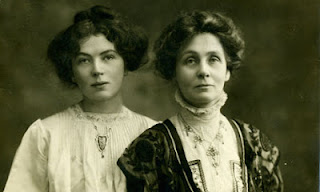

 Emmeline Pankhurst and her daughter Christabel

The campaign for woman suffrage in Great Britain has continued unabated.  The month began with the arrest of Mrs. Leonora Cohen for smashing glass cases in the Jewel House at the Tower of London.  Another woman was arrested the same day for breaking store windows in Pall Mall.  The following week, greenhouses in Kew Gardens were smashed in the middle of the night, resulting in the destruction of a number of valuable plants.  Cards reading "Votes for Women" were found at the scene, but no one has been apprehended.  On February 19, a bomb partially destroyed a country house at Walton Heath where Chancellor of the Exchequer David Lloyd-George was to stay on his next golf outing.  Later that day Mrs. Emmeline Pankhurst told an audience at Cardiff that she took full responsibility for the act.  Comparing the British suffragists with Mexican revolutionaries who had imprisoned members of the Madero government, she said "We have not got any ministers in prison yet, but we have blown up the Chancellor of the Exchequer's house."  She said she would go on a hunger strike if sent to prison.  Ironically, Mr. Lloyd-George is a supporter of woman suffrage.

Employing a somewhat less destructive tactic, some suffragists have sent envelopes to cabinet ministers containing red pepper or snuff designed to blow into the eyes when opened.  At least one parliamentary secretary has been temporarily blinded after being "peppered by post."


The Mauretania in New York Last Year

Both of the principal luxury liners of the Cunard Steamship Line, the Mauretania and the Lusitania, were in the news this month.  The Mauretania arrived in New York on February 8 a day behind schedule after encountering ferocious storms in the North Atlantic on its voyage from Liverpool.  Engineers had been concerned about how a vessel of its size would withstand the battering it would receive in extremely rough seas, especially under the stress the hull would experience as it was lifted and suspended between giant waves fore and aft.  The Mauretania experienced just such a storm on its latest voyage.  As it arrived in New York, however, although its superstructure was severely damaged, the integrity of its hull proved upon inspection to be unimpaired.  The Mauretania's sister ship, the Lusitania, did not fare so well, though from a less dramatic injury.  In December, as it was entering Fishguard Harbour on the north coast of Wales, the steering mechanism failed due to a small piece of marline that had dropped into the telemotor, the hydraulic system by which the steering gear is operated from the bridge.  To avoid a collision with a ship leaving port, the engines were thrown into emergency reverse.  Subsequent inspection has revealed that the maneuver overstressed and damaged the blades on the ship's newly installed turbines, requiring a major overhaul.  The Lusitania is expected to be out of service for six to eight months.


 Admiral Count Yamamoto Gonbei

Katsura Taro's tenure as prime minister of Japan has been short-lived.  Demonstrations against his return to power and a loss of support in the Diet caused him to resign this month.  He has been replaced by Admiral Count Yamamoto Gonbei.


Thomas Edison examining motion picture film in his studio last year

The famous inventor Thomas A. Edison turned 66 on February 11.  Among his inventions have been the phonograph, the modern electric light bulb, and the motion picture camera, as well as a system for the generation and distribution of municipal electric power.  In 1906 he organized the Motion Picture Patents Company, a patent pool that seeks, by combining and enforcing the members' patents, to exclude potential competitors from all aspects of the production, distribution and exhibition of motion pictures.


Guglielmo Marconi

An inventor of the younger generation, the 38 year old Italian Guglielmo Marconi, was also in the news this month.  Marconi is credited with inventions in the field of radio that make possible long-distance wireless communication.  In 1901 he received the first transatlantic wireless transmission, sent from a high-powered transmitter in Cornwall, England, to a receiver on Signal Hill at the entrance to the harbor at St. John's, Newfoundland.  Last year his wireless apparatus was used by the Titanic to transmit distress calls after it struck an iceberg off the Newfoundland coast.  Last month, a Marconi device was used to send a wireless message from Sayville, New York to Nauen, Germany, and this month it was announced that Marconi's company has awarded contracts to a construction firm to build a series of transmitting and receiving stations designed to enable the first wireless communication across the Pacific, from San Francisco to the island of Oahu in the Sandwich Islands, and ultimately to Japan and India.


John McGraw (left) and Boston Manager Jake Stahl at Last Year's World Series 

It was announced this month that Jim Thorpe, whose Olympic medals were stripped from him when it was learned that he had been paid for playing baseball, will now play baseball again, this time in the major leagues.  New York Giants Manager John McGraw has signed Thorpe to play outfield for the Giants in the 1913 season. The Giants won the National League pennant last year, but lost to the Red Sox in the World Series, four games to three, with one tie (the second game was called after eleven innings on account of darkness).


February 1913 – Selected Sources and Recommended Reading
Contemporary Periodicals:
American Review of Reviews, March and April 1913
New York Times, February 1913

Books and Articles:

John Milton Cooper, Jr., Woodrow Wilson: A Biography
John Milton Cooper, Jr., The Warrior and the Priest
Patrick Devlin, Too Proud to Fight: Woodrow Wilson's Neutrality
Andre Gerolymatos, The Balkan Wars
Martin Gilbert, A History of the Twentieth Century, Volume One: 1900-1933
Richard C. Hall, Balkan Wars 1912-1913: Prelude to the First World War
August Heckscher, Woodrow Wilson: A Biography
Paul M. Kennedy, The Rise of Anglo-German Antagonism, 1860-1914
Robert K Massie, Dreadnought: Britain, Germany and the Coming of the Great War
Daniel Okrent, Last Call: The Rise and Fall of Prohibition
Joseph Tumulty, Woodrow Wilson As I Know Him

Wednesday, January 30, 2013

January 1913

It's January 1913.  Mayor Gaynor of New York is skeptical about Carnegie's peace plan, President-elect Woodrow Wilson promises a radical administration, Jim Thorpe loses his Olympic medals, and woman suffragists go back on the warpath in Great Britain. John Paul Jones finds his final resting place, and the war in the Balkans might or might not be coming to an end.

*****


Nicholas Murray Butler

The members of the Electoral College met in their respective state capitals on January 13 and cast their votes to elect Woodrow Wilson the nation’s twenty-eighth president.  California split its vote, giving Theodore Roosevelt eleven of its thirteen votes and Wilson the other two.  President Taft did not even appear on the ballot in California.  Through the efforts of Governor Hiram Johnson, Roosevelt won the Republican primary earlier in the year, and the California Supreme Court ruled that for that reason only Roosevelt electors could appear on the ballot as Republicans (California voters vote for electors, not for the parties' presidential nominees).  Vice President James S. Sherman, nominated for reelection with President Taft, died shortly before the election.  The Republican Party chose Nicholas Murray Butler, president of Columbia University, as its replacement nominee for vice president, and he received Sherman's eight electoral votes.


The President-Elect at His Home in Princeton, New Jersey

President-elect Woodrow Wilson has left little doubt that his administration will pursue a radical agenda.  On January 11 he addressed a meeting of business men at the Blackstone Hotel in Chicago and let them know in no uncertain terms that it was up to them to change the direction of the country.  He told the Commercial Club gathering that "I am not indicting the banking methods of America.  Our banking system does not need to be indicted -- it has been convicted"; and he insisted that "the United States must be free from every feature of monopoly."  Two days later in Trenton, discussing his selection of a cabinet, he said "I shall pick out progressives, and only progressives."  Consistent with these views, in one of his last acts as governor on January 20 he presented seven bills to the New Jersey legislature outlawing price fixing and other practices deemed to be anti-competitive or conducive to monopoly.  He then traveled to Hoboken, where he spent the weekend as the guest of Mrs. Caroline Alexander, who took him on Saturday to Ellis Island to observe immigration procedures.  The next day she invited a group of "social welfare" advocates to meet with the president-elect at her home.  He responded sympathetically to their demands, but pointed out that the federal government's role was necessarily limited.  In the matter of child labor, for example, he said the federal government could collect and disseminate information; but regulation must be left to the states.  Meanwhile, back in Washington, the city is still reeling from the governor's recent pronouncement that, because of the expense involved, there will be no inaugural ball this year.


Joseph G. Cannon

The lame duck session of Congress required by Article I, Section 4 of the Constitution continued through January.  On January 18, former Speaker of the House Joseph G. Cannon delivered the first of a series of farewell speeches, this one devoted primarily to foreign affairs and defense issues.  He advised support of the Monroe Doctrine and the Panama Canal and maintenance of a strong army and navy, especially in light of America's newly acquired responsibilities in the Philippines.  He said that while he does not agree with the policies of the victorious Democratic Party, he will rejoice if it succeeds because that will mean the nation succeeds.  Other congressional action this month included Senate passage of the Culberson Bill, which if enacted would prohibit corporations from making contributions to political conventions and primaries and impose limits on individual campaign contributions (corporations are already barred from making contributions to political parties), and the appropriation of $2,000,000 for construction of a memorial in honor of President Abraham Lincoln.  The first regular session of the new Sixty-third Congress will not take place until December (Article I, Section 4 again), but it is expected that President-elect Wilson will convene a special session shortly after March 4, the date he takes office and the Sixty-second Congress expires.  


George W. Norris

State legislatures convened this month and in many states selected senators to serve in terms that will begin with the new Congress.  Among the new senators are Nebraska Republican George W. Norris, Texas Democrat Morris Sheppard and Arkansas Democrat Joseph T. Robinson.  This may be the last time state legislatures perform this function.  A proposed amendment to the Constitution providing for the direct election of senators was passed by Congress and submitted to the states in April.  Four states ratified it right away, and this month nine more states did so, bringing the total so far to thirteen.  Most observers believe it will receive the necessary thirty-six (three-fourths of the total) before the end of the year.  Another proposed amendment looks to be even closer to adoption.  On January 31, Delaware became the thirty-fifth state to ratify an amendment empowering Congress to impose a tax on incomes.


William Rockefeller

The attention of the Pujo Committee was focused this month on William Rockefeller, co-owner with his older brother John D. Rockefeller of the Standard Oil Company.  The Committee issued a subpoena requiring him to testify in its "money trust" investigation, but he left the country before the subpoena was served.  His attorney accepted service on his behalf, but argued that his client's health prevented him from testifying.  He was examined in the Bahamas by an independent physician, who confirmed his poor health, and at month's end a compromise was reached, over the objection of Chairman Pujo, allowing him to be questioned in private in Miami.  Back in Washington, the committee was told by H.P. Davison, speaking for all the partners of J.P. Morgan & Co., that there is no "money trust," and that the concentration of banks in New York is simply due to the concentration of the country's business there.


Mayor Gaynor

New York City Mayor William J. Gaynor spoke at the twenty-eighth annual dinner of the Holland Society held at the Waldorf-Astoria.on January 16.  He had some fun at the expense of Andrew Carnegie, one of the other guests, whose Peace Palace at the Hague is due to be dedicated next fall.  He said "when something vital comes up that concerns the sovereignty and the pride of two nations, I am afraid they won't be in any hurry to go to the Peace Palace."  Italy, he observed, did not "put on wooden shoes and tramp over to the Hague before she declared war against Turkey"; and "down there in the bowels of Europe where those mysterious people live who have gone to war with the Turks, they didn't make any peace pilgrimage to the Hague, either."  He supposed, however, that the land-locked Swiss "would probably make a pilgrimage to Mr. Carnegie's Peace Palace to avoid a naval war."  He ended his remarks on a more serious and hopeful note: "Although we may not be able to avoid war now, in the growth of God's time when the passions of men shall be softened, and when they will be willing to submit their disputes rather than to go like two dogs in a mad fight and wrestle, then will the Peace Palace have accomplished its great work."

Mayor Gaynor is popular and is widely expected to run for a second term this November, despite still carrying a bullet in his neck from an attempt on his life in 1910.  One of his off-hand comments at the dinner, however, created some doubt.  When one of the guests said he had not voted for him last time but would do so this time, the mayor acknowledged the man's comment but said "he won't have the chance."


Charles Murphy

The new governor of New York, William Sulzer, has wasted no time stirring up controversy.  On his first day in office he reinstated Major General John F. O'Ryan as commander of the state National Guard, ousting the commander recently installed by Governor John Dix.  The next day, in defiance of his erstwhile supporters at Tammany Hall, he appointed two members of the Graft Inquiry Commission who had been opposed by Tammany.  In an informal interview in his office he was asked whether he intended to clear appointments with Charles Murphy, Tammany's chief.  Sulzer emphatically declared his independence, stating "I am the Democratic leader of the State of New York. . . . If any Democrat wants to challenge that, let him come out in the open and the people will decide."  In the same interview, he told reporters he had asked former Republican Governor (now Supreme Court Justice) Charles Evans Hughes for advice and intended to continue doing so.


Secretary of State Philander C. Knox

As the Panama Canal nears completion, the tolls controversy with Great Britain continues.  On January 23, Secretary of State Philander Knox submitted the United States' formal reply to the British objection to the Panama Canal Act, which provides for free passage through the canal by American ships serving American ports.  Britain has demanded international arbitration of its claim that this legislation violates the 1902 Hay-Pauncefote Treaty's stipulation providing for equal access to the canal by ships of all nations.  In his reply, Secretary Knox argues that the remission of tolls is a mere domestic subsidy and not a violation of the treaty, and that in any event it is premature to arbitrate the issue until Great Britain can show that its interests have actually been harmed.


President Roosevelt Speaking at the Memorial Ceremony for John Paul Jones in 1906

In 1906 the body of Revolutionary War naval hero John Paul Jones was discovered in Paris and returned to the United States, where a memorial ceremony was conducted at the Naval Academy's Dahlgren Hall, with President Roosevelt presiding.  The body was interred in Bancroft Hall until this month, when it was moved to its permanent resting place, a newly constructed crypt under the Naval Academy Chapel.


Oliver Wendell Holmes, Jr.

Justice Oliver Wendell Holmes has denied rumors that he will resign his seat on the Supreme Court when the new administration takes office on March 4.  Justice Holmes, who is 72 years old, was appointed to the Court by President Roosevelt in 1902.  Speculation regarding a possible replacement in the event of a vacancy on the Court has included retiring President Taft (interesting, but not likely) and Democratic Senators O'Gorman of New York and Culberson of Texas, both of whom were strong supporters of Governor Wilson at the Baltimore convention last summer.


 Roald Amundsen at the Beginning of His Lecture Tour

On January 10, Captain Roald Amundsen arrived in New York to begin a lecture tour in the United States.  Captain Amundsen led the Norwegian expedition that succeeded in reaching the South Pole in March.  Robert Falcon Scott, whose British party set out for the pole at about the same time as Amundsen, has not been heard from since he began his dash for the Pole last January.  Another Antarctic exploration party, this one German, returned to Buenos Aires this month after spending the last fifteen months in the southern seas.


Jim Thorpe Receiving the Gold Medal from King Gustav V of Sweden

On January 27, Olympic champion Jim Thorpe was stripped of the medals he won last year in the Olympic Games after confessing to officials of the Amateur Athletic Union that he played professional baseball in North Carolina in the summers of 1909 and 1910.  Participation in professional sports automatically disqualifies an athlete from participating in the Olympics.  The awards he won for his first place finishes in the decathlon and pentathlon will be returned to Sweden to be awarded to the athletes who finished second in those events.  Professional or amateur, there is little doubt that Jim Thorpe remains, as King Gustav V called him in Stockholm last summer, the world's greatest athlete.


Arthur Collins and Byron G. Harlan

One of this month's most popular songs is this catchy composition by Irving Berlin, sung by Collins and Harlan (click to play):


 *****


Mahmud Shevket Pasha

January has been a month of ups and downs for hopes of peace in the Balkans.  The month began with the Turks offering to agree to all of the Balkan League's territorial demands except the surrender of Adrianople.  The Balkan allies refused, and further military reverses persuaded the Sublime Porte (seat of government of the Ottoman Empire) to submit the question to the Grand Council, which voted on January 22 to surrender Adrianople rather than continue the war.  That decision, in turn, was superseded the next day by a coup d'etat in which the Young Turks, resolved to resist the Balkan nations' demands, overthrew Grand Vizier Kiamil Pasha and installed a new ministry headed by Mahmud Shevket Pasha, who in 1909 cooperated with the Young Turks in the overthrow of Sultan Abdul Hamid.  Nazim Pasha, commander of the Ottoman army, was killed during the demonstrations that led to the coup.  The armistice that has suspended most of the fighting in the Balkans will end on February 3.


Arthur Balfour

On January 15 the British House of Commons began debate on the Irish Home Rule Bill with strong speeches by Prime Minister Asquith and former Prime Minister Arthur Balfour.  The next day the bill passed by a vote of 367 to 257.  It then went to the House of Lords where to no one's surprise it was soundly defeated, 329 votes to 69.  Under the Parliament Act of 1911, the Lords' veto can prevent the enactment of the legislation only twice: if it passes the Commons a third time it will become law even without the consent of the Lords.  Another issue stirring emotions in Britain is woman suffrage.  On January 24 debate began in the House of Commons on a woman suffrage amendment to the Franchise Reform Bill offered by Foreign Secretary Sir Edward Grey.  On January 27, however, the Government sought and obtained a ruling from the speaker that the proposed amendment would fundamentally alter the bill, making it necessary to withdraw it and begin the legislative process anew.  The next day suffragists, led by Mrs. Emmeline Pankhurst and Mrs. Flora Drummond, resumed their campaign of rioting and destruction.  Mrs. Drummond and Mrs. Pankhurst's daughter Christabel were among those arrested.


Raymond Poincare

On January 16 the French National Assembly chose Prime Minister Raymond Poincare as the country’s new president; Aristide Briand is the new prime minister.  This month also saw new foreign ministers assume office in Germany and Japan.  Gottlieb von Jagow, the German ambassador to Italy, will be the new German foreign minister, and Takaaki Kato, a former foreign minister and ambassador to Great Britain, will return to the foreign ministry of Japan.


Oskar Bider

There were advances this month in the fields of wireless communication and aviation.  On January 16, a wireless test message was sent successfully from a powerful new transmitter in Sayville, New York, on the south shore of eastern Long Island, to a receiver in Nauen, Germany, near Berlin.  On January 24, Oskar Bider, a French aviator, completed the first flight over the Pyrenees, and on January 25 a Peruvian aviator, Jean Bielovucci, flew his monoplane over the Alps from Brig, Switzerland to Domodossola, Italy.


January 1913 – Selected Sources and Recommended Reading
Contemporary Periodicals:
American Review of Reviews, February and March 1913
New York Times, January 1913

Books and Articles:

John Milton Cooper, Jr., Woodrow Wilson: A Biography
John Milton Cooper, Jr., The Warrior and the Priest
Patrick Devlin, Too Proud to Fight: Woodrow Wilson's Neutrality
Andre Gerolymatos, The Balkan Wars 
Richard C. Hall, Balkan Wars 1912-1913: Prelude to the First World War

August Heckscher, Woodrow Wilson: A Biography

Monday, December 31, 2012

December 1912

It's December 1912.  President Taft visits the almost-completed Panama Canal, President-elect Wilson returns from his Bermuda vacation, the governor of South Carolina tells lynchers they have nothing to fear, and the war in the Balkans either will or will not metastasize. We have our fingers crossed for 1913.

*****


 President Taft and His Party in Key West

It was announced on December 18 that President Taft has accepted an offer from Yale University to join its faculty next year as Kent Professor of Law.  Shortly afterward he and Mrs. Taft left on an inspection trip to the Panama Canal.  At Key West they boarded the U.S.S. Arkansas (BB-33), one of the newest battleships in the United States fleet.  Prior to getting under way from its home port in Newport News, the Arkansas' flag stateroom was refitted with an extra large bathtub to accommodate the presidential bulk.


U.S.S. Arkansas Under Way Earlier This Year

On Christmas, after spending the day inspecting the progress of the canal construction, the president left the Canal Zone to attend a ball in his honor in Panama City.  On the way to the celebration, he passed down Central Avenue, the city's main thoroughfare.  An explosion destroyed a kiosk on the Avenue a few minutes after he passed by, seriously injuring one bystander.  The president and his party were not injured.  The following day, before his departure, Taft announced his selection of Colonel George Washington Goethals, the canal’s chief engineer, to be the first civil governor of the Canal Zone.


Colonel George W. Goethals

*****

Wilson and Bryan in Trenton, December 21, 1912

During his post-election vacation in Bermuda, President-elect Wilson was invited to observe a session of the colonial assembly.  At the end of the session he gave a brief speech which the delegates received with loud cheers.  He returned to New York on December 15, and on December 17 he attended a dinner given by the Southern Society at the Waldorf-Astoria Hotel.  The Society gave the nation's first southern-born president since Zachary Taylor an enthusiastic reception.  In his speech, Wilson saluted the men of Virginia for their willingness during the Civil War to "fight to the death for the things in which they believed."   Although slavery was of no economic benefit, he said, they fought for the principle "that they had a right to order their own affairs."  He then addressed the concerns of the business community, saying that while many think the new administration "may disturb business," that will not happen "except as it disturbs the minds of business men," and he promised to build a "gibbet ... high as Haman's" for anyone who would use the machinery of the markets to precipitate a panic.  On his way back to Washington on December 21, he stopped in Trenton, New Jersey to confer with William Jennings Bryan.  Given his long-time leadership of the progressive wing of the Democratic Party and his key role in securing Wilson's nomination in Baltimore, Bryan is assumed to be the president-elect's inevitable choice for Secretary of State in the new administration.  After returning to Washington the president-elect visited Staunton, Virginia, where he was given a warm greeting by the residents of his birthplace.


 Josephus Daniels

Another man seemingly assured of a cabinet position is Josephus Daniels, the North Carolina newspaper editor and Democratic Party activist who strongly supported Wilson for the nomination.  Daniels is known in North Carolina for his leadership of the successful campaign in the late 1890's to secure the Democratic Party's control of the state through legislation making it difficult or impossible for Negroes to vote. By the early 1900's, every state of the former Confederacy had enacted some kind of legislation (such as literacy tests, grandfather clauses, poll taxes and white primaries) with that avowed goal.


Governor Blease

The fifth annual governors' conference took place this month in Richmond, Virginia.  South Carolina's governor, Coleman Livingston Blease, has been criticized for his expansive use of the pardon power, in particular his routine pardoning of white men arrested for lynching Negroes.  In a speech to the conference, Governor Blease said he would continue to grant pardons when they are justified, and cited cases in which he had pardoned Negroes as well as white men.  He justified his policy by citing the poor conditions he had observed in the state's penitentiary, which he said was a "tuberculosis incubator"; and he described one case of a Negro man who had spent 22 years in jail for stealing a $27 watch.  He was unapologetic about his pardoning of lynchers, stating that he "will never order out the militia to shoot down their neighbors and protect a black brute who commits a crime against a white woman. ... [W]hen a Negro assaults a white woman all that is needed is that they get the right man, and they who get him will neither need nor receive a trial."  Governor Blease's views on the subject of criminal justice are not shared by most southern governors.  Governor George Washington Donaghey of Arkansas, for example, is also known for his generous use of the pardon power, but not for lynchers.  He told the conference that in his opinion nothing short of the death penalty would deter murderers, and that he thinks lynchers are no different from other murderers.


 Governor Hadley

Governor Herbert Hadley of Missouri, who was a strong supporter of Colonel Roosevelt for the Republican nomination this year, is trying to patch the Republican Party back together.  After the Governors' Conference in Richmond, he visited Washington and made the rounds on Capitol Hill, promoting his idea of a Republican convention to be held this year, not to nominate candidates but to reunite the party.  His idea seems to have met with little favor so far.  Colonel Roosevelt himself has a very different idea.  Speaking at a Progressive Party conference in Chicago on December 9, he denounced both political parties and vowed a four-years fight for progressive principles in every state legislature. The conference unanimously endorsed the Colonel for president in 1916.


Colonel Archibald Gracie

Almost eight months after the sinking of the Titanic, a birth and a death occurred, both with connections to the disaster.  John Jacob Astor VI was born on December 2.  Both of his parents were on the Titanic; his mother was rescued but his father, John Jacob Astor IV, was lost.  Survivors report that Astor asked if he could accompany his pregnant wife in her lifeboat, and when he was told that only women and children were being boarded he accepted the decision gracefully and was not seen again.  Another prominent passenger survived the sinking but died on December 4.  After the ship went down, Colonel Archibald Gracie struggled to the surface and survived by climbing onto the keel of an overturned lifeboat along with several other men.  He spent the night there, soaked and shivering, before being dragged onto another lifeboat in the early morning light.  He was haunted to his final days by memories of the sinking, and had just finished writing a book describing his experiences.


E. H. Harriman

When Collis P. Huntington, the last of the "Big Four" founders of the Southern Pacific Railroad, died in 1900, E. H. Harriman's Union Pacific Railroad began buying Southern Pacific stock, eventually acquiring a forty-six percent interest.  On December 2 of this year, the United States Supreme Court ruled that the Union Pacific's ownership interest in the Southern Pacific violated the Sherman Act's prohibition on "combinations in restraint of trade."  This ruling follows the Court's decisions last year dissolving the Standard Oil and American Tobacco trusts.  In those decisions the Court ruled in favor of the government, but read into the Act a "rule of reason," raising concerns about the ultimate effectiveness of the Sherman Act in protecting competition.  This month's decision, because it was unanimous and because it treated a controlling (though minority) stock interest as a "combination," may allay some of those concerns.


J. P. Morgan with his son and daughter arriving for the Pujo Committee hearings

Earlier this year, at the urging of Representative Charles Lindbergh (Rep., Minn.) and others, a special committee under the chairmanship of Representative Arsene Pujo (Dem., La.) was formed to investigate the so-called "Money Trust."  With the convening of Congress this month, hearings resumed on December 9.  Samuel Untermeyer, the Committee's counsel, examined several witnesses, including Walter Frew, director of the Bankers Trust Company, and J. P. Morgan, founder and chairman of J. P. Morgan & Co., who ridiculed the idea that there was or could be such a thing as a money trust.


Rosalie Gardiner Jones (center) with other suffragists

A group of women led by "General" Rosalie Gardiner Jones left New York City on December 16 on a "suffrage hike" to Albany to demand votes for women.  Miss Jones is a Long Island socialite who has taken a leading role in the cause of woman suffrage.  Braving sore feet and snowstorms, the hikers reached Albany on December 28.  On the last day of the year they presented a petition to Governor-elect William Sulzer, who promised them his support.


Governor-elect Sulzer

Sulzer's term as governor will begin with the new year.  His political career thus far has been as a loyal member of Tammany Hall and beneficiary of its support.  Since his election, however, he has shown signs of independence that must be raising eyebrows at the Tammany Wigwam on Fourteenth Street.  Perhaps inspired by Woodrow Wilson's success in presenting himself as a progressive reformer after using machine support to get elected, Sulzer has lately been insisting that he will take directions from no one in staffing his administration and carrying out the people's business.  It remains to be seen how Sulzer's declaration of independence will affect his political future.  Tammany Hall's power in the New York Democratic Party is considerably greater than the Smith machine's ever was in New Jersey.


Anita Loos

“The New York Hat” was released on December 5.  Filmed in Fort Lee, New Jersey, directed by D.W. Griffith, written by Anita Loos and starring Mary Pickford and Lionel Barrymore, it is one of the latest moving picture productions of the Biograph Studios (click to play):

The New York Hat


*****


Greek Admiral Pavlos Kountouriotis

The fighting in the Balkans has been partially suspended, but still threatens to expand into a much wider war.  With Austria-Hungary mobilizing to head off Serbian expansion to the Adriatic, Germany announced the renewal of its Triple Alliance with Austria-Hungary and Italy, and warned Russia not to interfere.  France announced its intention to support Russia, and Great Britain is expected to support its fellow members of the Triple Entente, France and Russia.  Offering hope of a peaceful resolution, the major European powers agreed to convene in London in an attempt to resolve the crisis, and Bulgaria, Serbia and Montenegro agreed to an armistice with Turkey.  Even as those hopeful signs were emerging, however,  the Turkish fleet sortied to challenge Greek control of the Aegean and a battle ensued off the coast of Gallipoli.  The Greek fleet, commanded by Admiral Pavlos Kountouriotis, won a decisive victory, forcing the Turks to retreat to the safety of the Dardanelles, under the protective guns of the Turkish forts.  On December 23 in London, the Balkan allies presented their territorial demands, which if implemented would effectively end Turkish sovereignty in Europe. 


Prime Minister Katsura Taro

Former Prime Minister Katsura Taro returned to the premiership of Japan on December 17.  This will be his third term as prime minister.  In his first, he entered into a mutual defense treaty with Great Britain in 1902 and presided over Japan’s 1905 victory in the Russo-Japanese War.  In his second, he negotiated the Korean Annexation Treaty of 1910, under which Japan now rules the Korean peninsula.


Ambassador Whitelaw Reid

On December 9, Great Britain formally protested the Panama Canal legislation that was signed into law earlier this year by President Taft.  The British object to the provision granting free passage to American ships traveling between American ports, arguing that it violates the term of the Hay-Pauncefote Treaty of 1901 that provides for equal access to the canal for ships of all nations.  Britain demands repeal of that provision, or in the alternative that the issue be submitted to international arbitration.  Further discussion of the issue was momentarily interrupted by the death on December 15 of Whitelaw Reid, the American ambassador to the United Kingdom.  Reid was a newspaper editor and prominent Republican.  In addition to his service as ambassador to England, Reid served as ambassador to France in the Benjamin Harrison administration and was President Harrison's running mate in his unsuccessful bid for reelection in 1892.


Sir Robert Borden with First Lord of the Admiralty Winston Churchill

On December 5, Secretary of the Navy George von Lengerke Meyer submitted a request to Congress for an appropriation to build three new first-class battleships for the United States Navy.  On the same day, Prime Minister Sir Robert Borden asked the Canadian parliament for an appropriation to build three dreadnoughts for the Royal Navy.  He explained that the cost of imperial defense had become too great for the United Kingdom alone to bear, and that it is now necessary for the dominions to make a contribution.  He added that the ships would be subject to recall to the Canadian navy if circumstances required.


December 1912 – Selected Sources and Recommended Reading
Contemporary Records and Periodicals:
American Review of Reviews, January and February 1913
Literary Digest, December 1912
New York Times, December 1912

Books and Articles:
James Chace, 1912: Wilson, Roosevelt, Taft & Debs -- the Election That Changed the Country
John Milton Cooper, Jr., Woodrow Wilson: A Biography
Patrick Devlin, Too Proud to Fight: Woodrow Wilson's Neutrality
Andre Gerolymatos, The Balkan Wars 
Lewis L. Gould, Four Hats in the Ring: The 1912 Election and the Birth of Modern American Politics
Lewis L. Gould, The William Howard Taft Presidency
Richard C. Hall, Balkan Wars 1912-1913: Prelude to the First World War
Erle Heath, Seventy-Five Years of Progress: A Historical Sketch of the Southern Pacific, 1869-1944
August Heckscher, Woodrow Wilson: A Biography
Edmund Morris, Colonel Roosevelt
Patricia O'Toole, When Trumpets Call: Theodore Roosevelt After the White House
Henry F. Pringle, The Life and Times of William Howard Taft

Friday, November 30, 2012

November 1912

It's November 1912, as Americans go to the polls for a presidential election.  Democrat Woodrow Wilson wins in a landslide, defeating both the incumbent president and his predecessor. Another in a wave of assassinations of world leaders takes place, this one in Spain. There is turmoil in the British House of Commons. The Ottoman Empire is under attack, and a wider war threatens. The Great War is a month closer, but nobody knows it.

*****


1912 Presidential Election Results

Governor Woodrow Wilson of New Jersey has been elected the twenty-eighth president of the United States, defeating the incumbent President William Howard Taft and former President Theodore Roosevelt by a decisive margin.  He received less than 42 percent of the popular vote, but because two strong candidates split the Republican vote he swept the Electoral College, 435 votes to 88 for Roosevelt and only eight (Vermont and Utah) for Taft.  Wilson is only the second Democrat to be elected to the presidency since the Civil War; the first, Grover Cleveland, was elected by much slimmer Electoral College margins in 1884 and 1892, and lost by an equally slim margin in 1888.  Despite the efforts of Roosevelt's Bull Moose campaign to appeal to white southerners, the Democratic Party retained its grip on the "Solid South," aided in part by the candidacy of native southerner Woodrow Wilson and in part by the widespread disfranchisement of Negroes, most of whom would otherwise probably vote Republican.  Wilson rolled up commanding majorities in all the states of the old Confederacy (Mississippi gave him 89 percent of its vote).  Of the other states, not a single one gave Wilson a majority, but he won a plurality in most of them because of the split in the Republican vote.


Colonel House

Governor Wilson has almost four months before he assumes the presidency, and he has stated that he will remain in office as governor while the New Jersey legislature is in session.  The first item on his agenda, however, is an extended vacation in Bermuda.  He set sail with his wife and two of their daughters on November 16.  In his absence, the transition to the new administration is being managed by "Colonel" Edward Mandell House.  Colonel House is a wealthy Texan who was instrumental in organizing support for Wilson prior to the Baltimore convention and has emerged since the election as his most influential adviser.  Having turned down the offer of a cabinet post for himself, House is well positioned to become a power behind the throne in the new administration.


Eugene V. Debs Campaigning in 1912

The landslide Electoral College defeat of an incumbent president and his predecessor is not the only unique feature of the 1912 election.  Riding the nationwide progressive wave, Eugene V. Debs, the Socialist Party's candidate for president, received over 900,000 votes, by far the best showing in the party's history.  Debs was the leader of the American Railway Union at the time of the 1894 Pullman strike, when President Cleveland obtained an injunction against the strike and sent in federal troops to enforce it.  Debs and other officers of the union were jailed for disobeying the injunction.  They were represented by Clarence Darrow, who has since built a reputation as a vigorous spokesman for socialist and labor causes, including most famously his successful defense of "Big Bill" Haywood and others in their 1907 trial for the murder of former Idaho Governor Frank Steunenberg.  Most recently, Darrow represented the McNamara brothers in their trial last year for dynamiting the Los Angeles Times building.  After the brothers pled guilty, Darrow was indicted on two counts of jury tampering.  He was tried and acquitted on the first count earlier this year but still faces trial on the second.


Speaker Champ Clark

This has been a good year for Democrats, who not only won the White House but also gained control of both houses of Congress.  They kept their two-year-old majority in the House of Representatives and gained a majority in the Senate for the first time in twenty years.  Representative Champ Clark of Missouri, who came within a whisker of winning the Democratic presidential nomination this year (and thus most likely the presidency), will continue as Speaker.  As required by Article I, Section 4 of the Constitution, the Sixty-second Congress will reconvene for its "lame duck" session on December 2, the first Monday in December.  Although the Sixty-third Congress will not convene in regular session until next December, most observers expect that Wilson will call a special session shortly after March 4, when he and the new Congress will take office.


1912 has been a good year for American popular music.  Two of the most popular songs of the year are "Moonlight Bay" and "Be My Little Baby Bumble Bee," both recorded by popular recording star Billy Murray (click to play):

Moonlight Bay (sung by the American Quartet, featuring Billy Murray)


Be My Little Baby Bumble Bee (sung by Ada Jones and Billy Murray)

*****


Prime Minister Canalejas y Mendez

Prime Minister Jose Canalejas y Mendez of Spain was shot and killed on the streets of Madrid on November 12.  This is the latest in a wave of assassinations that over the last twenty years has also claimed the lives of an empress of Austria, a king of Italy, a king and a crown prince of Portugal, a king and queen of Serbia, a shah of Persia, an empress of Korea, prime ministers of Russia, Japan and Greece, two prime ministers of Bulgaria, another prime minister of Spain, and presidents of France and the United States.  Count Alvarado de Romanones has been appointed to succeed Canalejas y Mendez as Spanish premier.


Ambassador Bryce

James Bryce, the British ambassador to the United States, has announced his intention to resign his post and return to England.  The timing of his move may be seen as unfortunate.  Bryce is an outspoken liberal politician who is known and respected by President-elect Wilson, while his replacement, Sir Cecil Spring-Rice, is a close friend of Theodore Roosevelt, the new president's most outspoken political adversary.


Sir Rufus Isaacs

The British House of Commons was the scene of a rare, if not entirely unprecedented, outburst of pandemonium this month.  On November 11, the House surprised the government by defeating a routine amendment to the Irish Home Rule Bill.  Two days later the Government introduced a resolution to rescind the adverse vote.  Unionist members loudly objected, refusing to allow the Attorney General, Sir Rufus Isaacs, to speak in support of the resolution.  The House was adjourned for an hour, but when it reconvened the shouting from the Unionist side of the chamber resumed.  At the height of the tumult, a book hurled by a Unionist member struck First Lord of the Admiralty Winston Churchill on the ear.  Order was restored only when a Labor Party member began singing "Auld Lang Syne" and others joined in.


The Greek Navy Preparing for War, October 1912

The war in the Balkans poses a serious threat to world peace.  It is being waged on three fronts.  Serbia and Montenegro have occupied the Sanjak of Novibazar, a Turkish area that separates Serbia and Montenegro and borders on Bosnia, now a part of the Austro-Hungarian Empire, to the north.  To the south, Greece has occupied Macedonia, and Bulgaria has invaded Thrace, advancing toward Adrianople and Constantinople, where an epidemic of cholera has broken out.  The Balkan League's success against the Ottoman Empire thus far has been due in part to the Greek Navy's control of the Aegean Sea, which blocks reinforcements from Asian Turkey.  Turkey appealed to the major European powers to intervene, but they declined to do so, telling Turkey it must deal directly with the Balkan nations.  On November 8, in a move that underscores the religious tensions underlying the conflict between the Muslim Ottomans and the largely Christian Balkan League, the Sheik-ul-Islam, the highest ranking ecclesiastical official of the Ottoman Empire, declared a Jihad, or holy war, against unbelievers.


Count Leopold von Berchtold

Although they have declined to intervene, the major European powers are watching developments in the Balkans with grave concern.  The most directly concerned is Austria-Hungary, which borders Serbia, Montenegro and the Ottoman Empire itself, and whose annexation of Bosnia and Herzegovina in 1908 remains a source of friction with Serbia.  Alarmed by the victories of the Balkan League, Austria wants to deny Serbian ambitions to expand its borders to the south and west, in particular to gain a port on the Adriatic from which it could challenge Austrian naval power.  Count Leopold von Berchtold, Austria-Hungary's foreign minister, has persuaded Emperor Franz Joseph to mobilize Austrian forces along its borders with Serbia and Russia, Serbia's ally and protector.  Germany, Austria-Hungary's ally, appears ready to come to its aid in the event of conflict with Russia, and France appears ready to stand by its ally, Russia.  Prime Minister Asquith of Great Britain, speaking at the Lord Mayor's banquet at the Guild Hall on November 10, urged the parties to pursue a general settlement rather than forcing a decision on "isolated questions" such as Adriatic ports.  The prime minister was preceded by First Lord of the Admiralty Winston Churchill, who announced the presence of a strong British fleet of more than twenty battleships and cruisers in the eastern Mediterranean.  The United States has sent two warships to Turkey to protect American interests.

At month's end, there is reason to hope that the threatened general war may be averted.  Under the terms being discussed, the belligerent nations would agree to an armistice and Austria-Hungary would support the creation of a new state of Albania between Serbia and the Adriatic with guarantees of access to the Adriatic for Serbian trade.


November 1912 – Selected Sources and Recommended Reading
Contemporary Records and Periodicals:
American Review of Reviews, December 1912 and January 1913
Literary Digest, November 1912
New York Times, November 1912

Books and Articles:
James Chace, 1912: Wilson, Roosevelt, Taft & Debs -- the Election That Changed the Country
John Milton Cooper, Jr., Woodrow Wilson: A Biography
Patrick Devlin, Too Proud to Fight: Woodrow Wilson's Neutrality
John A. Farrell, Clarence Darrow: Attorney for the Damned
Andre Gerolymatos, The Balkan Wars
Lewis L. Gould, Four Hats in the Ring: The 1912 Election and the Birth of Modern American Politics
Lewis L. Gould, The William Howard Taft Presidency
Richard C. Hall, Balkan Wars 1912-1913: Prelude to the First World War
August Heckscher, Woodrow Wilson: A Biography
J. Anthony Lukas, Big Trouble
Edmund Morris, Colonel Roosevelt
Patricia O'Toole, When Trumpets Call: Theodore Roosevelt After the White House
Henry F. Pringle, The Life and Times of William Howard Taft