Thursday, July 31, 2014

July 1914

July 1914 will become known to history as the month of the July Crisis.  Looking back from the vantage point of the Twenty-first Century, it is hard to find a more consequential month, in the Twentieth, than this one.  The month begins with the reaction to the June 28 assassination of the Archduke Franz Ferdinand and his wife in Sarajevo; it ends with ultimatums and mobilizations that plunge Europe into a catastrophic conflict that will continue for over four years and change the world forever.  After the assassination, Austria-Hungary quickly determines that Serbia is to blame.  Like Russia in another July crisis a century later, Serbia denies responsibility for the "outrage" and calls for an investigation.  An Austrian ultimatum and an unsatisfactory Serbian response are followed by a declaration of war against Serbia.  By month's end, Russia, Serbia's patron, and Germany, Austria-Hungary's ally, have mobilized, and in England First Lord of the Admiralty Winston Churchill has ordered the Royal Navy's First Fleet (soon to be redesignated the Grand Fleet) to its war station in the Orkney Islands, where it will command the North Sea.  As preparations for war continue, much of the public's attention is elsewhere.  In London, the King makes an unsuccessful personal attempt to resolve the Irish Home Rule question.  In Paris, Mme. Caillaux is acquitted and M. Jaures is slain.  In Mexico, General Huerta resigns the presidency and leaves for Jamaica.  In the United States, President Wilson's emissary Colonel House returns home after two months in Europe. But as the month comes to an end, a sudden realization that war is imminent causes markets to collapse in London, New York, and other financial capitals.

*****


"A Chain of Friendship" (from the Brooklyn Eagle)

Weeks of diplomatic maneuvering that followed the June 28 assassination of Archduke Franz Ferdinand and his wife culminated on July 23 in an Austro-Hungarian ultimatum to Serbia, followed by a declaration of war on July 28.  Russian general mobilization ensued, followed by a German ultimatum to cease.  Russia will almost certainly refuse, and France is expected to stand by its ally.  At month's end, all Europe seems on the road to war.


Count Alexander Hoyos

Not long after the Archduke's assassination, Austrian authorities satisfied themselves through interrogation of Princip and others that the assassins were part of a conspiracy originating in Belgrade.  Rather than take action against Serbia immediately, however, the Austrian government decided to ascertain the degree of Germany's support.  On July 4, Foreign Minister Berchtold sent his Chief of Staff, Count Alexander Hoyos, to Berlin to deliver two notes in person.  One was a memorandum prepared before the assassination reviewing international threats to Austria-Hungary and its common interests with Germany, with an addendum prepared after the assassination arguing that good relations with Serbia were no longer possible.  The second was a personal note from Emperor Franz Joseph to the Kaiser asserting that the assassination was the result of a "well-organized conspiracy ... whose threads extend to Belgrade" and that there was no longer any possibility of conciliation between Austria-Hungary and Serbia.  It concluded that "the policy pursued by all European monarchs of preserving peace will be at risk as long as this hotbed of criminal agitation in Belgrade remains unpunished."  In Berlin on July 5, Hoyos gave copies of the notes to Count Laszlo Szogyenyi, the Austrian Ambassador to Germany, who took them to Potsdam and handed them to the Kaiser while Hoyos stayed in Berlin and met with German Undersecretary of State Arthur Zimmermann (Secretary of State Gottlieb von Jagow was in Italy on his honeymoon).  That evening the Kaiser conferred with Zimmermann, Chancellor Theobald von Bethmann-Hollweg, and senior German military officers.  The next morning, July 6, the Kaiser left for a tour of Scandinavia on his yacht.  That afternoon, Bethmann and Zimmermann met with Hoyos and Szogyenyi in Berlin.  Bethmann gave Hoyos the German government's formal reply to its notes, assuring him that, whatever Austria decided to do, it could be confident that Germany would stand by its side as an ally.


Baron Vladimir Giesl von Gieslingen

On July 10, Baron Giesl von Gieslingen, the Austro-Hungarian minister to Serbia, returned to Belgrade after an extended stay in Vienna.  Nikolai Hartwig, Russia's minister in Belgrade and a long-time advocate of a strong line against Austria-Hungary, took the occasion of Giesl's return to call on him at the Austrian Embassy and offer Russia's formal condolences for the death of the Archduke and Duchess.  Among other things, he denied rumors (nevertheless later confirmed) that the Russian Embassy, alone among foreign embassies in Belgrade, had not lowered its flag to half-mast during the memorial service for the Archduke.  While he and Giesl were conversing, Hartwig suffered a heart attack and died.  Despite Hartwig's prior poor health and the lack of any evidence to implicate the Austrians, many Serbs and Russians suspect foul play, and the ambassador's sudden death has served to inflame anti-Austrian sentiment in both countries.


Count Istvan Tisza

Germany advised Austria-Hungary that any punitive action against Serbia should be carried out swiftly.  The internal politics of the Dual Monarchy, however, made that impossible.  No action could be taken without the concurrence of Count Istvan Tisza, Minister-President of Hungary.  After the assassination, Tisza initially opposed war with Serbia, fearing that annexation of all or part of Serbia would diminish the power of Hungary within the Empire.  In a meeting of the Joint Ministerial Council on July 7, it was agreed that there would be no annexation of Serbian territory and, again at Tisza's insistence, that any attack on Serbia would be preceded by an ultimatum and declaration of war.  In another meeting on July 14, it was determined that an ultimatum would be drafted and submitted to the Council for its approval on July 19.  The Council also decided that presentation of the ultimatum would be delayed until July 23 so that it would not coincide with the visit of French President Poincare and Prime Minister Viviani to St. Petersburg, scheduled for July 20-23.


Sergei Sazonov

The Council of Ministers considered it important to keep its plans secret until the ultimatum was delivered.  Despite its efforts, however, the information leaked out through diplomatic channels.  On July 18, two days before the arrival of the French President and Prime Minister in St. Petersburg, Russian Foreign Minister Sergei Sazonov learned of Austria's intentions when he returned from the countryside and read a telegram from Nikolai Shebeko, the Russian Ambassador to Austria-Hungary.  When he showed the telegram to the Tsar the next day, the Tsar read it and wrote in the margin, "In my opinion a State should not present any sort of demands to another, unless, of course, it is bent on war."


Austro-Hungarian Foreign Minister Count Leopold Berchtold

On June 19, the same day the Tsar was reading and annotating the Shebeko telegram in St. Petersburg, the Austrian Ministerial Council met in Vienna to review the draft ultimatum.  The draft alleged that "the history of the past few years, and particularly the painful events of the 28th of June, have proved the existence of a subversive movement in Serbia, whose object it is to separate certain portions of its territory from the Austro-Hungarian Monarchy."  It further alleged that this movement, "which came into being under the very eyes of the Serbian government," has "found expression outside of [Serbia] in acts of terrorism, in a number of attempted assassinations, and in murders."  A number of demands followed, including that Serbia issue an official condemnation of propaganda directed against Austria-Hungary, suppress publications spreading such propaganda, enact measures to prevent smuggling of weapons and explosives across the Serbian frontier, and take action against individuals implicated in the June 28 conspiracy and other individuals who have taken action and made statements indicating "hostility towards the Austro-Hungarian Monarchy."  Points 5 and 6 demanded that Austria-Hungary be allowed to participate in the investigation and suppression of subversive movements in Serbia.  The Council approved the text as drafted, and directed that it be presented to the Serbian government on June 23.


President and Tsar in St. Petersburg

President Poincare and Prime Minister Viviani of France arrived in St. Petersburg on July 20.  Unbeknownst to the Austrian government, its plan to keep the ultimatum secret until after their visit had failed.  The leaders of the French and Russian governments therefore had an opportunity to consult directly on a common course of action.  On July 21, while the Tsar was entertaining the French visitors, Foreign Minister Sazonov warned Friedrich Pourtales, Germany's ambassador to Russia, that "there must be no talk of an ultimatum."  Sazonov and Poincare agreed before the French leaders' departure that they would send substantially identical messages to Vienna warning that they would not tolerate a humiliation of Serbia.  Accordingly, on July 23 Sazonov instructed Shebeko to warn the Austrian government against taking "measures incompatible with the dignity of Serbia"; and early in the morning of July 24, at sea shortly after leaving St. Petersburg, Prime Minister (also Foreign Minister) Viviani instructed the French ambassador in Vienna that "no avenue must be neglected" to prevent any action by Austria-Hungary that might "be considered a violation of [Serbia's] sovereignty or her independence."  By the time those warnings were received in Vienna, Ambassador Giesl had already delivered the ultimatum in Belgrade.  The deadline for a response was 6:00 p.m. on Saturday, July 25.


French Ambassador to Russia Maurice Paleologue


Foreign Minister Sazonov at His Desk

On Friday morning, July 24, the Austro-Hungarian ambassador to Russia, Count Friedrich Szapary, arrived at Foreign Minister Sazonov's office to deliver a copy of the ultimatum his government had sent to Serbia the previous day.  Sazonov reviewed the text and told Szapary that Serbia could never agree to allow the participation of Austrian officials in the investigation of the assassination.  Angry, he accused Austria of "setting Europe ablaze" and told Szapary that other European nations, particularly France and Great Britain, would also consider Austria's stance to be nothing less than "unjustified aggression."  He rejected Szapary's argument that Austria-Hungary was acting to vindicate the "monarchical principle," saying "the monarchical idea has nothing to do with this."  After Szapary left, Sazonov called a meeting of the Council of Ministers for that afternoon.  At the meeting, the Council approved Sazonov's plan to order a "partial mobilization" of the military against Austria-Hungary only.  That evening, Sazonov received the German ambassador, Friedrich Pourtales, and told him that Russia would "not leave Serbia to settle her differences with Austria alone," and would consider Austrian aggression against Serbia a reason to "make war."  Later, he received the French ambassador, Maurice Paleologue, and reported his conversation with Pourtales.  He also informed the ambassador of the decisions the Council of Ministers had made earlier that day, including the decision to order partial mobilization against Austria-Hungary.

The next day, the Council of Ministers met again, this time with the Tsar presiding.  The Tsar approved Sazonov's partial mobilization plan and authorized the immediate institution of a "Period Preparatory to War," a step just short of mobilization that included enhanced powers for military authorities, recall of reservists, concentration of troops and equipment, mining of harbors, and heightened security at magazines and supply depots.


Nikola Pasic

Five minutes before the July 25 deadline expired, Serbian President Nikola Pasic presented himself at the Austro-Hungarian legation in Belgrade and handed Ambassador Giesl the Serbian response to the ultimatum.  While some of the responses were conditional or asked for more information, most of Austria-Hungary's demands were agreed to.  Russia's support, however, had emboldened Serbia to resist the most objectionable parts.  In response to Paragraph 6, the response stated: "The [Serbian] Government considers it its duty as a matter of course to begin an investigation against all those persons who have participated in the outrage of June 28th and who are in its territory. As far as the cooperation in this investigation of specially delegated officials of the [Austro-Hungarian] Government is concerned, this cannot be accepted, as this is a violation of the constitution and of criminal procedure. Yet in some cases the result of the investigation might be communicated to the Austro-Hungarian officials.When Ambassador Giesl received the response and saw that it was not an unconditional acceptance of Austria-Hungary's demands, he handed Pasic a previously drafted letter stating that he and his staff would leave Belgrade that evening.


First Lord of the Admiralty Winston Churchill

The harsh Austrian ultimatum and Serbia's refusal to acquiesce unconditionally made European governments realize for the first time that a continent-wide war was a distinct possibility.  On Sunday, July 26, the day Russia's "Period Preparatory to War" took effect, the German government issued a statement warning other powers not to interfere with Austria's action against Serbia.  On the same day, Great Britain's First Lord of the Admiralty, Winston Churchill, ordered the ships of the British First and Second Fleets, coming off maneuvers and due to return to peacetime status, to remain on alert and concentrated at Portland.  On July 28, he ordered the First Fleet, comprising the bulk of Britain's naval strength, to get under way and proceed to its war station at Scapa Flow.


Conrad von Hoetzendorf

On Tuesday, July 28, Emperor Franz Joseph signed Austria-Hungary's declaration of war against Serbia.  The next day, Austrian gunboats in the Danube began bombarding Belgrade and Minister of War Conrad von Hoetzendorf ordered the Austrian army to prepare for a two-front war.  Actual commencement of military operations, however, had to await the return of soldiers from harvest leave.


Tsar Nicholas II

On July 29, in response to the Austrian declaration of war against Serbia, Tsar Nicholas ordered general mobilization, then changed his mind and ordered partial mobilization against Austria-Hungary only.  The same day, messages from the Tsar to Kaiser Wilhelm and from the Kaiser to the Tsar, each employing an intimate form of address ("Willy" and "Nicky") and pleading for an avoidance of war, crossed paths.  The Tsar's message to Wilhelm read "An ignoble war has been declared to a weak country.  The indignation in Russia shared by me is enormous.  I foresee that very soon I shall be overwhelmed by the pressure brought upon me and be forced to take extreme measures which will lead to war.  To try to avoid such a calamity as a European war I beg you in the name of our old friendship to do what you can to stop your allies from going too far."  The Kaiser's message to Nicholas warned that "military measures on the part of Russia which could be looked upon by Austria as threatening would precipitate a calamity we both wish to avoid, and jeopardize my position as mediator which I readily accepted on your appeal to my friendship and my help." 


Russian Minister of War Vladimir Sukhomlinov

The crisis peaked as the month drew to a close.  On July 30, under pressure from Minister of War Vladimir Sukhomlinov and senior members of the Russian military, Tsar Nicholas changed his mind again and ordered general mobilization.  On July 31, Germany proclaimed a state of "Imminent Danger of War" throughout the German Empire and issued an ultimatum demanding that Russia halt its mobilization.  In another message to Nicholas, Kaiser Wilhelm said he had "authentic news of serious preparations for war" by Russia, and told the Tsar that "the peace of Europe may still be maintained by you, if Russia will agree to stop its military measures."  Following Germany's ultimatum and war preparations, the neighboring nations of Belgium, Switzerland and the Netherlands mobilized to protect their frontiers and maintain their neutrality.  In Great Britain, First Lord of the Admiralty Winston Churchill informed the builders of two dreadnoughts under construction in British shipyards, about to be completed and delivered to the Turkish Navy, that the Government could not allow Turkey or any other foreign government to take possession of them.


Depositors Outside the Bank of England

As a European war appeared increasingly likely in the last week of July, a financial crisis exploded across Europe, threatening a collapse of the world banking system.  Depositors lined up at banks to withdraw their funds and holders of paper currency lined up to exchange their notes for gold.  On Friday, July 31, the London Stack Exchange, faced with a flood of sell orders and few if any buyers, remained closed for the first time in its history.  Other exchanges throughout the world, including the New York Stock Exchange, also closed.


A Cartoon in the Irish World

The seriousness of the Irish Home Rule question was underscored this month when King George V intervened on behalf of the monarchy in what until now has been considered a mainly political issue.  It was announced on July 18 that the King would cancel his planned review of the fleet, and on July 20 he convened a conference at Buckingham Palace in an attempt to broker a resolution.  The Nationalists were led by John Redmond and John Dillon, the Unionists by Unionist (Conservative) Party leader Andrew Bonar Law and Sir Edward Carson.  The conference ended without agreement on July 24.


Nationalist Leaders Redmond and Dillon Arriving at Buckingham Palace

*****


Mme. Caillaux on Trial

Henriette Caillaux, the second wife of former French Premier Joseph Caillaux, was tried this month for the murder of Le Figaro editor Gaston Calmette following the magazine's publication of private letters between herself and her husband written when both of them were married to others.  She claimed that she had not planned to kill Calmette, only to teach him a lesson, but had been overwhelmed by passion.  She told the court the shooting was an accident: "It is terrible how these revolvers go off when they begin shooting -- one can't stop them!"  The trial began July 20.  It ended on July 28, the day Austria-Hungary declared war on Serbia, when after deliberating less than an hour the jury returned a verdict of not guilty.  In the courtroom the verdict was greeted with stunned silence, except for a small group of Mme. Caillaux's supporters in the back of the room who erupted in cheers.  Thousands demonstrated in the streets for hours after the verdict, shouting "murderess," "assassin" and "down with Caillaux."

With the conclusion of the Caillaux trial, the French public was able for the first time in weeks to turn its attention to the growing international crisis.


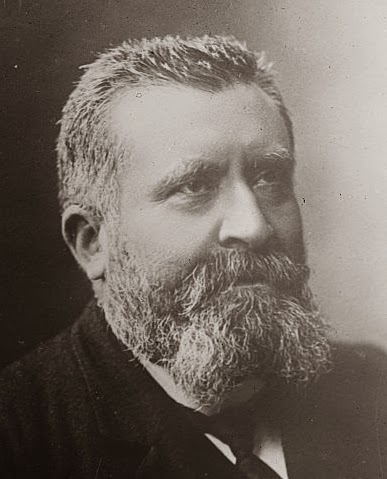
Jean Jaures

No sooner was the Caillaux trial over than France was shocked by another murder.  Jean Jaures, the leader of the French Socialist Party, returned on July 30 from a conference of the Socialist International in Brussels at which he and Hugo Haase, the leader of the Socialist Party in Germany, along with other European socialist leaders, pledged international solidarity in their opposition to war and resolved that if their countries declared war they would call general strikes to deprive their governments of the ability to conduct military operations.  The day after Jaures returned to Paris, as he was dining in a Paris cafe, he was shot and killed by a nationalist fanatic, Raoul Villain.


Raoul Villain

*****


Colonel House

Colonel Edward M. House, who was sent to Europe in May as a representative of United States President Woodrow Wilson, left England on July 21 to return home.  Sir William Tyrell, British Foreign Minister Sir Edward Grey's private secretary, caught up with House just before he sailed and delivered a message from Grey stating that recent developments had left him gravely concerned about the Austro-Serbian situation.  By the time Colonel House landed in Boston on July 29, Austria-Hungary was at war with Serbia.


 Francisco Carvajal

General Victoriano Huerta resigned the presidency of Mexico on July 15.  After a leisurely journey from Mexico City to Puerto Mexico, Huerta boarded a German steamer, which set sail for Kingston, Jamaica during the night of July 20.  He was replaced by Minister of Foreign Relations Francisco Carvajal, who took office as provisional president.  The real power in Mexico appears to be held by the leader of the Constitutionalists, Venustiano Carranza, and other rebels, including Pancho Villa and Emiliano Zapata, who, while not quite allies of Carranza, have until now been working toward the same goal, the ouster of Huerta.  The political situation in Mexico is far from settled, but with the departure of Huerta it may have taken a step toward resolution.  Meanwhile, the occupation of Veracruz by the United States continues.


Justice Lurton

United States Supreme Court Justice Horace Lurton died on July 12.  Prior to serving on the Supreme Court, Lurton served as a judge on the Sixth Circuit Court of Appeals, where he became a good friend of his fellow judge, William Howard Taft.  After Taft became president, Lurton was his first Supreme Court appointment.

Former President Roosevelt has announced his resignation from the board of editors of The Outlook, the magazine to which he has been a frequent contributor since leaving the presidency in 1909.  He says he wants to have more time to devote to politics.  As the month draws to a close, President Wilson's attention is riveted on his wife, whose health has taken a turn for the worse.


Walter Brock After Winning the Hendon-Paris-Hendon Race

On July 11, American aviator Walter Brock won the air race from the Hendon Aerodrome outside London to Paris and back. His actual flying time was seven hours three minutes and six seconds.  Six competitors began the race; only two completed it.  All the others landed safely except Lord John Carbery, who was forced down in the English Channel on the return leg and was rescued by a British steamer. 


Collins and Harlan

The international news is grim, but much American popular music is lighthearted.  This month Arthur Collins and Byron Harlan recorded "The Aba Daba Honeymoon," written by Arthur Fields and Walter Donovan (click to play):


July 1914 – Selected Sources and Recommended Reading

Contemporary Periodicals:
American Review of Reviews, August and September 1914
New York Times, July 1914

Books and Articles:
A. Scott Berg, Wilson
Philip Blom, The Vertigo Years: Europe, 1900-1914
Randolph S. Churchill, Winston S. Churchill Volume II: Young Statesman, 1907-1914
Winston S. Churchill, The World Crisis 1911-1918
Christopher Clark, The Sleepwalkers: How Europe Went to War in 1914
John Milton Cooper, Jr., Woodrow Wilson: A Biography
John Milton Cooper, Jr., The Warrior and the Priest: Woodrow Wilson and Theodore Roosevelt
Patrick Devlin, Too Proud to Fight: Woodrow Wilson's Neutrality
David Fromkin, A Peace to End All Peace: Creating the Modern Middle East, 1914-1922
Martin Gilbert, The First World War: A Complete History
Martin Gilbert, A History of the Twentieth Century, Volume One: 1900-1933
Martin Gilbert, Winston S. Churchill Volume III: The Challenge of War, 1914-1916
Richard F. Hamilton and Holger H. Herwig, Decisions for War, 1914-1917
Max Hastings, Catastrophe 1914: Europe Goes to War
August Heckscher, Woodrow Wilson: A Biography
Godfrey Hodgson, Woodrow Wilson's Right Hand: The Life of Colonel Edward M. House
John Keegan, The First World War
Arthur S. Link, Woodrow Wilson and the Progressive Era, 1910-1917
Margaret MacMillan, The War That Ended Peace: The Road to 1914
Robert K. Massie, Dreadnought: Britain, Germany, and the Coming of the Great War
Robert K. Massie, Castles of Steel: Britain, Germany, and the Winning of the Great War at Sea
Sean McMeekin, July 1914: Countdown to War
Michael S. Neiberg, Dance of the Furies: Europe and the Outbreak of World War I
Kenneth Rose, King George V
Charles Seymour ed., The Intimate Papers of Colonel House
George Malcolm Thomson, The Twelve Days: Two Weeks in Europe's Fatal Summer
Barbara W. Tuchman, The Guns of August
Barbara W. Tuchman, The Proud Tower: A Portrait of the World Before the Great War
Barbara W. Tuchman, The Zimmermann Telegram


Monday, June 30, 2014

June 1914

Note:  This month I received the following message from the Web Archiving Team at the Library of Congress: "The Library of Congress has selected this website for inclusion in its historic collection of internet materials related to the World War One Centennial.  We consider your website to be an important part of this collection and the historical record."  I am grateful for this recognition, and will do my best to live up to the Library's expectations.

__________


June 1914 is the month the old world is left behind, never to return.  The heir to the Austro-Hungarian throne and his wife are assassinated on a state visit to Sarajevo, leading, in a little over a month, to a general European war.  Former President Theodore Roosevelt, in Europe for his son's wedding, calls on the continent's leading statesmen in the last few weeks of the old world.  He returns home before the assassination, but Woodrow Wilson's personal emissary Colonel House, who is also in Europe, will remain, at least for a while.  The United States prepares for the opening of the Panama Canal, as President Wilson, still struggling with the Mexican question, finally gets Congress to repeal the free tolls provision of the Panama Canal Act.  Former Vice-President Adlai Stevenson dies; his fourteen year-old grandson will grow up to become governor of Illinois, two-time Democratic Party candidate for president, and United States Ambassador to the United Nations.


*****


Archduke Franz Ferdinand and his Family

Archduke Franz Ferdinand, nephew and heir of Emperor Franz Joseph of Austria-Hungary, and his wife Sophie, Duchess of Hohenberg, were shot and killed on June 28 as they were being driven through the streets of Sarajevo, the capital of the recently annexed Austrian province of Bosnia-Herzegovina.  The Archduke was in Sarajevo on a state visit and to observe military maneuvers as a representative of the Emperor.

The timing of the Archduke's visit was unfortunate.  June 28 is an important date for Serbs, who make up a significant portion of the Bosnian population.  It is St. Vitus Day, honoring a saint venerated in the Serbian Orthodox Church, and is also.the date on which, in 1389, a Serbian army was defeated at the Battle of Kosovo, resulting in the absorption of the Serbs into the Ottoman Empire.  Patriotic fervor among Serbs is running particularly high this year, as the recent Balkan Wars have resulted in significant territorial gains for Serbia, including the restoration of Kosovo itself.  Much of this nationalist feeling takes the form of hostility toward Austria-Hungary, whose 1908 annexation of Bosnia-Herzegovina the Serbs bitterly opposed.  Serbian nationalists were particularly incensed this year by what they saw as the deliberately provocative decision to conduct Austrian military exercises in Bosnia on this anniversary.


The Archduke and His Wife the Day Before Sarajevo

The Archduke and his wife were observing another anniversary.  It was on June 28 fourteen years ago that they finally received the Emperor's permission to marry.  Because the Duchess (then merely a Czech countess) was not of sufficiently exalted nobility, the Emperor had forbidden the marriage, finally allowing it only after the Archduke took an oath excluding Sophie from Imperial titles and honors and the children of the marriage from succession to the Hapsburg throne.  In Vienna, Sophie was subjected to repeated petty humiliations, not accorded the title of archduchess and not being allowed, for example, to sit with her husband in the royal box at the opera, to sit near him at state dinners or to ride with him in the royal carriage.  Sarajevo was different: there she was to accompany her husband and be accorded the honors normally due the consort of the heir apparent.  For the royal visit, the city was bedecked with welcoming banners and crowds lined the route of the Archduke's procession to Town Hall, a route that had been widely publicized in advance.

Several would-be assassins were lying in wait.  As the procession moved down the Appel Quay en route to the welcoming reception at Town Hall, one of the conspirators threw a bomb at the Archduke's car.  It struck the Archduke, but fell away and exploded under the car behind, injuring the military governor's adjutant and several bystanders.  The Archduke reacted coolly, stopping his car and seeing to the treatment of the injured.  He then directed that the day's program continue with the addition of a trip to the hospital to visit those hurt in the attack.


Archduke Franz Ferdinand at Town Hall

At Town Hall the Archduke was met by the Mayor and Town Councillors.  As the Mayor began his welcoming address, the Archduke interrupted, saying "Herr Burgermeister, it is perfectly outrageous!  We have come to Sarajevo on a visit and have had a bomb thrown at us."  After a stunned silence, he said "Now you may go on."  As the Mayor and the Archduke were speaking and word of the attempt on the Archduke's life spread, a crowd gathered at Town Hall and began chanting "Zivio!," the Slavic word for "hurrah!"  After a brief tour of the Town Hall, the Archduke and his wife returned to their automobile and retraced their route along Appel Quay toward the hospital, traveling this time at full speed to frustrate any further attacks.


The Archduke and Duchess Returning to Their Car

When the procession reached Franz Joseph Street the lead car turned to the right, following the original route rather than the new route to the hospital.  The other cars followed.  When the Archduke's driver in the third car realized his mistake, he stopped and began struggling to return the car to Appel Quay.  One of the conspirators, Gavrilo Princip, was standing on the corner in front of a spice emporium.  Seeing his opportunity, he ran to the Archduke's car, raised his pistol, and fired two shots.  Count Harrach, the Archduke's bodyguard, was standing on the left side running-board to protect against any attack from that direction as the car sped down Appel Quay; it was the wrong side to provide any protection against Princip's attack from the right on Franz Joseph Street.  Both of Princip's shots proved fatal, one each to the Archduke and his wife.


Gavrilo Princip

*****


The Regatta at Kiel

News of the assassination reached the German Kaiser on his yacht, where he was attending the annual regatta at Kiel, on Germany's Baltic Sea coast.  The Kiel Canal, built several years ago to connect the North and Baltic Seas, was recently enlarged to accommodate Dreadnought-size battleships.  When he learned of the assassination, the Kaiser, who considered the Archduke a friend, canceled the remainder of his cruise and returned to Berlin.  A British fleet under the command of Rear Admiral Sir George Warrender, which was paying a courtesy visit marked by social events and visits between German and English officers, departed Kiel on June 30.  As the British fleet got under way, the German fleet in the harbor hoisted signal flags with the message "Pleasant journey."  Admiral Warrender replied by wireless: "Friends in past and friends forever."


 Admiral Warrender

*****


Edith Wharton

Former President Roosevelt spent most of the month in Europe, where he pursued a full schedule.  He disembarked at Cherbourg on June 4 and proceeded to Paris, where he called on President Poincare and dined with Ambassador Myron Herrick on June 6.  The next day he joined the American author Edith Wharton for breakfast, then traveled to Madrid for his son's wedding.  (The warmth of his welcome there may have been diminished somewhat by the memory of his role in the Spanish-American War.)  After the June 11 wedding, he traveled back through Paris to London, where he visited Prime Minister Asquith and other members of the Liberal government, including David Lloyd George and Sir Edward Grey.  He also called on Unionist politicians including former Prime Minister Arthur Balfour, parliamentary party leader Andrew Bonar Law and former Viceroy of India Lord Curzon.  During his stay in London he addressed the Royal Geographic Society, repeating the description he gave last month in Washington of his exploration of the River of Doubt in South America.


Roosevelt In His Stateroom on the Imperator

Roosevelt boarded the Hamburg-America liner SS Imperator at Southampton on June 18 for his return voyage to the United States.  Arriving in New York on June 24, he was welcomed at Quarantine by his wife Edith aboard a steam yacht owned by businessman William H. Childs.  Also aboard the yacht were George W. Perkins, a former Morgan partner who is a major financial supporter and Chairman of the Executive Committee of the Progressive Party; Roosevelt's nephew Theodore Douglas Robinson; and Dudley Field Malone, the Collector of the Port of New York, accompanied by two inspectors who passed the former president's luggage expeditiously after its removal from the liner.  The yacht then proceeded directly to Roosevelt's home on Oyster Bay, arriving around midnight.


George W. Perkins

Roosevelt's recovery from his Brazilian adventure has been less than complete.  On his  way back from Europe on the Imperator, he had a recurrence of the malarial fever that had felled him in South America.  His doctors have advised him to rest, something he has found impossible to do in an election year.  Immediately upon his arrival in New York, he handed the waiting reporters a written statement denouncing President Wilson's handling of the Mexican crisis, as well as the recently negotiated treaty with Colombia which expresses regret for Roosevelt's actions in Panama in 1903.  His statement asserts that "the handling of foreign affairs by President Wilson and Secretary Bryan has been such as to make the United States a figure of fun in the international world."  He says the Colombian treaty in particular will "render us an object of contemptuous derision to every great nation."  In interviews with the press, he has come to the defense of George Perkins, whose leadership of the Progressive Party has been questioned by some who consider it inappropriate for the party to be represented by a millionaire who sits on the boards of giant trusts such as United States Steel and International Harvester.  Asked by reporters for his reaction to the calls for Perkins to step down, he said "If they read George out of the party, they will have to read me out too."

Roosevelt had been home less than a week when he learned of the assassination of the Archduke and Duchess in Sarajevo.  On June 30 he was in Pittsburgh, Pennsylvania, speaking to a Progressive League dinner.  Apart from a general denunciation of President Wilson's "wretched foreign policy," his speech was limited to domestic issues.


Ambassador Walter Hines Page

Another American in England this month was Colonel Edward M. House, President Wilson's close friend and confidant, who is visiting Europe at the President's request.  After negotiations between Ambassador Gerard and the German Foreign Office, he had a brief private conversation with the Kaiser at Schrippenfest on June 1.  He then traveled to Paris, where all the talk was about the forthcoming trial of Mme. Caillaux for the murder of Gaston Calmette, editor of Le Figaro (see the March 1914 installment of this blog).  From Paris he went to London, where he had lunch on June 17 with United States Ambassador Walter Hines Page, British Foreign Secretary Sir Edward Grey, and Grey's private secretary Sir William Tyrell.  He reported on his meeting with the Kaiser and discussed ways that tensions between Great Britain and Germany might be eased.  He was still in England at month's end as Europe reacted to news of the Archduke's assassination.


President Wilson Dedicating the Confederate War Memorial


President Wilson was also observing anniversaries this month.  On June 4, the 106th anniversary of the birth of Confederate President Jefferson Davis, he traveled across the Potomac to dedicate the Confederate War Memorial in Arlington National Cemetery.  On Saturday of the following week, June 13, he was at Princeton University for the thirty-fifth anniversary reunion of his Class of 1879.

On June 29, after learning of the assassination of Archduke Franz Ferdinand and his wife in Sarajevo, the President sent a message to Emperor Franz Joseph expressing himself "deeply shocked at the atrocious murder" and extending the "sincere condolences of the Government and people of the United States and an expression of my own profound sympathy."  The Emperor responded the next day with a message of "sincerest and cordial thanks."

The Sixty-third Congress, in continuous session for fifteen months, has been remarkably productive in terms of legislative output.  Among its completed accomplishments are comprehensive tariff reform, passage of federal income tax legislation, and establishment of a system of Federal Reserve Banks.  This month, over the opposition of leaders of the president's own party, it finally passed legislation repealing the free tolls provision of the Panama Canal Act, legislation President Wilson signed into law on June 15.  Still pending are bills to expand and clarify the Sherman Anti-trust Law (among other things exempting labor unions from liability for "combinations in restraint of trade"), and to establish a federal interstate trade commission.  President Wilson has taken a direct hand in all these legislative efforts, not only by addressing Congress in person multiple times, but also by attacking lobbyists and other opponents of his favored legislation, who he says represent only special interests working through newspapers and other organs of opinion to advocate positions that do not reflect the interests or opinions of the general public.

The principal foreign policy concern in the United States is the dispute with Mexico.  As efforts continue to persuade General Huerta to relinquish power, American Army forces under the command of General Funston occupy the major port city of Veracruz.  The situation has been complicated by Japanese support for Huerta, reinforced by the recent visit of a Japanese battleship to Mexico's west coast.  Observers consider it likely that, when President Wilson asked Congress in March to repeal the free tolls provision of the Panama Canal Act so that he could deal with "matters of even greater delicacy and nearer consequence," he was referring to the importance of maintaining good relations with Great Britain, which has close relations with Japan, in the hope that it will play a constructive role in Mexico.

The United States' own relations with Japan are strained, due not only to their different views of the Mexican situation, but also to lingering resentment caused by California legislation restricting Japanese land ownership.  Next spring the U.S. Atlantic Fleet, comprising some twenty battleships and numerous smaller ships, will accompany ships of foreign nations through the Panama Canal on their way to the Panama Pacific Exposition in San Francisco.  Secretary of the Navy Daniels made a statement on June 26 suggesting that the Atlantic Fleet ships, once in the Pacific, would remain there for a long time.  A clarifying statement issued later that day said that no such final determination has been made, although "with the opening of the Panama Canal it is of course obvious that there will eventually be more ships in Pacific waters than at present."


Adlai Stevenson

Former Vice-President Adlai Stevenson died on June 14.  Born in Kentucky in 1835, he moved with his family to Bloomington, Illinois in 1852.  As a young lawyer, he campaigned for Stephen A. Douglas in his 1858 Senate race against Abraham Lincoln.  He remained active in Democratic Party politics, and after two non-consecutive terms in Congress he was appointed First Assistant Postmaster General in the first administration of Grover Cleveland.  In that position, responsible for the appointment of postmasters, he earned a reputation as the "Headsman" for his zeal in eliminating Republicans and replacing them with deserving Democrats.   In 1892, as the Democratic Party nominated Cleveland for a second term (third consecutive nomination), it chose Stevenson as his running mate to please party regulars.  Cleveland won -- the only example in American history of a president elected to non-consecutive terms -- and Stevenson served as his vice-president for the next four years.  In 1900 the party nominated Stevenson again, this time as William Jennings Bryan's running mate (another precedent-breaking event: the only time a former vice-president has been nominated for the office with another candidate leading the ticket).  The Bryan-Stevenson ticket lost that election to President William McKinley, who was seeking reelection, and his running mate Theodore Roosevelt.


June 1914 – Selected Sources and Recommended Reading

Contemporary Periodicals:
American Review of Reviews, July and August 1914
New York Times, June 1914

Books and Articles:
A. Scott Berg, Wilson
Philip Blom, The Vertigo Years: Europe, 1900-1914
Randolph S. Churchill, Winston S. Churchill: Young Statesman 1907-1914
Christopher Clark, The Sleepwalkers: How Europe Went to War in 1914
John Milton Cooper, Jr., Woodrow Wilson: A Biography
John Milton Cooper, Jr., The Warrior and the Priest: Woodrow Wilson and Theodore Roosevelt
Patrick Devlin, Too Proud to Fight: Woodrow Wilson's Neutrality
Charles Emmerson, 1913: The World Before the Great War
David Fromkin, A Peace to End All Peace: Creating the Modern Middle East, 1914-1922
Martin Gilbert, A History of the Twentieth Century, Volume One: 1900-1933
Doris Kearns Goodwin, The Bully Pulpit: Theodore Roosevelt, William Howard Taft, and the Golden Age of Journalism
Richard F. Hamilton and Holger H. Herwig, Decisions for War, 1914-1917
Max Hastings, Catastrophe 1914: Europe Goes to War
August Heckscher, Woodrow Wilson: A Biography
Godfrey Hodgson, Woodrow Wilson's Right Hand: The Life of Colonel Edward M. House
Arthur S. Link, Woodrow Wilson and the Progressive Era, 1910-1917
Margaret MacMillan, The War That Ended Peace: The Road to 1914
Robert K. Massie, Dreadnought: Britain, Germany, and the Coming of the Great War
Sean McMeekin, July 1914: Countdown to War
Candice Millard, The River of Doubt: Theodore Roosevelt's Darkest Journey
Kenneth Rose, King George V
Barbara W. Tuchman, The Zimmermann Telegram
United States Senate, Official Biography, Adlai Ewing Stevenson, 23rd Vice President, www.senate.gov/artandhistory/history/common/generic/VP_Adlai_Stevenson.htm
Rebecca West, Black Lamb and Grey Falcon: A Journey Through Yugoslavia

Saturday, May 31, 2014

May 1914

It's May 1914.  In the United States, former President Roosevelt returns from a dangerous voyage of exploration in the Brazilian jungle and Treasury Secretary McAdoo takes time off from setting up the Federal Reserve System to marry the president's daughter.  Former New York Police Lieutenant Charles Becker is convicted, again, for the murder of Herman Rosenthal.  Mediation to settle the dispute between the United States and Mexico gets under way in Canada, as the Mexican Constitutionalists capture Saltillo and the American occupation of Veracruz continues.  Abroad, Irish home rule comes a step closer to reality, just in time to be derailed by the outbreak of war.  Elections in France will probably lead to another change of government, but the French are thinking only about the upcoming murder trial of Mme. Caillaux.  As the month comes to an end, the international crises that have bedeviled European politics over the last few years, from Morocco to Libya to the Balkans, seem to be fading into the past; but the assassination that will trigger the Great War is less than a month away.


*****


Roosevelt aboard the Aidan, arriving in New York

Last October, former President Theodore Roosevelt left New York on an extended voyage to South America.  After addressing welcoming crowds and legislative assemblies in Brazil, Argentina and Chile, he returned through Argentina to Paraguay, where he embarked on an expedition to map the previously unexplored Rio da Duvida (the "River of Doubt").  He and his companions, including his son Kermit, embarked on their journey of exploration on December 12, traveled up the Paraguay River as far as possible, then overland through the Brazilian Highlands to the headwaters of the River of Doubt.  They began their descent of the river on February 27 and reached its confluence with the Aripuana, a tributary of the Amazon, on April 26.  At this point Roosevelt was much the worse for wear from the hardships of his journey, and had to be carried on a stretcher to the riverboat that took him to the mouth of the Amazon.  There he boarded the steamship Aidan and, after a stop in Barbados, arrived in New York Harbor on May 19.  Roosevelt appeared much improved after his sea voyage home, though he was somewhat gaunt and walking with the aid of a cane (which he called his "big stick").


 Northern Liberty Market

Some skeptics, including the president of the Royal Geographic Society in London, have expressed skepticism about Roosevelt's report of his expedition's accomplishments.  To answer the doubters, Roosevelt traveled to Washington, D.C. on May 26 to address a meeting of the National Geographic Society.  He had a full day in Washington.  His train from New York arrived at Washington's new Union Station at 3:00 P.M.  Roosevelt then called on President Wilson at the White House, visited the new National Museum at the Smithsonian Institution (where he admired trophies from his big game hunting trip to Africa five years ago), attended a reception for the Diplomatic Corps at the home of Senator Lodge, was guest of honor at a dinner attended by thirty-four people, and received newspapermen at the New Willard Hotel.  The Geographic Society meeting, which began at 8:30 P.M., was held in Convention Hall.  The only space in the District of Columbia large enough to accommodate the invited guests, it occupies the entire upper level of the Northern Liberty Market building at 5th and K Streets Northwest.  The heat wave gripping Washington, combined with the capacity crowd, poor ventilation and the pervasive odor of overripe food emanating from the market below, made for an uncomfortable experience for the attendees, further aggravated by the difficulty of hearing Roosevelt's voice in the cavernous room.  His presentation, however, was well received, and put the doubts largely to rest.  He emphasized that he had not "discovered" the river, claiming only that he had descended it and "put it on the map."  After his speech, Roosevelt went to Progressive Party headquarters, where he conferred with the party's members of Congress for over an hour.  He left for New York on the overnight sleeper a little after midnight.

A few days later Roosevelt was traveling again, this time aboard the RMS Olympic on his way to Europe.  Next month he will attend the wedding of his son Kermit to Belle Willard, daughter of the American ambassador to Spain.


The White House Flower Girls

Another presidential wedding, this one in the White House, took place on May 7.  Eleanor Wilson, the president's youngest daughter, was married to Secretary of the Treasury William G. McAdoo.  It was a quiet affair in comparison to last year's wedding of the bride's sister Jessie to Francis B. Sayre, which was in the East Room with over 500 guests in attendance.  This one was held in the smaller Blue Room, with fewer than 100 guests.  The iron gates on Pennsylvania Avenue were closed and guarded by policemen for the occasion, and only invited guests were admitted to the White House grounds.  Mrs. Wilson, showing no sign of her recent illness, received the guests as they entered the Blue Room.  Miss Sallie McAdoo, the youngest of the bridegroom's three daughters, led the bridal procession, followed by the bride's sisters.  The bride was preceded by a second flower girl, the Secretary of the Interior's daughter Miss Nancy Lane.


ABC mediation in session at Niagara Falls; Americans on the left, Mexicans on the right, mediators at the head of the table.

The Mexican crisis that began last month with the arrest of American sailors in Tampico, and continued with the United States Navy's interception of a German shipment of arms to Veracruz, led at the end of April to an agreement to submit the issues to the "ABC" powers, Argentina, Brazil and Chile.  Mediation sessions began on May 20 in Niagara Falls, Ontario, and resulted in a proposed settlement that was submitted to the parties on May 27.  Among other things, it calls for General Huerta to step down as interim president of Mexico and to be replaced by a temporary government of five cabinet members.  Until agreement is reached, the American military will continue to occupy Veracruz.


The Ypiranga in Veracruz

As the mediation proceeds, the Constitutionalists led by Venustiano Carranza are continuing to make gains against the Huerta regime.  Constitutionalist forces commanded by Francisco "Pancho" Villa captured and occupied Saltillo on May 21, and on May 31 Carranza assumed the title of provisional president and began the establishment of a government at Saltillo.  Meanwhile, the U.S. Navy has released the German merchant ship Ypiranga, which attempted to deliver arms to the Huerta regime at Veracruz last month, an attempt that led to the vessel's detention and eventually to the occupation of Veracruz by American forces.  After its release, the Ypiranga proceeded to nearby Puerto Mexico, where on May 27 it delivered the arms to Huerta's forces without interference.


Rosenthal, Becker, and the Hotel Metropole

Former New York City Police Lieutenant Charles Becker was convicted in October 1912 of first degree murder in the killing earlier that year of Herman Rosenthal, who was cooperating with District Attorney Charles Whitman in an investigation of graft and corruption in the New York Police Department.  The three gunmen who carried out the murder on the sidewalk in front of the Hotel Metropole were executed last month, but the Court of Appeals vacated Becker's conviction on the ground of bias and trial errors by the trial judge, Justice John Goff.  Not to be denied, Whitman vowed immediately after the Court of Appeals ruling to try Becker again.  The retrial took place this month before Justice Samuel Seabury.  On May 22 Becker was again found guilty of murder in the first degree.


SS Vaterland

The two largest passenger ships in the world had their maiden voyages this month, both sailing to New York from their home ports in Europe.  The Hamburg-America liner Vaterland sailed from Cuxhaven on May 14, arriving in New York May 21.  With a displacement of over 54,000 tons, it is the largest ocean liner afloat.  Because of its size, a strong ebb tide, and contrary winds on the Hudson River, it took the giant vessel five hours to maneuver from Quarantine to its dock at Hoboken.  Only slightly smaller is the new Cunard liner Aquitania, which departed Liverpool on May 30.  Its displacement of approximately 49,000 tons makes it larger than either of its sister ships, the Lusitania and the Mauretania.


RMS Empress of Ireland

The day before the Aquitania left Liverpool, a passenger liner bound for Liverpool met a tragic fate in the lower St. Lawrence River.  The Canadian Pacific liner RMS Empress of Ireland, under way from Quebec in heavy early morning fog, was struck amidships by the Norwegian collier Storstad.  The liner sank within fifteen minutes, killing 1024 passengers and crew.  452 were rescued.


 General Sickles with His Staff After the Battle of Gettysburg . . .


. . . and in 1902

Major General Daniel Sickles died on May 3 in his home at 23 Fifth Avenue in New York City.  He had a remarkably eventful life.  Active in Democratic Party politics in the years before the Civil War, he entered the state legislature in 1847, where he was instrumental in the creation of New York City's Central Park.  He served in the United States Congress from 1857 to 1861.  In 1859, on Lafayette Square across the street from the White House, he shot and killed his wife's lover, Philip Barton Key, the District Attorney for the District of Columbia and the son of Francis Scott Key, author of "The Star-Spangled Banner."  In the subsequent trial, Sickles pled temporary insanity and was found not guilty.  He achieved additional fame in the Civil War when he commanded a corps at the Battle of Gettysburg.  On the second day of the battle, in violation of orders, he advanced his corps into the Peach Orchard, a move that endangered his troops but may have helped save the day for the Union Army.  After the battle, in which he lost a leg, he was promoted to major general and awarded the Medal of Honor.  He served as United States Minister to Spain from 1869 to 1874, and again in Congress from 1893 to 1895.


Jacob Riis

Another notable death this month was that of Jacob Riis, the well-known social worker and author, who died on May 26.  He pioneered the use of photographs to accompany his social commentary.  His 1890 book, How the Other Half Lives, documented the lives of tenement dwellers in New York City:


"Bandit's Roost" from How the Other Half Lives

*****


James Couzens, in the Front Seat with Henry Ford

James Couzens, Treasurer of the Ford Motor Company, announced in a statement on May 16 that the company would lay off some 6,000 men due to the onset of the annual slack season of the automobile business.  He said "we do not intend to work any hardship if it can be avoided.  Single men will be the first to go.  Married men who measure up to the standard of efficiency demanded at this time will be held as long as possible."  This development is due in part to the company's institution earlier this year of a five dollar daily minimum wage and institution of three shifts for round-the-clock production on the assembly line, an innovation that has resulted in the market demand for automobiles being satisfied several weeks earlier than in previous years.


Irish Party Leader John Redmond

The Irish Home Rule bill passed its third reading in the House of Commons on May 25.  The vote was 351 to 274.  The Bill will now go to the House of Lords, where it is expected to be defeated, as it has been in its two prior trips to the Upper House of Parliament:  This time, however, it will receive the royal assent and become law with or without the Lords' concurrence.  Both Belfast and Dublin received the news quietly; celebratory fireworks and bands greeted the news in Limerick.  To counter the threat of violence, armed police have been moved to the North, and railway authorities have been instructed to have troop trains ready in case they are needed.  John Redmond, the leader of the Irish Party, issued a statement hailing passage of the bill as an event that "marks the death, after an inglorious history of 114 years, of the Union of Pitt and Castlereagh," referring to the abolition of the Irish Parliament in 1800, an event Redmond called "the cause of Ireland's poverty, misery, depopulation, and demoralization, the cause of famine, insurrection, and bloodshed, and of the disloyalty of the Irish people throughout the whole world."  He says "there are only two eventualities ... which could possibly prevent the Home Rule bill from becoming a statute in a few weeks' time.  The first is that the present session of Parliament should come to an abrupt end before one month from this date -- an utterly unthinkable proposition -- and the other is that the House of Commons should suddenly go mad and pass a resolution that the bill should not be presented for the royal assent."  He said "the assembling of an Irish Parliament is as certain as the rising of tomorrow's sun," and expressed the hope that the people of Ulster will "abandon unreasonable demands" and accept "the indisputable facts of home rule and a home rule Parliament."


Colonel House

"Colonel" Edward M. House does not hold any official position in the United States government, having declined President Wilson's offer of a cabinet office at the beginning of his administration.  (Nor is he a real colonel: the title is an honorary one conferred by Governor Jim Hogg of Texas).  As an informal adviser, however, he is a close and influential confidant of the President, and he shares Wilson's concern about the growing tensions between Germany and Great Britain.  At the President's request, he sailed with his wife to Europe this month on the German liner Imperator, hoping to meet with the Kaiser while in Germany.   He arrived on May 23 and dined that evening with Admiral Tirpitz and other German dignitaries. Ambassador James Gerard has been trying to arrange a private meeting between House and the Kaiser, but this has been resisted by the Kaiser's advisers, who insist that a representative of the German Foreign Office be present at all such meetings.  After some negotiations, House and Gerard have been invited to join the Kaiser at Potsdam on June 1 during an annual military festival called Schrippenfest, and it has been agreed that while he is there House will be allowed to have a conversation with the Kaiser out of earshot but within view of Gerard and Undersecretary Arthur Zimmermann of the German Foreign Office.


Premier Gaston Doumergue . . .


. . . and Socialist Leader Jean Jaures

French elections on April 26 and May 10 resulted in big gains for the Socialists, led by Jean Jaures, and other parties of the radical bloc, which now accounts for over 400 of the 600 members of the Chamber of Deputies.  Minister of Finance and former Premier Joseph Caillaux, who resigned his seat in March when his wife shot and killed the editor of Le Figaro, was reelected.  The present government, headed by Premier Gaston Doumergue, is the forty-eighth in the forty-three years of the Third Republic, and it is likely to be replaced again as a result of the elections.  President Poincare is looking for candidates to form a new government.

*****


The Perils of Pauline

The new entertainment medium of motion pictures is enjoying increasing popularity in the United States.  The latest format is the serial, in which the same actors playing the same roles are used in successive episodes, drawing audiences to theaters from week to week to follow their favorite characters' adventures.   One of the most popular is The Perils of Pauline, starring Pearl White, the first episode of which was released in March.  The series follows Pauline and her stepbrother Harry, who is in love with her and pursues her romantically into a variety of dangerous situations from which he is then obliged to rescue her.  The serial’s fifth episode was released May 18.  In it, a Signor Baskinelli lures Pauline into Chinatown, where she finds herself imprisoned in a joss house.  Harry discovers her there and, in the episode's climactic scene, frees her after a heroic struggle:


Pauline in Peril; Harry to the Rescue


May 1914 – Selected Sources and Recommended Reading

Contemporary Periodicals:
American Review of Reviews, June and July 1914
New York Times, May 1914

Books and Articles:
A. Scott Berg, Wilson
Philip Blom, The Vertigo Years: Europe, 1900-1914
Randolph S. Churchill, Winston S. Churchill: Young Statesman 1907-1914
Christopher Clark, The Sleepwalkers: How Europe Went to War in 1914
John Milton Cooper, Jr., Woodrow Wilson: A Biography
John Milton Cooper, Jr., The Warrior and the Priest: Woodrow Wilson and Theodore Roosevelt
Patrick Devlin, Too Proud to Fight: Woodrow Wilson's Neutrality
Charles Emmerson, 1913: The World Before the Great War
David Fromkin, A Peace to End All Peace: Creating the Modern Middle East, 1914-1922
Martin Gilbert, A History of the Twentieth Century, Volume One: 1900-1933
Doris Kearns Goodwin, The Bully Pulpit: Theodore Roosevelt, William Howard Taft, and the Golden Age of Journalism
Richard F. Hamilton and Holger H. Herwig, Decisions for War, 1914-1917
Max Hastings, Catastrophe 1914: Europe Goes to War
August Heckscher, Woodrow Wilson: A Biography
Godfrey Hodgson, Woodrow Wilson's Right Hand: The Life of Colonel Edward M. House
Arthur S. Link, Woodrow Wilson and the Progressive Era, 1910-1917
Margaret MacMillan, The War That Ended Peace: The Road to 1914
Robert K. Massie, Dreadnought: Britain, Germany, and the Coming of the Great War
Candice Millard, The River of Doubt: Theodore Roosevelt's Darkest Journey
Kenneth Rose, King George V
Barbara W. Tuchman, The Zimmermann Telegram