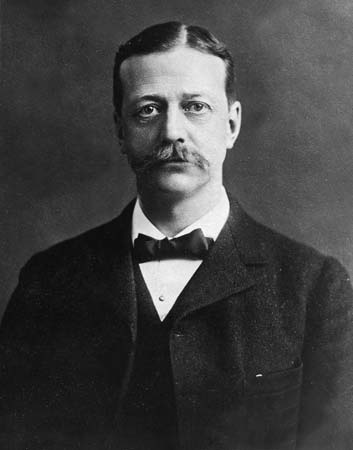
Wednesday, September 30, 2015

September 1915

In September 1915, one hundred years ago this month, there are few if any signs that an end is in sight to the Great War that began over a year ago.  The British and French mount major offensives on the Western Front, including the first use of poison gas by the British.  The Tsar takes personal command of the Russian Army.  Socialists meeting in Switzerland call for an end to the ongoing war between nations, to be replaced by a class war; Lenin and Trotsky are there.  The United States and Germany struggle to find common ground on the subject of submarine warfare, and the Royal Navy's blockade of Germany continues to be an irritant in Anglo-American relations.  The United States demands the recall of Baron Dumba, the Austro-Hungarian ambassador (Franz von Papen, his military attache, will become Chancellor and then Vice-Chancellor of Germany under Hitler in the 1930's).  Zeppelins drop bombs on London, and the British Landships Committee conducts its first test of an armoured vehicle designed to overcome machine guns and barbed wire.  An Anglo-French Financial Commission negotiates a large loan from American banks.  The civil war in Mexico may be coming to an end as Carranza gains the upper hand, but violence continues on the Texas border.  Subway construction causes streets to collapse in New York City, W.C. Fields makes his first motion picture, and the Grand Army of the Republic commemorates the fiftieth anniversary of the end of the Civil war with a parade in Washington.

*****


 "Tower Bridge" at Loos 

In an attempt to relieve pressure on their Russian ally, the French and British armies mounted coordinated offensives on the Western Front on September 25.  French armies attacked German positions in Champagne while the British attacked at Loos supported by a French attack at nearby Artois.  The area around Loos is largely industrial and the land flat and featureless except for slag heaps and a pit head lift behind the town that reminded British soldiers of Tower Bridge in London, a name they promptly gave it.  Both the slag heaps and the pit head machinery provided excellent vantage points for the defending Germans.  


British Troops Advancing Through Their Own Gas

The attack at Loos was the first time the British Army has made use of the new "Kitchener Battalions" recruited since the start of the war.  It also featured the first use by the British of poison gas, the effectiveness of which was lessened by the failure of the wind at some parts of the front to carry the gas toward the German trenches and by the hesitancy of the newly recruited troops to attack through the gas cloud.  In one area a Scottish battalion was encouraged to attack by Piper Daniel Laidlaw, who strode up and down the parapet playing "Scotland the Brave" and other airs on his bagpipe.  At month's end, the Allies had made slight advances at a great cost in casualties.  Among the missing is John Kipling, only son of the famous author and poet Rudyard Kipling.


Grand Duke Nicholas

Defeats and withdrawals on the Eastern Front have significantly shortened the Russian Army's defensive lines, but have also resulted in the abandonment of Russian Poland.  On September 5, the Tsar assumed personal command of the Russian armies, relieving his uncle Grand Duke Nicholas, whom he appointed Viceroy of the Caucasus and commander of the Caucasian Army.  He told his uncle, whose authority has been undermined since the beginning of the war by Minister of War Vladimir Sukhomlinov, that "my duty to my country, entrusted to me by God, impels me to take the supreme command."

The Russian Army in the Caucasus, now commanded by Grand Duke Nicholas, is only one of several Allied armies confronting the Ottoman Empire.  British, Anzac and French troops are clinging to beachheads on the Gallipoli Peninsula, the British in Egypt face Turkish forces across the Suez Canal, and in Mesopotamia an Anglo-Indian advance toward Baghdad continued this month with the capture of Kut Al Amara on the Tigris River.


Trotsky (Front and Center) at Zimmerwald

Zimmerwald, a small town near Bern, Switzerland, was the site of an International Socialist Conference from September 5 through 11.  Socialist parties from across Europe sent representatives.  Among those from Russia were the Bolshevik leader Vladimir Lenin and the former Menshevik Leon Trotsky.  At the end of the conference, the delegates issued a manifesto calling for an immediate end to the war and a class uprising in pursuit of revolutionary goals in every European country.


Ambassador von Bernstorff

The diplomatic crisis between the United States and Germany that began with the sinking of the Lusitania and intensified with the attack on the Arabic continued this month without a final resolution.  When the month began, it appeared that agreement might be near when German Ambassador Johann Heinrich von Bernstorff gave Secretary of State Lansing a copy of a letter from his government stating that submarine commanders had been instructed not to attack civilian passenger liners without warning and without providing for the safety of the lives of non-combatants, provided they did not try to escape or offer resistance.  The United States considered the undertaking regarding future conduct unsatisfactory, however, unless it was accompanied by a "disavowal" of the Arabic sinking and compensation for the loss of American lives.  On September 9, the negotiations appeared to hit an impasse when a note from the German government arrived claiming for the first time, and contrary to the available evidence, that the Arabic had been sunk in self-defense.  If the United States disagreed with that claim, the note offered to refer the dispute to the Hague Tribunal for arbitration and to pay an indemnity if the Tribunal concluded that the submarine commander had exceeded his instructions.  The American reaction, conveyed informally through Bernstorff, was strongly negative, leading Germany to take a step back.  On September 28 it agreed not to dispute the claim that the attack on the Arabic was without provocation and thus contrary to instructions, and to pay an indemnity, not as an admission of guilt but as a token of friendliness.  Still missing was the express "disavowal" upon which the American government had insisted.

Also missing, and no longer insisted upon by the United States, was any undertaking to discontinue submarine attacks on civilian merchant ships.  Germany justifies such attacks by pointing to the British blockade of all shipments of goods bound for Germany, a blockade which because of Great Britain's geographic location and superior naval forces can be enforced without submarines (and therefore without the destruction of lives and property involved in submarine attacks).  A key element of the British blockade is the "doctrine of continuous voyage," which holds that goods bound for a neutral port may nevertheless be treated as contraband if there is reason to believe that they are ultimately destined for an enemy country.  On September 16 the British prize court decided a case involving American meat products shipped to Scandinavian ports on ships sailing under Swedish and Norwegian flags that had been intercepted and their cargoes seized by the Royal Navy.  Applying the doctrine of continuous voyage, the prize court ruled that in order to prevail the American owners would have the burden of proving that none of their products were destined to enter into trade between the Scandinavian countries and Germany, a showing that was virtually impossible to make given the fact that trade between those countries and Germany is free and unrestricted.  On its side of the argument, Great Britain can point to the American Civil War, in which the countries' positions were reversed.  In that war, the United States aggressively invoked the doctrine of continuous voyage to justify seizure of British shipments en route to the Bahamas for eventual delivery to the Confederacy.


Baron Dumba and His Wife

The Arabic affair coincided with a diplomatic crisis between the United States and Austria-Hungary.  At the end of August John Archibald, an American journalist on his way to Berlin and Vienna and known to be in the pay of the German government, was arrested when his ship docked at Falmouth, England.  His luggage contained documents, intended for delivery to the German and Austrian Foreign Offices, describing in detail espionage and sabotage activities in the United States.  One document was an extensive memorandum that had been sent to the Austro-Hungarian Ambassador to the United States, Baron Konstantin Dumba, outlining plans for fomenting strikes at Bethlehem Steel and other American plants manufacturing war supplies for the Allies.  Attached to the memorandum was a forwarding letter from Dumba to the Austrian Foreign Minister enthusiastically endorsing its contents.  Also in Archibald's possession were a number of letters from Dumba and his military attache Captain Franz von Papen containing insulting references to Americans in general and President Wilson in particular. On September 9, the American State Department demanded Dumba's recall.  Captain von Papen is expected to depart with the Ambassador.


Damage in the City of London After the September 8 Zeppelin Raid

During the night of September 7-8, a German Zeppelin dropped bombs that started a major fire in the City of London.  Eighteen people were killed and thirty injured.  The following night another Zeppelin attacked the Greater London neighborhoods of Holborn and Bloomsbury, hitting two motor-buses and killing twenty-two.


"Little Willie"

Trenches, barbed wire and machine guns have given the defending armies a significant advantage in land warfare as it is conducted in the present war, an advantage that has led to the present bloody stalemate on the Western Front.  When he was First Lord of the Admiralty, Winston Churchill asked whether there was some alternative to "sending our armies to chew barbed wire in Flanders."  One of his answers was to establish the Landships Committee with the mission of designing a vehicle capable of advancing against those obstacles. The Committee's work so far has resulted in the No. 1 Lincoln Machine, nicknamed "Little Willie" in sardonic reference to the German Crown Prince.  Its first test run was conducted on September 9 at the William Foster & Co.'s Wellington Foundry.


The Anglo-French Financial Commission Leaving the Morgan Library

Early in the war Secretary of State William Jennings Bryan banned American loans to belligerents on the ground that they were "inconsistent with the true spirit of neutrality," arguing that "money is the worst of all contrabands because it commands everything else."  Shortly thereafter, not wanting the United States to turn its back on the lucrative markets created by the outbreak of war, President Wilson revised Bryan's policy by drawing a distinction between making loans and extending credit for "debts incurred in trade."  This month an Anglo-French Financial Commission is in the United States to negotiate an extension of credit for the purchase of war supplies and other commodities.  On September 28 the Commission and a consortium of American bankers meeting at J.P. Morgan's library in New York announced the extension of a $500 million credit to the Allies.  The loans will be in dollars and the proceeds will remain in the United States until drawn upon to pay for purchases.  Thus Bryan's ban on loans to belligerents, as well as the distinction between loans and "debts incurred in trade," seems to have vanished along with the departed Secretary of State.  Meanwhile, another shipment of gold from Great Britain, this one valued at $30 million, arrived in New York on September 8.


U.S. Troops Guarding Mexican Bandits Captured at the Border

After defeating Villa's forces at Saltillo on September 4, Venustiano Carranza forced Villa's withdrawal from Torreon on September 18.  On the same day, he rejected a proposal of the United States and Latin American countries to mediate the dispute.  Those countries then advised each of the warring Mexican factions that they had three weeks to demonstrate control sufficient to warrant recognition, at which time each country would make its own determination.  Along the Texas border, meanwhile, fighting intensified between Mexican bandits and Texas Rangers and U.S. Army troops commanded by General Frederick Funston.


W.C. Fields in Vaudeville

The popular juggler and comedian W. C. Fields has followed Charlie Chaplin and other performers in making the transition from vaudeville to the new medium of motion pictures.  The Pool Sharks, Fields's first motion picture, was released on September 19 (click to play):


*****


Subway Collapse on Seventh Avenue

Forty-five miles of subway construction are under way in New York City using the tunneling method rather than open cuts to allow traffic to continue uninterrupted on the surface.  The limitations of that approach were demonstrated this month when subway tunnels caused streets to collapse in two locations.  In the first, on September 22, an entire block of Seventh Avenue collapsed at 24th Street, killing seven and injuring dozens more.  The second occurred on Broadway three days later, killing one and injuring three.


The Grand Review of the Union Armies in 1865 
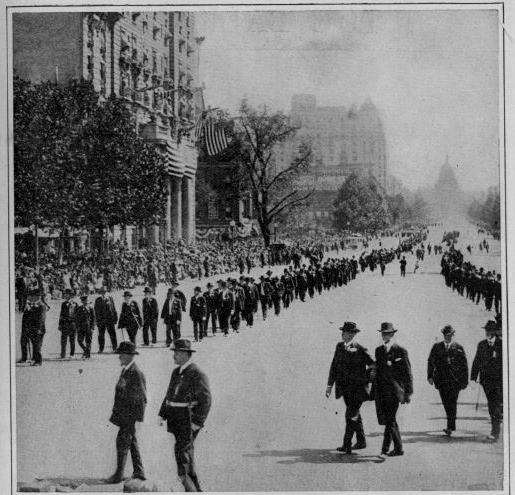
Fifty Years Later: The Grand Army of the Republic on Parade

Twenty thousand members of the Grand Army of the Republic, an organization of Union Army veterans formed after the Civil War, marched down Pennsylvania Avenue on September 29.  The president reviewed them as they passed the White House.  The parade commemorated the Grand Review of the Union Armies held fifty years ago at the end of the Civil War.


September 1915 – Selected Sources and Recommended Reading

Contemporary Periodicals:
American Review of Reviews, October and November 1915
New York Times, September 1915

Books and Articles:
A. Scott Berg, Wilson
Howard Blum, Dark Invasion 1915: Germany's Secret War and the Hunt for the First Terrorist Cell in America
Britain at War Magazine, The Second Year of the Great War: 1915
Winston S. Churchill, The World Crisis 1911-1918
John Milton Cooper, Jr., Woodrow Wilson: A Biography
John Milton Cooper, Jr., The Warrior and the Priest: Woodrow Wilson and Theodore Roosevelt
Patrick Devlin, Too Proud to Fight: Woodrow Wilson's Neutrality
David Fromkin, A Peace to End All Peace: Creating the Modern Middle East, 1914-1922
Martin Gilbert, The First World War: A Complete History
Martin Gilbert, A History of the Twentieth Century, Volume One: 1900-1933
Martin Gilbert, Winston S. Churchill Volume III: The Challenge of War, 1914-1916
Richard F. Hamilton and Holger H. Herwig, Decisions for War, 1914-1917
Peter Hart, Gallipoli
August Heckscher, Woodrow Wilson: A Biography
Godfrey Hodgson, Woodrow Wilson's Right Hand: The Life of Colonel Edward M. House
Michael Kazin, A Godly Hero: The Life of William Jennings Bryan
John Keegan, The First World War
Louis W. Koenig, Bryan: A Political Biography of William Jennings Bryan
Nicholas A. Lambert, Planning Armageddon: British Economic Warfare and the First World War
Arthur S. Link, Wilson: The Struggle for Neutrality, 1914-1915
Arthur S. Link, Woodrow Wilson and the Progressive Era, 1910-1917
Robert K. Massie, Castles of Steel: Britain, Germany, and the Winning of the Great War at Sea
G.J. Meyer, A World Undone: The Story of the Great War, 1914 to 1918
J. Lee Thompson, Never Call Retreat: Theodore Roosevelt and the Great War
Barbara W. Tuchman, The Zimmermann Telegram   
Geoffrey C. Ward and Ken Burns, The Roosevelts: An Intimate History
The West Point Atlas of War: World War I

Monday, August 31, 2015

August 1915

It's August 1915.  As the second year of the World War begins, Allied forces at Gallipoli make a final major effort to secure the heights.  Once again, the attempt is unsuccessful.  Italy joins the war against Turkey.  With the Lusitania crisis still unresolved, another British ship carrying American passengers is sunk by a German submarine; American public opinion leaders respond in sharply different but predictable ways.  The carelessness of a German diplomat leads to the revelation of German espionage and sabotage efforts in the United States.  The United States effectively takes over the government of Haiti and joins other Latin American nations in an attempt to bring order out of chaos in Mexico.  A famous French aviator is a war casualty.  Britain declares cotton absolute contraband and seeks to deal with a financial crisis caused by the Allies' massive war expenditures.  General Pershing, who will soon lead American troops into Mexico and then to France, suffers a crushing family tragedy.  Leo Frank, the Jewish factory manager whose death sentence for murder has been commuted to life imprisonment by the outgoing governor, is lynched in Georgia.

*****


British Troops Ashore at Suvla Bay

August was a month of high hopes and keen disappointment for the Allied effort at Gallipoli.  On August 6, after receiving reinforcements consisting largely of newly recruited "Kitchener" battalions, General Sir Ian Hamilton mounted a three-pronged offensive in a major attempt to drive the Turks from the peninsula and establish control of the Dardanelles.  Simultaneous attacks began that day at Cape Helles, Anzac Cove and Suvla Bay. The principal effort was made at Anzac Cove, with the intent of seizing and holding Sari Bair Ridge overlooking the Straits.  The Cape Helles operation was designed to draw Turkish forces to the south and hold them in place, while a landing at Suvla Bay to the north would unhinge the Turkish position on the heights around Anzac.  The Helles operation succeeded in diverting Turkish forces to the south, and Australian forces attacking from Anzac Cove succeeded in driving the Turks from Lone Pine Ridge on the right flank of the attack.  The attack was unsuccessful in its main objective, however, as the Australians, after a difficult night march through unfamiliar terrain, failed to break through at Sari Bair.  The most promising Allied success was at Suvla Bay, where British forces under Lieutenant General Sir Frederick Stopford landed and established a beachhead against light opposition.  Rather than seize the heights, however, General Stopford spent two days unloading supplies and consolidating his position on the beach.  This allowed the Turks to reinforce their position and to turn back the British attempt to advance to the high ground, which finally took place on August 9.  Assaults on Scimitar Hill and Hill 60 designed to link the Allied forces at Suvla Bay and Anzac cove were turned back on August 21.  Elsewhere in the Gallipoli operation, a torpedo bomber from the seaplane carrier HMS Ben-my-Chee took off from the Aegean Sea near the island of Xeros on August 12 and flew across the neck of the peninsula to the Sea of Marmora where it sank a Turkish supply ship in the first successful aerial torpedo attack in history.  On August 13, the military transport HMT Royal Edward, en route to Gallipoli with Canadian troops, was torpedoed by a German submarine and sank with heavy loss of life. 

Another enemy entered the war against the Ottoman Empire on August 21 when Italy declared war, citing Turkey's support for a Libyan revolt against Italian rule and its interference with "the free departure of Italian subjects from Asia Minor."


S.S. Arabic

The United States' latest note to Germany regarding submarine attacks on passenger vessels, sent only last month, included a stern warning to Germany that any further attacks of that kind that affected American citizens would be regarded as "deliberately unfriendly" acts.  Less than a month later, an attack took place that seems to fit that description.  On August 19 the passenger liner S.S. Arabic, sailing from Liverpool to New York, was torpedoed without warning in the Irish Sea and sank in minutes, near the spot where the Lusitania suffered the same fate in May.  Forty-four passengers, including two Americans, lost their lives.  Unlike the Lusitania, which was a passenger vessel that also carried cargo (including munitions), the Arabic was a cargo ship that was primarily engaged in transporting munitions and other war supplies from the United States to Great Britain, and only incidentally carried passengers.  The loss of American lives, however, has brought new urgency to the unresolved crisis caused by the sinking of the Lusitania, and Secretary of State Lansing has pressed his demand for assurances from Germany regarding the safety of American passengers.  At month's end discussions were continuing and administration officials are said to be hopeful that some acceptable pledge will be forthcoming.


Cardinal Gibbons

The reaction of the American public to the Arabic sinking and the continuing crisis in relations with Germany has followed familiar lines, with advocacy from opposing points of view by former Secretary of State William Jennings Bryan and former President Theodore Roosevelt.  In an article in the August 15 issue of The Commoner, Bryan repeated his call for Americans to be warned not to travel on British ships, saying the nation should not try to avenge the loss of a hundred Americans in ship sinkings by going to war and losing "a million more killed before we get out of it."  The Archbishop of Baltimore, Cardinal James Gibbons, considered by many the leading voice of the Roman Catholic Church in America, agreed, saying in an interview on August 24 that "it seems a terrible cost to sacrifice thousands of young men, the life and sinew of the nation, just because a few insist on taking . . . the dare of traveling by ships that are in danger."


 Plattsburg Military Training Camp

Roosevelt took a sharply contrasting view on August 25 at the Plattsburg Military Training Camp, on the shore of Lake Champlain in upstate New York.  Operated by the Army, Plattsburg is staffed by Army officers and run by Major General Leonard Wood, the commander of the Army's Eastern Department, who commanded Roosevelt's regiment, the "Rough Riders," at the Battle of San Juan Hill.  The Army offers military training at the camp to civilians who wish to undertake it at their own expense.  Among those going through the Plattsburg regimen this year are New York City Mayor John Purroy Mitchel and three of Roosevelt's sons.  In his speech that evening on the drill plain, Roosevelt lashed out at "poltroons" and "hyphenated Americans" who "are seeking to Chinafy this country."  He denounced "the professional pacifists, the peace-at-any-price men, who have tried to teach our people that silly all-inclusive arbitration treaties and the utterance of fatuous platitudes at peace conferences are substitutes for adequate military preparedness."  He did not specifically mention the president in his speech, but later he dictated a statement for the press in which he said that he believes we "must stand by the president," but only "so long as the president stands by the country."  Without mentioning President Wilson by name, he asserted that "to treat elocution as a substitute for action, to rely on high sounding words unbacked by deeds, is proof of a mind that dwells only in the realm of shadow and of sham."


Lindley Garrison

The next day, Secretary of War Lindley Garrison reprimanded General Wood for giving Roosevelt the opportunity to make a political speech.  Roosevelt came to Wood's defense, calling Garrison's reprimand "peculiarly mean and unfair."  Garrison refused to take Roosevelt's objection seriously, dismissing it in a jocular statement the humor of which the former president failed to see, characterizing it as "buffoonery."  Garrison replied, saying his pleas for preparedness have been "as strong as words would make them" without also borrowing Roosevelt's idea that "our present state of unpreparedness makes it desirable to engage in war with four or five other nations."  Roosevelt fired back by repeating his charge that for thirteen months the United States has "failed in any way to prepare," and that as for going to war, he "never said anything of the kind."  He reminded Garrison that in the seven and a half years he was president "not one shot was fired by any American soldier or sailor against any foreign foe, and not an American soldier or sailor was killed by any foreign foe."  He contrasted this with the record of the Wilson administration, which since it has been in office "has waged two small wars, one with Mexico and one with Haiti," in one of which "our ships and marines bombarded and took Veracruz for the purpose of having our flag saluted" and "lost a score of American lives and caused the loss of scores of Mexican lives, and then came away without getting the salute."  Almost forgotten in this exchange was what started it: Garrison's reprimand of General Wood.  It has long been expected that, if the United States were ever to enter the war in Europe, General Wood would be placed in command of any American troops sent to Europe.  Since Plattsburg, that seems less certain.


 Dr. Albert

Doctor Heinrich Albert is the Commercial Attache and Financial Adviser to the German Ambassador to the United States, Count Johann von Bernstorff.  Last month Dr. Albert left his briefcase on the Sixth Avenue Elevated Train in New York City where it was swiftly retrieved by a Secret Service agent who had been following him.  Review of the contents of the briefcase revealed extensive German sabotage and espionage activities in the United States in violation of America's neutrality.  Secretary of the Treasury McAdoo, after consultation with President Wilson, turned the documents over to the New York World, where they were published on three consecutive days beginning August 15.


Haiti's New President

Even as relations with Germany deteriorate on the issue of submarine warfare, the Western Hemisphere remains a major source of concern for the United States.  After ordering the occupation of Haiti last month following the overthrow and murder of President Guillaume Sam, the Wilson Administration installed a pro-American senator, Philippe Sudre Dartiguenave, as president on August 12.  The new president then signed a treaty giving the United States control over Haitian finances and the right to intervene militarily whenever it deems it necessary.  A domestic police force has been established under the control of the United States Marines.

In Mexico, control of the capital changed hands again on August 7 as Carranza's forces reentered the city.  A conference of the ABC Powers (Argentina, Brazil and Chile) was held in Washington, D.C. on August 5 and 6 to address the Mexico problem.  Carranza, now holding the upper hand, responded on August 11 with a note objecting to outside interference.  President Wilson returned from his vacation home in New Hampshire on August 12 to address the issue personally.  On August 14, the United States, the ABC Powers and other Latin American countries proposed a conference of the competing factions.


Russian Artillery Captured at Novo Georgievsk

The German offensive in Poland continued this month with a series of military successes.  The German Army occupied Warsaw on August 6.  On August 20, after a ten-day siege, the fortress of Novo Georgievsk surrendered, and Brest-Litovsk was captured on August 25.  On the Western Front, an attack by British forces recovered the ground lost in and around the crater at Hooge that was created by last month's enormous underground explosion.  The crater has changed hands twice since the explosion: British troops occupied it immediately afterward, German troops retook it using flame throwers, and it is now back in British hands.


 Pegoud Receiving the Croix de Guerre

The French aviator Alphonse Pegoud, who became famous for flying upside down and looping-the-loop in 1913, was shot down and killed on August 31 while flying a reconnaissance mission.  He had a distinguished record in the war, receiving the Croix de Guerre and being mentioned in dispatches several times for valor.  His most remarkable exploit came on August 20, when he fought an aerial duel in which he was forced down behind enemy lines.  Pegoud pretended to be dead as the German pilot landed and approached his wrecked aeroplane, then shot him and made his escape in the German's machine.


A Cotton Boat on the Mississippi

The economic war escalated this month as the British government on August 21 declared cotton, a major export product of the United States and an essential ingredient of many explosives and propellants used by the military, to be absolute contraband.  Two days later, the British Embassy in Washington issued a statement assuring American shippers that cotton shipments to neutral countries would not be interfered with as long as they did not exceed those countries' normal consumption.  If the United States objects, the British will likely point out that the their position regarding shipments to neutral countries is no different from that of the United States regarding British shipments to the Bahamas and other neutral destinations during the American Civil War.


Lord Reading

Massive British purchases of war supplies in the United States have led to a rapid fall in the value of the British pound sterling against the American dollar.  England's Lord Chief Justice Rufus Isaacs, Baron Reading, arrived in New York on August 13 for discussions with American bankers to establish credits of between five hundred million and one billion dollars for additional purchases.  As a first step in stabilizing the currency exchange, gold and securities valued at approximately $100,000,000, sent by the Bank of England to J.P. Morgan & Co., arrived in New York by rail from Halifax, Nova Scotia on August 12 and 29.  They were carried across the Atlantic by a British battle cruiser escorted by a flotilla of torpedo boat destroyers under the command of Vice Admiral David Beatty, the victor of last year's naval battle in the Heligoland Bight.


Pershing's House After the Fire (the Arrow Indicates the Location of Warren's Room)

Brigadier General John J. Pershing commands the Eighth Brigade of the United States Army, with headquarters at the Presidio in San Francisco.  Last year, in response to increasing concerns about events in Mexico, the brigade was deployed to Fort Bliss, on the Mexican border.  General Pershing accompanied his troops but left his family at the Presidio.  There, in the early morning hours of August 27, a fire broke out in the family home.  Pershing's wife and three daughters died in the blaze; only his six-year-old son Warren survived.


Cobb County Justice

On June 21, the day before his scheduled execution, Leo Frank's death sentence for the murder of Mary Phagan was commuted to life imprisonment by Georgia Governor John Slaton.  Protest demonstrations followed, but seemed to subside after a few days, notwithstanding an attempt on Frank's life by a fellow inmate last month (see the June and July installments of this blog).  Fears of mob justice were confirmed, however, on August 17.  In a raid executed with military precision, a band of twenty-five armed and masked men cut the telephone and telegraph wires to the Milledgeville state prison farm where Frank was being held, overpowered the warden and guards, and sped with Frank over 100 miles of country road to a wooded grove near the Phagan home in Cobb County, where they lynched Frank by hanging him from a tree.  Before the large crowd assembled at the site could carry out its threat to set the body afire, it was cut down and transported to Atlanta where it was hastily embalmed and put on a train to New York for burial, accompanied by Mrs. Frank and local friends and family.  Although the new governor has denounced the lynching and promised a full investigation, no suspects have been identified or arrests made, and it is considered unlikely that any prosecution in Cobb County would be successful.


August 1915 – Selected Sources and Recommended Reading

Contemporary Periodicals:
American Review of Reviews, September and October 1915
New York Times, August 1915
New York World, August 1915

Books and Articles:
A. Scott Berg, Wilson
Howard Blum, Dark Invasion 1915: Germany's Secret War and the Hunt for the First Terrorist Cell in America
Britain at War Magazine, The Second Year of the Great War: 1915
Winston S. Churchill, My Early Life
Winston S. Churchill, The World Crisis 1911-1918
John Milton Cooper, Jr., Woodrow Wilson: A Biography
John Milton Cooper, Jr., The Warrior and the Priest: Woodrow Wilson and Theodore Roosevelt
Patrick Devlin, Too Proud to Fight: Woodrow Wilson's Neutrality
David Fromkin, A Peace to End All Peace: Creating the Modern Middle East, 1914-1922
Martin Gilbert, The First World War: A Complete History
Martin Gilbert, A History of the Twentieth Century, Volume One: 1900-1933
Martin Gilbert, Winston S. Churchill Volume III: The Challenge of War, 1914-1916
Richard F. Hamilton and Holger H. Herwig, Decisions for War, 1914-1917
Peter Hart, Gallipoli
August Heckscher, Woodrow Wilson: A Biography
Godfrey Hodgson, Woodrow Wilson's Right Hand: The Life of Colonel Edward M. House
Michael Kazin, A Godly Hero: The Life of William Jennings Bryan
John Keegan, The First World War
Louis W. Koenig, Bryan: A Political Biography of William Jennings Bryan
Nicholas A. Lambert, Planning Armageddon: British Economic Warfare and the First World War
Arthur S. Link, Wilson: The Struggle for Neutrality, 1914-1915
Arthur S. Link, Woodrow Wilson and the Progressive Era, 1910-1917
Robert K. Massie, Castles of Steel: Britain, Germany, and the Winning of the Great War at Sea

G.J. Meyer, A World Undone: The Story of the Great War, 1914 to 1918
J. Lee Thompson, Never Call Retreat: Theodore Roosevelt and the Great War
Barbara W. Tuchman, The Zimmermann Telegram  
United States Department of State, Office of the Historian, U.S. Invasion and Occupation of Haiti, 1915-34
Geoffrey C. Ward and Ken Burns, The Roosevelts
The West Point Atlas of War: World War I
Ernest Wittenberg, The Thrifty Spy on the Sixth Avenue El, American Heritage, December 1965


Friday, July 31, 2015

July 1915

In July 1915 the first year of the Great War comes to an end, but the end of the war itself is nowhere in sight.  A German-American plants a bomb in the U.S. Capitol and tries to assassinate a leading American banker; he appears not to have acted alone.  Germany and the United States continue their war of words over submarine attacks on civilian ships.  The Wilson administration tries to steer a course between pacifists and preparedness advocates, leaving neither satisfied.  In the war it's mostly a bad month for the Allies, as Russia abandons Warsaw, Italy suffers major losses for little gain against Austria-Hungary, and the month ends much as it began on the Western Front and in Gallipoli.  Some Allied successes, however, can be found in Africa and Mesopotamia.  In the United States, murder is in the news as New York executes a police lieutenant and an inmate spared the death penalty in Georgia is almost killed by a fellow prisoner.  An excursion steamer capsizes in the Chicago River, killing hundreds.

*****


Bomb Damage in the Capitol

Shortly before midnight on July 2, a bomb exploded in an alcove outside the vice-president's office on the Senate side of the U.S. Capitol.  No one was injured.  The next day, a man forced his way into the mansion of J.P. Morgan, Jr. in Glen Cove, Long Island, and shot Morgan twice before being subdued by Morgan, his butler, and other servants who responded to calls for help.  After his arrest the assailant was identified as Frank Holt, a former instructor of German at Cornell University.  Holt turned out to be the man who had planted the bomb in the Capitol the day before.  Subsequent investigation revealed that he was also the man who had taught at Harvard under the name of Erich Muenter until 1906, when he disappeared after his first wife's suspicious death by arsenic poisoning.  On July 6, Holt/Muenter killed himself in the Mineola jail by climbing to the top of his cell door and plunging head first to the floor some twenty feet below.


Erich Muenter After His Arrest

The perpetrator of the Capitol bombing and the attack on Morgan was a German-American who, in addition to being wanted for many years for his wife's murder, was nursing an intense anger against the United States for its financial support of the Allies in the war.  Using a variety of aliases, he had bought the guns and ammunition he used in the attack on Morgan, the dynamite he used in the Capitol bombing, and a large quantity of additional explosives.  Failure to locate or account for all of the explosives, together with a letter he wrote to his wife in Dallas after his arrest, led authorities to believe that he had put dynamite on a ship  being loaded with war supplies in New York for delivery to the Allies in Europe.  The letter, combined with statements made by Muenter during his interrogation, indicated that the dynamite was set to explode on July 7.  Initial concern was focused on two ships, the Cunard liner Saxonia and the American Line steamship Philadelphia.  Warning messages were sent by wireless to both ships in mid-ocean but a thorough search revealed nothing.  When July 7 arrived, however, the fear of sabotage was confirmed when an explosion aboard another ship, the Atlantic Transport liner Minnehaha, started a fire that threatened its cargo of 1,000 cases of cordite and hundreds of cases of loaded shells, cartridges and high explosives.  The liner was immediately diverted to Halifax, its crew battling the blaze for two days and two nights before reaching port safely on July 9.  Investigators believe it is unlikely under the circumstances that Muenter acted alone.  They are pursuing their investigation in the hope of uncovering what increasingly appears to be an organized terrorist plot.


German Foreign Minister Gottlieb von Jagow

The exchange of diplomatic notes in the wake of the sinking of the Lusitania continued this month.  On July 8, replying to the second American note, Germany argued that submarine attacks on British liners are justified in light of the British policy of intercepting shipments of all goods bound for Germany.  In an attempt to address the American complaints, it said that German submarines would be instructed to give safe passage to American passenger steamers "when made recognizable by special markings and notified a reasonable time in advance," relying on the American government to "guarantee that these vessels have no contraband on board."  It offered to extend the same protection to "a reasonable number of neutral steamers under the American flag" and to "four enemy passenger steamers for passenger traffic between North America and England" as long as they are carrying American passengers and flying the American flag.

On July 21, the United States told Germany that it found its response "very unsatisfactory."  It rejected the claim that the sinking of the Lusitania was a legitimate act of retaliation, saying that because retaliation by definition is invoked to justify acts that are otherwise illegal, it cannot be used to justify acts that injure the lives of neutrals.  Rejecting the German offer of limited safe passage, it said that any such agreement "would, by implication, subject other vessels to illegal attack and would be a curtailment and therefore an abandonment of the principles for which this Government contends and which in times of calmer counsels all nations would concede as of course."  It stopped short of demanding that Germany cease all submarine attacks on civilian vessels, suggesting that compliance with "cruiser rules" would be sufficient, but it used unusually strong language in demanding that the German Government "disavow[ ] the wanton act of its naval commander in sinking the Lusitania," and warning that any future attacks on passenger liners that affect American citizens would be regarded as "deliberately unfriendly" acts.  The next day, Secretary Lansing told the German ambassador that he would not continue writing notes and insisted on receiving explicit assurances.


Harvard President Lowell

Last month at Independence Hall in Philadelphia, a new organization was formed with the avowed intention of linking the nations of the earth together in an organization to ensure universal peace.  The League to Enforce Peace was formed in the midst of a war that has expanded from a Balkan crisis to a global conflict in less than a year, despite the safeguards established by the Hague Tribunals of 1899 and 1907.  The League began with a series of meetings at the Century Club in New York, and is led by over 100 of America's leading citizens, including former president William Howard Taft and Harvard University President A. Lawrence Lowell.  At Independence Hall the League adopted a resolution proposing the abolition of warfare through the enforcement of peace by the armed forces of the signatory nations.  The resolution advocates the establishment of "a working union of sovereign nations to establish peace among themselves and to guarantee it by all known and available sanctions at their command."  It proposes that the United States join a "league of nations" in which disputes arising between member nations "shall be submitted to a Council of Conciliation for hearing, consideration and recommendation," and that "the signatory powers shall jointly use forthwith both their economic and military forces against any one of their number that goes to war, or commits acts of hostility, against another of the signatories."  The proposal was adopted despite opposition from some who oppose the use of "militarism to fight militarism," an objection also voiced by former Secretary of State William Jennings Bryan.  Former President Theodore Roosevelt opposes it on other grounds, arguing that  by submitting disputes to a supranational tribunal it would compromise American sovereignty.

The pacifist sentiments of many Americans were captured in a song that has seen increasing popularity this year.  "I Didn't Raise My Boy To Be a Soldier" is sung here by the Peerless Quartet (click to play):


*****


Roosevelt Visiting the Pan Pacific Exposition

Former President Roosevelt departed New York for the west coast on July 11, holding informal conferences with political leaders as he traveled through the Midwest and Rocky Mountain states.  He arrived in Portland, Oregon on July 19, and continued to San Francisco, where he was greeted by warships in the harbor with a 21-gun salute.  On July 21 he toured the Pan Pacific Exposition, which declared the day "Theodore Roosevelt Day."  He delivered two speeches, one to a group of soldiers, sailors and marines at the Enlisted Men's Club, and another to an enthusiastic crowd of 60,000 at the Court of the Universe.  In a blunt allusion to the popular song, he told the enlisted men that "a mother who is not willing to raise her boy to be a soldier is not fit for citizenship."  At the larger gathering, where he was introduced by Governor Hiram Johnson, his 1912 running mate, he told the onlookers that he took pride in the Exposition and in the Panama Canal it celebrated.  He said "it was my good fortune to take the action in 1903, failure to take which, in exactly the shape I took it, would have meant that no Panama Canal would have been built for half a century."  Referring to the ongoing dispute with Colombia, he asserted that "in everything we did in connection with the acquiring of the Panama Zone we acted in a way to do absolute justice to all other nations, to benefit all other nations, including especially the adjacent states," and that "if there were the slightest taint upon our title or our conduct it would have been an improper and shameful thing to hold this exposition."  He said the building of the Panama Canal "nearly doubles the potential efficiency of the United States Navy, as long as [the Canal] is fortified and is in our hands, but if left unfortified it would at once become a menace to us."  Repeating his criticism of the Wilson administration on the issue of preparedness, he charged that regarding "pretty much everything not connected with the Isthmus of Panama, . . . we have been culpably, well-nigh criminally, remiss as a nation in not preparing ourselves, and if, with the lessons taught the world by the dreadful tragedies of the last twelve months, we continue with soft complacency to stand helpless and naked before the world, we shall excite only contempt and derision if and when disaster eventually overwhelms us."


The Crater at Hooge

On the Western Front, the Ypres salient continues to be the scene of bitter fighting but little advance.  British sappers dug a tunnel under the German position at Hooge, on the eastern edge of the salient, and on July 19, without any preliminary bombardment or other warning, the mine was exploded, creating a crater and a gap in the German line 120 feet wide and 20 feet deep.  British troops attacked and succeeded in occupying the crater, but on July 30 the Germans mounted a counterattack using a new weapon, the flammenwerfer, or flamethrower, which propelled flaming liquid up to sixty-five feet.  The British were driven from the crater and the German line was reestablished.

The news is no better for the Allies elsewhere in Europe.  On the Eastern Front, the Russians evacuated Warsaw on July 25 in anticipation of a German offensive.  On the new front between Italy and Austria, several Italian attacks in the Dolomites have been turned back, while repeated attacks by Italy along the Isonzo River have resulted in heavy Italian casualties but only minor gains.  Two Italian cruisers have been lost to Austrian submarines in the Adriatic.


SMS Konigsberg

General Louis Botha

Allied military operations in Africa and the Ottoman Empire illustrate the worldwide scope the war has assumed in recent months.  The German light cruiser SMS Konigsberg, stationed off the east coast of Africa, began raiding Allied shipping in the Indian Ocean when the war began.  Pursued by superior Royal Navy forces, Konigsberg retreated into the Rufiji River delta, where she remained until July 11 when her captain, his ship under intense shelling by British cruisers, sent her crew ashore and ordered the ship scuttled.  On the other side of the continent, German forces in Southwest Africa surrendered to British forces led by General Louis Botha on July 9.  Botha is also Prime Minister of the Union of South Africa, an office he has held since South Africa achieved dominion status within the British Empire in 1910.

In Mesopotamia, the British advance toward Baghdad continued as a combined Anglo-Indian force attacked the Turkish garrison at Nasiriyah on the Euphrates River.  On July 24, the Turks abandoned Nasiriyah and withdrew upriver to Kut.  On the other side of the Ottoman Empire, the fighting In Gallipoli increasingly resembles the stalemate on the Western Front as British and French attacks at Cape Helles on July 13 have resulted in only minor gains.


Admiral Caperton

As the World War raged elsewhere, the United States was occupied with turmoil in its back yard.  On July 10, Mexico City fell for the third time to the Constitutionalist forces of Emiliano Carranza as General Gonzales, a Carranza ally, entered Mexico City.  Gonzales was forced to withdraw on July 18 when the Villa/Zapata forces cut off the railroad linking Mexico City and Veracruz.  Villa controls the city at month's end, but the railroad remains closed and the city is threatened with starvation.  Elsewhere in the Americas, a revolution in Haiti resulted in the overthrow and assassination of President Guillaume Sam on July 28, immediately following the government's execution of over 160 political prisoners.  President Wilson ordered the United States Navy to intervene, and Navy and Marine forces under the command of Rear Admiral William B. Caperton occupied Port-Au-Prince the next day.


The Prison Ward Where Leo Frank Was Attacked

Last month Governor Slaton of Georgia, in one of his last acts as governor, commuted the death sentence of Leo Frank, the Jewish superintendent of an Atlanta pencil factory, following his conviction for murder in the death of a young female employee, on weak evidence and in an atmosphere of intense antisemitism.  For several days after the governor's action, mobs filled the streets demanding that Frank, or Slaton, or both, be lynched.  Eventually the protests subsided, but on July 18 a fellow prisoner attacked Frank and cut his throat with a butcher knife while he was sleeping in a prison ward at the Georgia State Farm at Milledgeville.  Frank survived the attack, even though his jugular vein was partially severed.


Becker's Lawyers Martin Manton and Bourke Cockran (second and third from left)

In another high-profile murder case, New York City Police Lieutenant Charles Becker, under sentence of death for the 1912 murder of informer Herman Rosenthal, appealed for clemency on July 20.  Becker was represented by two of New York's most prominent lawyers, Martin Manton and his partner, former Congressman Bourke Cockran.  (Cockran is a close friend of Lady Randolph Churchill and an early mentor of her son Winston, who later became Great Britain's First Lord of the Admiralty.  Cockran, a renowned orator, gained prominence in the 1890's as a leader of the "Gold Democrats" who opposed William Jennings Bryan's "Free Silver" platform.)  To no one's surprise, Governor Whitman, who prosecuted the case against Becker as district attorney and rode his success in that case to the governorship, denied Becker's appeal.  Cockran then made a last-minute application to the New York Supreme Court for a new trial, in which he accused Whitman of suppressing evidence at trial.  The court denied Cockran's motion on July 28, and on July 30 Becker, still proclaiming his innocence, died in the electric chair.
 

The Eastland After Sinking

On July 24, in the worst maritime disaster in the history of the Great Lakes, the excursion steamer S.S. Eastland sank at its pier in the Chicago River, drowning over 800 passengers and crew.  It had just completed taking on passengers for an excursion to Michigan City, Indiana, for the Western Electric Company's annual picnic.  The Eastland was the first of several ships to be loaded for the cruise.  Long known to be top-heavy, it rolled to its side when hundreds of passengers ran to the port side to observe the other ships that were arriving to take on passengers.  President Wilson has ordered the Department of Commerce to conduct a thorough investigation into the cause of the tragedy.


July 1915 – Selected Sources and Recommended Reading

Contemporary Periodicals:
American Review of Reviews, August and September 1915
New York Times, July 1915

Books and Articles:
A. Scott Berg, Wilson
Howard Blum, Dark Invasion 1915: Germany's Secret War and the Hunt for the First Terrorist Cell in America
Britain at War Magazine, The Second Year of the Great War: 1915
Winston S. Churchill, My Early Life
Winston S. Churchill, The World Crisis 1911-1918
John Milton Cooper, Jr., Woodrow Wilson: A Biography
John Milton Cooper, Jr., The Warrior and the Priest: Woodrow Wilson and Theodore Roosevelt
Patrick Devlin, Too Proud to Fight: Woodrow Wilson's Neutrality
David Fromkin, A Peace to End All Peace: Creating the Modern Middle East, 1914-1922
Martin Gilbert, The First World War: A Complete History
Martin Gilbert, A History of the Twentieth Century, Volume One: 1900-1933
Martin Gilbert, Winston S. Churchill Volume III: The Challenge of War, 1914-1916
Richard F. Hamilton and Holger H. Herwig, Decisions for War, 1914-1917
Peter Hart, Gallipoli
August Heckscher, Woodrow Wilson: A Biography
Godfrey Hodgson, Woodrow Wilson's Right Hand: The Life of Colonel Edward M. House
John Keegan, The First World War
Nicholas A. Lambert, Planning Armageddon: British Economic Warfare and the First World War
Arthur S. Link, Wilson: The Struggle for Neutrality, 1914-1915
Arthur S. Link, Woodrow Wilson and the Progressive Era, 1910-1917
Robert K. Massie, Castles of Steel: Britain, Germany, and the Winning of the Great War at Sea
Michael McMenamin and Curt Zoller, Becoming Winston Churchill: The Untold Story of Young Winston and His American Mentor
G.J. Meyer, A World Undone: The Story of the Great War, 1914 to 1918
J. Lee Thompson, Never Call Retreat: Theodore Roosevelt and the Great War
Barbara W. Tuchman, The Zimmermann Telegram  
Geoffrey C. Ward and Ken Burns, The Roosevelts
The West Point Atlas of War: World War I

Tuesday, June 30, 2015

June 1915

In June 1915, as the world observes the 100th anniversary of the Battle of Waterloo and the 700th anniversary of the Magna Carta, it confronts a war of unprecedented destruction and geographic scope.  German submarine warfare threatens a rupture in relations with the United States.  A second note pressing the American case brings about the resignation of Secretary of State William Jennings Bryan.  His successor, Robert Lansing, is the son-in-law of a former secretary of state and the uncle of a future one, John Foster Dulles.  Freed from the constraints of office, Bryan addresses a peace rally in Madison Square Garden.  President Wilson's friend and adviser Colonel House returns from an extended trip to Europe, and in his report to the president predicts war with Germany.  Another British attack fails in Gallipoli.  Great Britain is feeling the financial and personal pain of waging war; she gains, then loses, one of her first war heroes.  The U.S.S. Arizona is launched in Brooklyn.  "The Class the Stars Fell On" graduates from West Point; its members will lead the American Army in another world war.  President Wilson honors the American flag, and is honored at a reunion of Confederate veterans.  Two notorious murder cases, one in Georgia and one in New York, move closer to final resolution. The governor of Georgia commutes Leo Frank's death sentence, but cannot protect either himself or Frank from angry mobs.  In New York, only the governor now stands between Charles Becker and the electric chair, and he is convinced of Becker's guilt.  Becker's lawyer, Martin Manton, faces a roller-coaster future: he will become a federal judge, be on the short list for the Supreme Court, serve as Chief Judge of the Second Circuit Court of Appeals, and wind up in jail for taking bribes.


*****


An Editorial Comment on the Lusitania Notes

Last month the United States and Germany exchanged diplomatic notes following the attack on the Lusitania that cost the lives of 1,198 passengers and crew, including 128 Americans (see last month's installment of this blog).  On June 9, the United States sent a second note to Germany.  Like the first one, it was drafted principally by President Wilson himself.  It responds to several assertions made by Germany in its reply to the first note "with regard to the character and outfit of [the Lusitania]," telling the German government that "these are matters concerning which the Government of the United States is in a position to give the Imperial German Government official information."  It acknowledges that it was the duty of the United States, as a neutral power, "to see to it that the Lusitania was not armed for offensive action, that she was not serving as a transport, that she did not carry a cargo prohibited by the statutes of the United States, and that, if in fact she was a naval vessel of Great Britain, she should not receive clearance as a merchantman."  The note assures Germany that the United States "performed that duty and enforced its statutes with scrupulous vigilance through its regularly constituted officials" and "is able, therefore, to assure the Imperial German Government that it has been misinformed."  It asks the German Government, if it has "convincing evidence that the officials of the Government of the United States did not perform these duties with thoroughness," to "submit that evidence for consideration."  Referring to the contention that the Lusitania was carrying contraband munitions and that the torpedo caused those munitions to explode, the note says that those contentions are "irrelevant to the question of the legality of the methods used by the German naval authorities in sinking the vessel."  It asserts that "the sinking of passenger ships involves principles of humanity which throw into the background any special circumstances of detail that may be thought to affect the cases," and that, whatever other facts there might be, "the principal fact is that a great steamer, primarily and chiefly a conveyance for passengers, and carrying more than a thousand souls who had no part or lot in the conduct of the war, was torpedoed and sunk without so much as a challenge or a warning, and that men, women, and children were sent to their death in circumstances unparalleled in modern warfare."  The United States therefore "very earnestly and very solemnly renews the representations of [the first] note" and asks for assurances that the German Government will "adopt the measures necessary" for "the safeguarding of American lives and American ships."


The New Secretary of State

Although the second Lusitania note added little of substance to the earlier one, it had the important result of bringing about the resignation of the Secretary of State, William Jennings Bryan.  He was known to have been unhappy with the position taken in the first note, preferring a warning to Americans not to travel on belligerent ships combined with a protest to Great Britain for its blockade policy.  When the second note restated and reenforced the position of the first, Bryan decided that he could no longer be identified with the government's position.  A broader and more important factor may have been his conviction that he had never been President Wilson's principal or most trusted adviser on foreign policy.  When Bryan met with the president on Monday, June 7, and told him of his intention to resign, among the reasons he gave was that "Colonel House has been your Secretary of State, not I, and I have never had your full confidence."  Bryan's letter of resignation was submitted the next day.  The president, in his reply, accepted it "with much more than deep regret -- with a feeling of personal sorrow,"  and said "We shall continue to work for the same causes even when we do not work in the same way."  The note to Germany, signed by State Department Counselor Robert Lansing as Acting Secretary, was delivered on June 9.  On June 23 the president appointed Lansing Secretary of State; the Senate confirmed his appointment the next day.  Lansing's father-in-law is John Foster, who was Secretary of State under President Benjamin Harrison.


Colonel House with President Wilson

After sending Lansing's name to the Senate, President Wilson left for a vacation in Cornish, New Hampshire, where he is staying again at novelist Winston Churchill's Harlakenden House.  On his way north, he stopped in New York to confer with Colonel House, who returned to the United States June 13 after four months in Europe.  In a report sent three days after his return, House told the president "I think we shall find ourselves drifting into war with Germany."  The two men met on June 24 at the Colonel's home at Roslyn, Long Island, where they discussed House's report and the details of his meetings with high-level officials of the British, French and German governments.  House told the president that, because the public in each of the warring countries is insistent that any peace agreement must justify the terrible losses already suffered, there is no possibility that any terms acceptable to one side would be acceptable to the other even as a basis for discussion. 


 Madison Square Garden

That evening in Manhattan, a huge peace rally was held at Madison Square Garden.  William Jennings Bryan, the recently resigned Secretary of State, addressed a capacity crowd that included the Austro-Hungarian and Turkish ambassadors and the German military and naval attaches.  Henry Weismann, president of the New York branch of the German-American Alliance, told the friendly crowd that "the pulse of America does not beat in the gilded halls of Washington.  The president is surrounded by sycophants on the one hand and by skilled, shrewd, paid agents of our enemies on the other."  He welcomed Bryan as "the new leader of the American people that stand for peace."  When Bryan took the podium, he tried to downplay his rift with the president, telling the crowd that he and President Wilson had "found it impossible to share responsibility together.  He could not do otherwise than he did, believing as he did, and I could not do otherwise than I did, believing as I did.  There was no concealment.  We separated as two friends should separate."  He said that "if war comes, we will stand as one man behind the Government, but until Congress declares war each citizen is at liberty to express his opinion as to whether or not there should be war."  He appealed to "the national honor of a peace-loving nation, not the false pride of a bully or a braggart," and concluded by asking "if others desire that our flag be feared, let us prefer that it be loved.  If others would have the world tremble in awe at the sight of it, let us pray that the plain people everywhere may turn their faces toward it and thank God that it is the emblem of justice and the hope of peace."

Outside, thousands more filled Madison Square Park and Madison Avenue from 23rd to 27th Street, listening to speakers who addressed the crowds from six outdoor stages, many speaking in German and all delivering essentially the same message in opposition to American involvement in the World War.


British Troops on the Attack

As if in mockery of the sentiments being expressed in Madison Square, war continued this month around the world.  On June 4 British and French forces on the Gallipoli peninsula mounted another attack in an attempt to secure the commanding heights of Achi Baba overlooking the Dardanelles, the original objective of the landing at Cape Helles.  Once again they fell short, and a Turkish counterattack on June 6 drove the Allies back to their original positions but failed to drive the Allies off the peninsula.  In eastern Europe, the Austro-German offensive in the Carpathians resulted in the capture of Przemysl on June 3 and of Lemberg on June 22.  On the Western Front, French attacks in Artois and on the Meuse-Argonne front resulted in thousands of casualties but no significant gains.  On the new front at the head of the Adriatic, Italian forces attacked Austro-Hungarian positions along the Isonzo River, but were turned back with heavy losses.  Nor has North America been peaceful: while there is no declared war, battles between competing factions in Mexico have been raging for over two years.  On June 2, President Wilson issued a statement to the warring parties warning them to come together and set up a government that other nations can deal with or risk American intervention.


Prime Minister Asquith

Great Britain may be the wealthiest nation in the world, but the strain of global war is beginning to be felt, financially and otherwise.  On June 15, Prime Minister Asquith told Parliament the war is costing Great Britain $13,000,000 a day, and the House of Commons voted an additional $1,250,000,000 in war appropriations, bringing the total so far to $4,310,000,000.  On June 19, the Prime Minister reported that British casualties in the war in Europe and the Mediterranean from the beginning of the war through the end of May have been 50,342 killed, 153,980 wounded, and 53,747 missing.  The Munitions for War Act became law on June 23.  It prohibits strikes in businesses supplying the armed forces and gives the newly created Ministry of Munitions, headed by David Lloyd George, power to regulate wages, hours and working conditions.


Lieutenant Warneford

For the British public, Zeppelin raids on English cities have added a new and frightening dimension to the war.  On June 7 aviator Lt. Reginald A. J. Warneford became a national hero when he attacked and destroyed a Zeppelin near Ghent as it was returning from a failed raid on London.  He is the first, and so far the only, aviator in history to bring down an airship.  Ten days later Warneford lost control of his aeroplane during a demonstration flight near Paris.  He and his passenger, an American journalist, were ejected and killed.


 Arizona Ready for Launch

The new American superdreadnought U.S.S. Arizona (BB-39) was launched at the New York Navy Yard on June 19 before some 75,000 spectators.  Arizona Governor George W. Hunt, New York City Mayor John Purroy Mitchel, Secretary of the Navy Josephus Daniels and Admiral Frank F. Fletcher, Commander in Chief of the Atlantic Fleet, were among the dignitaries in attendance.  In recognition of Arizona's recent vote to become a dry state, a bottle of Arizona water as well as the traditional bottle of champagne was broken over the bow in the christening ceremony.  As she slid down the ways into the East River, she was greeted by whistles from the other warships present in the shipyard, including the battleships U.S.S. Wyoming, New York, Utah, Arkansas, Florida and Texas, and two flotillas of destroyers.  Tugboats took her in tow under the Williamsburg Bridge, and before long had her moored securely alongside her dock, where she will receive her guns, engines and other equipment.  When commissioned, Arizona and her sister ship U.S.S. Pennsylvania (BB-38), launched in March at Newport News, Virginia, will be the largest warships in the world, each displacing over 31,000 tons.


Secretary Garrison, General Scott and Colonel Townsley Reviewing the Corps of Cadets

On June 12 the United States Military Academy at West Point graduated 164 cadets, the largest class in its history.  Secretary of War Lindley Garrison, Army Chief of Staff Major General Hugh Scott and Academy Superintendent Colonel Clarence Townsley reviewed the cadets on parade, after which Secretary Garrison addressed the graduating class.  He told them that they might be called upon at any time to demonstrate their worth, and that upon their conduct "may depend issues of vital moment" to their country.  Each graduate was cheered as he received his diploma.  Judging from the volume and duration of the cheers as observed by the New York Times reporter, the most popular members of the graduating class were the athletic standouts, including Cadets James Van Fleet, Omar Bradley, and Dwight Eisenhower.  After the ceremony, the new second lieutenants went to New York for dinner and a Broadway play.


President Wilson Delivering his Flag Day Address

The Stars and Stripes was adopted as the flag of the United States on June 14, 1777.  In recent years the anniversary of that date has been unofficially observed as Flag Day.  On June 14 this year, President Wilson delivered an address from the south portico of the Treasury Department Building, next door to the White House.  He began by telling the assembled crowd that "for me the flag of the United States does not express a mere body of vague sentiment.  The flag of the United States has not been created by rhetorical sentences in declarations of independence and in bills of rights.  It has been created by the experience of a great people, and nothing is written upon it that has not been written by their life."  He closed by saying that he would like to see them "wear a little flag of the Union every day" but that "if you lose the physical emblem, be sure that you wear it in your heart, and the heart of America shall interpret the heart of the world."


Congressman Heflin (center) with Senators Vardaman (D., Miss.) and James (D., Ky.)

The United Confederate Veterans held their twenty-fifth annual reunion June 1-3 in Richmond, Virginia.  On June 2 they adopted a resolution "as soldiers, who know only too well the horrors of war, and as citizens of a reunited country."  The resolution praised President Wilson as one "who, strictly neutral between warring nations, will, with wisdom and courage, stand for all regard and respect for the honor of the American flag and a proper observance of the full rights of the humblest American citizen."  Congressman J. Thomas Heflin (D., Ala.) also praised the president, telling the veterans they had survived the Civil War "to see a man, born in the Southland, the son of a Confederate soldier, the President of the United States."


Chief Justice White

The Fifteenth Amendment, which became part of the United States Constitution in 1870, forbids states to deny the vote to citizens "on account of race, color, or previous condition of servitude."  As Reconstruction ended and the Democratic Party regained control of the governments in the southern states, many of them adopted literacy and property ownership requirements for voting that were designed to deny the franchise to Negro citizens.  Those requirements passed constitutional muster, but they threatened to disenfranchise poor and illiterate whites as well as blacks, so many states added "grandfather clauses," exempting from the property and literacy requirements anyone who had been eligible to vote, or whose ancestors had been eligible to vote, prior to a given date (typically a date before the abolition of slavery).  On June 21 of this year, the U.S. Supreme Court held such "grandfather clauses" unconstitutional.  The vote was 8-0, with Mr. Justice McReynolds not voting.  The opinion was written by Chief Justice Edward White, a Democrat who grew up on a Louisiana plantation before the Civil War.  Property and literacy requirements for voting, where they exist, now apply to all citizens, but they are administered at the discretion of local officials, leaving much room for discrimination in their actual implementation.


Governor and Mrs. Slaton

On June 21, as his term was drawing to a close, Georgia Governor John Slaton commuted the death sentence of Leo Frank, the Atlanta pencil factory superintendent convicted of the murder two years ago of Mary Phagan, a 13-year-old female factory employee, to life imprisonment.  Frank's trial was conducted in an atmosphere of intense hostility, fueled by antisemitism and marked by unruly mobs outside the courthouse demanding a guilty verdict.  (For further background, see the March 1914 and April 1915 installments of this blog.)  In considering the clemency petition the governor reviewed the evidence and heard arguments of counsel, following which he concluded that there was substantial doubt as to Frank's guilt.  He announced the commutation a day before Frank's scheduled execution, triggering mass protests at the Atlanta City Hall and at the courthouse where Frank had been tried.  Similar demonstrations took place elsewhere in the state.  In Marietta, Mary Phagan's home town, a life-size dummy bearing a sign that read "John M. Slaton, King of the Jews and Georgia's traitor forever" was strung to a telephone pole   In Newnan, not far from Atlanta, effigies of Slaton and Frank were hung to a giant oak tree in a park, then set on fire and dragged through the streets.  A few days later Governor Slaton attended his successor's inauguration, after which an armed escort was necessary to get him safely from the capitol building to his car and out of town.  At month's end, Slaton and his wife were visiting friends in New York prior to a tour of Canada.  He told reporters that "after a careful and long study of the great mass of evidence in the case it would have been simply impossible for me to have taken any other action than the one I did."


Martin Manton (right) at the Becker-Rosenthal Trial

In another high-profile murder case, former New York Police Lieutenant Charles Becker has lost his last appeal and faces the electric chair for ordering the 1912 murder of Herman Rosenthal to prevent him from giving evidence to District Attorney Charles Whitman.  (For further background, see the August and October 1912, March and April 1914, and May 1915 installments of this blog.)  Becker's motion for reconsideration of the Court of Appeals ruling was denied on June 18; his attorney Martin Manton has applied for clemency to Whitman, who is now the governor.  Manton has said he might ask Whitman, because of his prior involvement in the case, to step aside and let the clemency petition be considered by Lieutenant Governor Edward Schoeneck.

*****


June 1915 – Selected Sources and Recommended Reading

Contemporary Periodicals:
American Review of Reviews, July and August 1915
New York Times, June 1915

Books and Articles:
A. Scott Berg, Wilson
Winston S. Churchill, The World Crisis 1911-1918
John Milton Cooper, Jr., Woodrow Wilson: A Biography
John Milton Cooper, Jr., The Warrior and the Priest: Woodrow Wilson and Theodore Roosevelt
Patrick Devlin, Too Proud to Fight: Woodrow Wilson's Neutrality
David Fromkin, A Peace to End All Peace: Creating the Modern Middle East, 1914-1922
Martin Gilbert, The First World War: A Complete History
Martin Gilbert, A History of the Twentieth Century, Volume One: 1900-1933
Martin Gilbert, Winston S. Churchill Volume III: The Challenge of War, 1914-1916
Richard F. Hamilton and Holger H. Herwig, Decisions for War, 1914-1917
August Heckscher, Woodrow Wilson: A Biography
Godfrey Hodgson, Woodrow Wilson's Right Hand: The Life of Colonel Edward M. House
John Keegan, The First World War
Nicholas A. Lambert, Planning Armageddon: British Economic Warfare and the First World War
Erik Larson, Dead Wake: The Last Crossing of the Lusitania
Arthur S. Link, Wilson: The Struggle for Neutrality, 1914-1915
Arthur S. Link, Woodrow Wilson and the Progressive Era, 1910-1917
Robert K. Massie, Castles of Steel: Britain, Germany, and the Winning of the Great War at Sea
G.J. Meyer, A World Undone: The Story of the Great War, 1914 to 1918
J. Lee Thompson, Never Call Retreat: Theodore Roosevelt and the Great War
Barbara W. Tuchman, The Zimmermann Telegram 
Geoffrey C. Ward and Ken Burns, The Roosevelts
Stanley Weintraub, Young Mr. Roosevelt: FDR's Introduction to War, Politics, and Life