Saturday, April 30, 2016

April 1916

It's April 1916.  In the twenty-first month of the Great War, the Allies continue to struggle. The British government's attention is temporarily diverted from the Western Front to its own soil as an uprising by Irish nationalists in Dublin costs the lives of British soldiers, many of them Irish, as well as Irish rebels.  On the Western Front the assault on Verdun continues and a squadron of American pilots, later named the Lafayette Escadrille, begins operations.  Preparations continue by the British for the attack along the Somme and by the Russians for an offensive against Austria-Hungary on the Eastern Front.  Great Britain and France agree to divide the Ottoman Empire into areas of control and spheres of influence.  The United States sends a tough note to German about submarine attacks on civilian ships.  General Pershing's expeditionary force clashes with Mexican troops deep in Mexican territory.  The presidential election season draws near.

*****

Sir Roger Casement

After decades of controversy and escalating threats of violence on both sides, the Irish Home Rule Bill was passed in the summer of 1914, but its implementation was delayed by the outbreak of war.  Strong opinions have continued to be held, however, on both sides of the issue.  Nationalists seeking home rule, or better yet independence, for Ireland are bitterly opposed by Unionists, who insist that Ireland must remain a part of the United Kingdom governed by the Parliament in Westminster.  Extreme Nationalists have gone so far as to regard the World War as an opportunity to further the cause of Irish independence by enlisting the aid of Great Britain's enemy Germany.  One of them, Sir Roger Casement, persuaded the German government to ship weapons and ammunition to Ireland to support an uprising.  On April 21 the German ship SS Libau, disguised as a Norwegian freighter, was intercepted by Royal Navy warships off the coast of County Cork and scuttled by its crew.  The same day Casement, having been transported to Ireland in a German submarine, was arrested after being put ashore in Tralee Bay on the coast of Kerry.  He has been taken to Dublin to await trial for high treason.


The General Post Office After the Uprising

The Nationalist uprising went ahead without Sir Roger Casement and without the German weapons aboard the Libau.  On the day after Easter, April 24, Nationalist rebels led by Patrick Pearse and James Connolly mounted attacks on government buildings including Dublin Castle, City Hall, Trinity College, and the General Post Office on Sackville Street.  The rebels made the General Post Office their headquarters, and Pearse stood on its steps to read a "Proclamation of the Irish Republic" declaring the island's independence.  British troops were caught unawares at first, but were able to bring in reinforcements and, after several days of fighting, to regain control of the city.  The General Post Office building was destroyed by fire.  132 British soldiers and 64 rebels lost their lives in the rising, along with over 250 civilians.  The rebel leaders are in custody.


General Petain

If the purpose of the German attack on Verdun, which began in February, was to inflict painful losses on the French Army, it has succeeded.  By the end of March the fighting around Verdun had cost 89,000 French casualties, but at the cost of 81,607 German dead and wounded.  This month the fighting has continued with undiminished intensity as the German Army renewed attacks on both sides of the River Meuse.  April began with a German assault on the village of Vaux, east of the Meuse, and a declaration by the Kaiser that "this war will end at Verdun."  On April 9 the Germans made another attempt to capture Mort-Homme, on the west bank, but were driven back with heavy losses as the French commander, General Henri Philippe Petain, rallied his troops in his order of the day: "Courage! on les aura!" ("Take courage, we'll get them!").  Elsewhere on the Western Front, a squadron manned largely by American pilots called the Escadrille Americaine was deployed in Luxeuil-les-Bains on April 20.


General Brusilov

Elsewhere in Europe, Russian General Aleksei Brusilov on the Eastern Front and British General Sir Douglas Haig on the Western Front are planning major offensives to relieve German pressure on Verdun.  Russian attacks that began last month at Lake Naroch have been thrown back by German counterattacks.  On April 10 an attempt to observe a truce on Russian Orthodox Easter ended when over a hundred Russian soldiers who crossed into the Austrian lines to fraternize were taken prisoner.  Italian offensives in the Dolomites have made small gains with heavy losses; Punta Serauto, a 9,715-foot peak, changed hands twice before being retaken on April 14 by Italian troops under the command of Captain Menotti Garibaldi, grandson of Giuseppe Garibaldi, the hero of Italian unification in the 1860's.  Entente forces on Salonika were reinforced in mid-April by Serbian troops transported from Corfu by French and British troopships. The Turks, unsuccessful in operations against the British in the Sinai and the Russians in the Caucasus, achieved a significant victory in Mesopotamia.  An Anglo-Indian force under the command of Major General Sir Charles Townshend has been under siege in Kut Al-Amara since January, after being turned back at Ctesiphon the month before.  The Turks have defeated several attempts by British forces to relieve the siege, and the annual floods this month have made any further relief attempts impossible.  The British garrison of more than 9,000 troops surrendered on April 29.


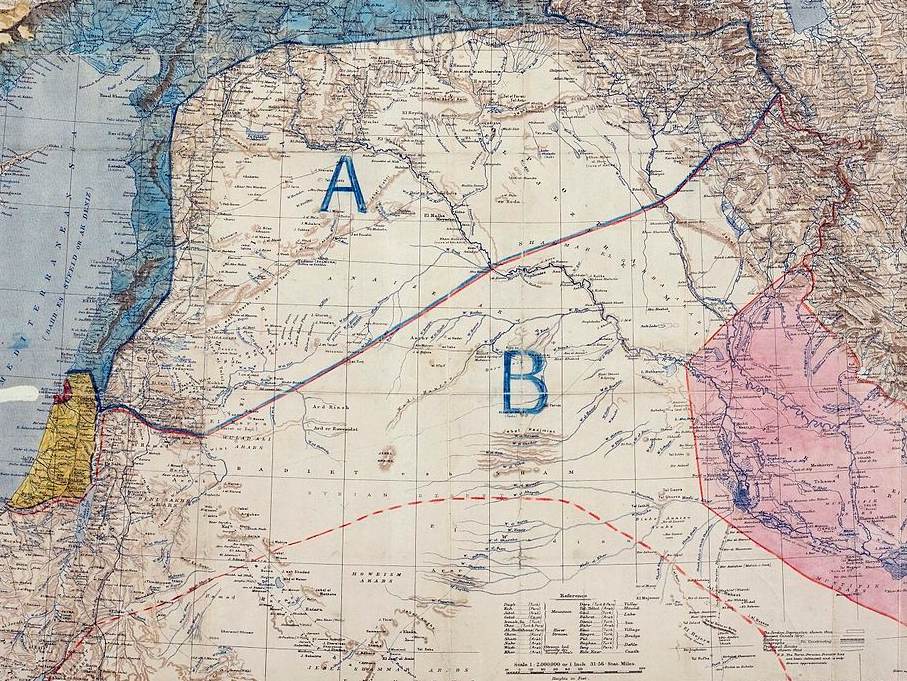
 Map Showing Agreed Areas of Control (Influence): Blue (A) is French, Red (B) is British

The Allies' military losses to the Ottoman Empire at Gallipoli and in Mesopotamia have not discouraged them from planning for the aftermath of Turkey's defeat.  British and French diplomats Sir Mark Sykes and Francois Georges-Picot have negotiated a secret agreement by which their countries are to share the fruits of victory in Asia Minor.  In Petrograd on April 26, they presented it to Russian Foreign Minister Sergei Sazonov, who agreed.  The agreement (now the Tripartite Agreement) provides that after the Ottomans are defeated France will assume control of the area along the Mediterranean coast known as the Lebanon with its capital at Beirut and of a separate, nominally sovereign, state of Syria with its capital at Damascus.  Britain will govern southern Mesopotamia as far as Baghdad, as well as the Mediterranean port cities of Haifa and Acre, the planned terminals of a pipeline and railway from the Mesopotamian oil fields.  Russia will control the Black Sea straits, Constantinople, and eastern Anatolia.  Palestine will be under the joint protection of Great Britain, France and Russia.


Sussex Passengers After the Attack

Last month's torpedoing of the Sussex has elicited a strong response from the United States.  On April 18, a note that amounted to an ultimatum was delivered by the United States to Germany.  It points out that several unarmed ships, not just the Sussex, have been attacked by German submarines recently, and threatens to sever diplomatic relations unless Germany abandons "its present method of submarine warfare against passenger and freight carrying vessels."  It stops short of demanding cessation of all submarine attacks on commercial shipping, insisting instead that Germany agree to abide by what in effect are traditional "cruiser rules," requiring passengers and crew members to be removed to a place of safety.  In one respect, however, it expands last year's demand after the sinking of the Arabic.  That demand was limited to passenger ships, while this one includes all commercial shipping, including merchant vessels.

During last month's confrontation over the Gore-McLemore Resolution, President Wilson promised Senator Stone that he would consult congressional leaders before taking any step that might lead to war,  Despite that promise, he decided to send this note first and inform congressional leaders after the fact.  The note was delivered at 6:00 p.m. on April 18, Congressional leaders were informed the following morning, and the President addressed Congress that afternoon.  He told Congress he had taken the action "with the keenest regret" but "in the confidence that it will meet with your approval and support" because "we cannot forget that we are in some sort and by the force of circumstances the responsible spokesmen for the rights of humanity, and that we cannot remain silent while those rights seem in process of being swept utterly away in the maelstrom of this terrible war."


General Pershing Crossing Into Mexico, Followed by his Aide, Lieutenant George S. Patton

As the month began, General Pershing's punitive expedition was being drawn deeply into Mexico as Pancho Villa retreated to the Parral district in the far southern part of the state of Chihuahua.  Conditions imposed on the promised use of the Mexican railways has rendered them virtually useless, so as Pershing moved south his supply situation became critical, requiring thousands of troops to maintain lines of communication and to occupy numerous intermediate locations in Mexican territory.  As the presence of American troops became more visible to the local population, political resistance within Mexico increased.  On April 12 a "flying squadron" of about 100 troops from the 13th Cavalry Regiment commanded by Major Frank Tompkins entered Parral to purchase supplies.  Local residents became openly hostile, shouting "Viva Villa" and throwing rocks and other missiles at the Americans.  As the American soldiers retreated, the mob was joined by Mexican government soldiers, who fired on the Americans and harassed them during a fighting withdrawal.  Two American soldiers were killed and six, including Major Tompkins, were wounded.  Over forty Mexicans were killed.


Major Tompkins and his "Flying Squadron"

On the same day as the Parral incident, the Mexican government presented a note to the United States government stating that American forces should be withdrawn from Mexican territory altogether.  It rejected the earlier suggestion of agreement on a mutual right of hot pursuit on the ground that Villa's band had been dispersed and the Mexican government was now capable of eliminating the threat.  As Mexican Army troops moved to oppose any further advance to the south, Pershing withdrew to Namiquipa, approximately 180 miles north of Parral.  President Wilson and Secretary Baker, anxious to avoid anything that might lead to further military conflict with the Mexican government "Carrancistas," are willing to withdraw American troops to the border areas but not to leave Mexican territory altogether until Villa is captured.  They have sent Army Chief of Staff General Hugh Scott and General Frederick Funston, Pershing's immediate superior, to meet in Juarez with Mexican General Alvero Obregon to try to reach agreement on the deployment of American troops.  The American negotiators are insisting on maintaining United States forces in Mexico at a location agreeable to the Carranza government, while General Obregon, acting pursuant to his instructions, is insisting on withdrawal of all American Army forces from Mexico.

On April 13, in the midst of the diplomatic crises with Germany and Mexico, President Wilson addressed his fellow Democrats at the annual Jefferson Day banquet in Washington.  He said "God forbid that we should ever become directly or indirectly embroiled in quarrels not of our own choosing ..., but if we should ever be drawn in, are you ready to go in only where the interests of America are coincident with the interests of mankind ...?  Are you ready for the test?  Have you courage to go in?"  The audience answered with a resounding "Yes!"


 The Former (and Future?) President

The presidential nominating conventions are scheduled for June.  The Republican and Progressive Parties will meet in Chicago on June 7, the Democrats a week later in St. Louis.  There is little doubt that the Democrats will nominate President Wilson for a second term; he has not announced his candidacy but has allowed his name to be placed on the ballot in primary states, and there are no other announced candidates.  On the Republican side, former President Roosevelt has not allowed his name to be placed on any primary ballots, telling his party leaders they should not nominate him unless they consider it in the interest of the Republican Party and the United States to do so.  In a meeting with a small group of Republicans at Sagamore Hill, he told them they should not expect him to "pussy foot on any single issue" and that he expected every citizen to be "pro-United States first, last, and all the time, and no pro-anything else at all."  Later in the month, after President Wilson's address to Congress describing the Sussex note, Roosevelt issued a statement in which he recalled the note sent fourteen months ago warning Germany that it would be held to "strict accountability" for the destruction of American ships or the lives of American citizens.  He said that if that note "meant anything it meant at least what the present note means," but that the president's actions since then have been "such that Germany did not believe that the note meant anything and acted accordingly."  He said it was "unpardonable" that instead of standing behind the "strict accountability" policy with a strategy of true preparedness, Wilson had followed a "diluted mush and milk policy" that left the American people unsure whether the administration was "retreating or adventuring, threatening or preparing for further concessions."


Hughes as Governor of New York

New York Governor Charles Evans Hughes was appointed to the Supreme Court in 1910.  Unlike most other prominent Republicans, therefore, he was able to avoid taking sides in the 1912 split between the regulars and the progressives in the party.  Again this year, his position as a Supreme Court Justice allows (indeed arguably requires) that he avoid any brush with electoral politics.  At the time of his appointment to the Court (by President Taft), Hughes was considered a progressive governor, so he has some appeal to both sides.  This year he has insisted that he is "entirely out of politics."  He has not only refused to allow his name to be entered in any primaries but has rejected any suggestion that he might be interested in the nomination and has steadfastly refused to make any comments of a political nature.  This, of course, makes him a formidable candidate.


Karl Liebknecht

In a major speech in the Reichstag on April 5, Chancellor Bethmann-Hollweg argued that Germany was fighting a defensive war, and disclaimed any ambitions for territorial conquest.  He insisted, however, that post-war Belgium must be a Flemish nation, free from French or British domination, and that Poland must be freed from the grip of Russia.  He derided as "fanciful" any claim that Germany had designs on the Americas. Reviewing the military situation, he took satisfaction in the failure of the Allied expedition in the Dardanelles, the success of the Serbian campaign, the unsuccessful attempts by the British to relieve their garrison at Kut-Al-Amara, and the success of German and Turkish forces in turning back Russian attacks in Galicia and Eastern Anatolia.  He declared that British efforts to starve Germany were bound to fail because "thanks to the organizing powers of the whole nation, Germany is equal to the task of distribution of food supplies" and "in cases in which there is a real shortage the German nation is able to make use of moral reserves which enable us to lower our standard of life, which has risen remarkably during the last decades."  All the party leaders, including Friedrich Ebert for the Social Democrats, supported the Chancellor's speech.  Karl Liebknecht, an outspoken member of the anti-militarist wing of the SDP, provoked an angry response from the other deputies when he interrupted the Chancellor to insist that the German people were not free, and had never wanted war.


Vladimir Lenin

The Second Socialist International met at Kienthal, Switzerland. from April 24 to 30.  The attendees were virtually unanimous in their denunciation of the war.  A rare exception was Vladimir Lenin, a delegate from the Russian Bolshevik Party, who argues that the war is a necessary intermediate step on the road from capitalism to socialism.


April 1916 – Selected Sources and Recommended Reading

Contemporary Periodicals:
American Review of Reviews, May and June 1916
New York Times, April 1916

Books and Articles:
A. Scott Berg, Wilson
Britain at War Magazine, The Third Year of the Great War: 1916
Winston S. Churchill, The World Crisis 1911-1918
John Milton Cooper, Jr., Woodrow Wilson: A Biography
John Milton Cooper, Jr., The Warrior and the Priest: Woodrow Wilson and Theodore Roosevelt
Patrick Devlin, Too Proud to Fight: Woodrow Wilson's Neutrality
John Dos Passos, Mr. Wilson's War
David Fromkin, A Peace to End All Peace: Creating the Modern Middle East, 1914-1922
Martin Gilbert, Churchill: A Life
Martin Gilbert, The First World War: A Complete History
Martin Gilbert, A History of the Twentieth Century, Volume One: 1900-1933
Martin Gilbert, Winston S. Churchill Volume III: The Challenge of War, 1914-1916
Richard F. Hamilton and Holger H. Herwig, Decisions for War, 1914-1917
August Heckscher, Woodrow Wilson: A Biography
Godfrey Hodgson, Woodrow Wilson's Right Hand: The Life of Colonel Edward M. House
Paul Jankowski, Verdun: The Longest Battle of the Great War
Keith Jeffrey, 1916: A Global History
Roy Jenkins, Churchill: A Biography
John Keegan, The First World War
David M. Kennedy, Over Here: The First World War and American Society
Nicholas A. Lambert, Planning Armageddon: British Economic Warfare and the First World War
Arthur S. Link, Wilson: Confusions and Crises, 1915-1916 
Arthur S. Link, Woodrow Wilson and the Progressive Era, 1910-1917
G.J. Meyer, A World Undone: The Story of the Great War, 1914 to 1918
Malise Ruthven, The Map ISIS Hates, New York Review of Books June 25, 2014
Jonathan Schneer, The Balfour Declaration: The Origins of the Arab-Israeli Conflict 
J. Lee Thompson, Never Call Retreat: Theodore Roosevelt and the Great War
Barbara W. Tuchman, The Zimmermann Telegram   
Geoffrey C. Ward and Ken Burns, The Roosevelts: An Intimate History
The West Point Atlas of War: World War I

Tuesday, March 29, 2016

March 1916

In March 1916, Pancho Villa and his bandits cross the border and attack a town in the United States, burning buildings and killing Americans before being driven back into Mexico.  President Wilson, who has appointed a new Secretary of War, sends Brigadier General John J. Pershing on a punitive expedition into Mexico to capture Villa.  The Mexican government objects to this violation of its territory.  In Washington, presidential opposition defeats a Congressional resolution warning Americans not to travel on ships of nations at war.  Back from Europe, Colonel House confers with President Wilson, who endorses the House-Grey Memorandum.  The British response is not encouraging.  From his vacation in Trinidad, former President Roosevelt issues a statement denying any interest in the 1916 presidential campaign, a statement that is widely interpreted as a declaration of candidacy.  The submarine issue surfaces again when a German U-boat attacks a ferry in the English Channel, injuring four Americans; the United States considers its response.  On leave from the front, Winston Churchill returns to England and speaks in the House of Commons, but his critique of British naval policy is not well received.  Elsewhere on the Continent the war continues.  The German attack on Verdun increases in intensity as the Allies mount simultaneous offensives: by the Russians in the Caucasus and White Russia (now Belarus), and by the Italians on the Isonzo.  In Mesopotamia the British make another attempt to relieve the besieged garrison at Kut Al Amara.  General Gallieni resigns as French Minister of War.  Yuan Shih-Kai abandons the idea of a Chinese empire with himself as emperor.


*****

 Columbus, New Mexico, After the Attack

The recognition of the Carranza government last year by the United States and the ABC powers (Argentina, Brazil, Chile) has not brought an end to civil strife in Mexico.  Carranza's bitterest foe, Francisco ("Pancho") Villa, controls large parts of northern Mexico and is now directing his violence against the United States as well as the government in Mexico City.  In January Villa and his followers attacked a train in Mexico and murdered all but one of the Americans on board in cold blood after forcing them to line up beside the track (one escaped by dashing into the desert before the shooting started).  On March 9 Villa took his terrorism a step further by leading a band of "Villistas" into United States territory, attacking the border town of Columbus, New Mexico.  Buildings were set afire and several Americans killed before the Thirteenth Cavalry Regiment under the command of Colonel Herbert Slocum drove the attackers back across the border, pursuing them some fifteen miles into Mexico.


Newton D. Baker

On the same day as Villa's raid, President Wilson appointed a new Secretary of War, Ohio attorney Newton D. Baker, to replace Lindley Garrison, who resigned last month.  Baker's selection was something of a surprise.  A progressive former Mayor of Cleveland, the new Secretary is considered a pacifist and thus an unlikely choice to lead the nation's military.  He is, however, a political ally of the president, and his pacifism makes him acceptable to substantial elements of both parties in Congress.  Considered as a possible running mate for Wilson at the 1912 Democratic Convention in Baltimore, after the election he turned down an offer to join the Wilson administration as Secretary of the Interior.  At age 44, he is the youngest member of the Cabinet.


Going After Pancho Villa

Ironically, the first order of business of the new pacifist Secretary of War is an invasion of Mexico.  On March 15, after minimal consultation with the Carranza government, American troops under the command of Brigadier General John J. Pershing crossed the border in pursuit of Pancho Villa.  This has, of course, led to diplomatic complications.  At first it appeared that Carranza would acquiesce as long as Mexican troops were given the same privilege (admittedly theoretical) to pursue Villa into the United States.  On March 25 President Wilson issued a statement that "the expedition into Mexico was ordered under an agreement with the de facto government of Mexico for the single purpose of taking the bandit Villa, . . . and is in no sense intended as an invasion of that republic or as an infringement of its sovereignty."  Carranza's position hardened following reports that some elements of the Mexican Army were joining forces with Villa, and his government lodged a formal protest against the presence of American troops on Mexican soil.  On March 29, however, Carranza gave permission for the use of Mexican railroads to supply Pershing's forces.


Senator Stone

Last month Representative A.J. McLemore (Dem., Tex.) introduced a resolution requesting the president to warn Americans against traveling as passengers on ships of nations at war.  After an exchange of letters between the President and Senate Foreign Relations Committee Chairman William J. Stone (Dem., Mo.), the measure lost support and appeared destined for a quiet death (see last month's installment of this blog).  President Wilson, however, insisted that it be brought to a vote in order to clear up any misunderstanding in other parts of the world about American policy.  On March 7, by a vote of 276 to 142, the House voted to table the McLemore resolution.  Earlier the Senate, following a confusing series of parliamentary maneuvers, voted to table a substitute resolution, offered by Senator Thomas P. Gore (Dem., Okla.), that raised the same issue in the form of a statement of hypothetical circumstances under which the United States would declare war, which Senator Gore argued was the practical effect of the President's announced policy.  Senator Gore voted against his own resolution.


 President and Mrs. Wilson and Colonel House

After two months in Europe Colonel House returned to the United States on March 5, landing in New York and proceeding directly to Washington by train.  The next day he joined President Wilson and the new first lady for lunch, followed by a two-hour automobile ride through Washington during which he outlined the results of his European mission.  On the way back he was dropped off at the State Department, where he met with Secretary of State Lansing.  Then he went next door to the White House and showed the House-Grey Memorandum to the president.  Wilson gave the Memorandum, and House's report as a whole, his full approval.  He authorized a telegram to Sir Edward Grey ratifying the Memorandum, only adding the word "probably" after "would" and before the words "leave the conference" in the second paragraph (see last month's installment of this blog).  This applies the same qualification to a German refusal to agree to terms "not unfavorable to the Allies" that already existed with respect to a German refusal to participate in a proposed conference in the first place.  All of this is hypothetical, of course, and hedged with conditions in addition to the "probablies," such as the statement that nothing can be done without the Allies' approval.  In diplomatic if not military terms, however, it aligns the United States firmly on the side of the Allies, albeit with the United States itself in the role of mediator.

Meanwhile, back in Westminster, the War Committee of the British Cabinet met on March 21.  The House-Grey Memorandum was the last item on the agenda, and after discussing House's proposal the Committee decided not to adopt it, at least for the present.  In his response to House on March 24, Grey said he could not present his proposal to the other Allies without clearing it first with the French.  He said he and Asquith were planning to meet the French Premier in Paris on March 30, at which time the Premier would have an opportunity to share his views.  The meeting took place as scheduled, but the subject did not come up.  For the time being at least, the idea of a peace conference hosted by the United States appears to be dead.


Roosevelt with American Oil Workers in Trinidad

Former President Roosevelt and his wife ended their Caribbean cruise on March 9 in Trinidad.  While there, Roosevelt visited resident Americans and engaged in birding and cave exploration.  Before leaving, he issued a statement in response to press reports that his supporters were planning to enter his name in the upcoming Massachusetts Republican primary as a candidate for president.  His statement says he does not want the nomination and requests that his name not be entered in the Massachusetts primary or that of any other state.  "I will not enter into any fight for the nomination and I will not permit any factional fight to be made in my behalf.  Indeed, I will go further and say that it would be a mistake to nominate me unless the country has in its mood something of the heroic -- unless it feels not only devotion to ideals but the purpose measurably to realize those ideals in action."  The statement goes on to express "disgust with the unmanly character of the present administration," and says the American people should not be "content merely to change the present administration for one equally timid, equally vacillating, equally lacking in vision, in moral integrity and in high resolve."  It says "the delegates who go to Chicago" should be "men of rugged independence, . . . controlled by no man and no interest and their minds should be open."  On his return voyage to New York, Roosevelt's ship encountered an Atlantic storm which had him up one night at two o'clock in the morning bailing seawater out of his stateroom with a bucket.  He arrived in New York on March 25, where he met with reporters but refused to comment on his statement except to say that he meant every word he said.

American political leaders are unanimous in their understanding that, with the Trinidad Statement, Roosevelt has joined the race for the 1916 presidential campaign.


 The Sussex in Boulogne After Being Torpedoed

The issue of German submarine warfare resurfaced before the month was over.  In the latter half of March German submarines torpedoed several unarmed ships.  One was the Sussex, a channel steamer en route from Folkestone to Dieppe with 380 passengers, including twenty-five Americans, four of whom were injured in the attack.  Although its bow was blown off and several passengers were killed, the Sussex did not sink, and what remained of the vessel was towed into Boulogne.  These attacks are in apparent violation of Germany's "Arabic Pledge" to the United States last year, but President Wilson is reluctant to sever diplomatic relations, which he regards as a prelude to war.  He is in consultation with Secretary Lansing and Colonel House, and so far has not decided on the appropriate course of action.


Arthur Balfour with Churchill Last Year

When his battalion rotated out of the trenches on March 2, Churchill returned to England, leaving his battalion in the care of his second in command Sir Archibald Sinclair.  On March 7, still a member of Parliament though no longer in the government, he rose in the House of Commons to take part in the debate on the Naval Estimates introduced by Arthur Balfour, the former Conservative Prime Minister and Churchill's successor as First Lord of the Admiralty.  In a 40-minute speech, Churchill offered a defense of his own record as First Lord and trenchant criticisms of the performance of the current administration of the Admiralty.  The effect of his speech, however, was severely diminished by its conclusion, in which he urged that former First Sea Lord Jackie Fisher be recalled to his post.  This suggestion was met with derision, given Lord Fisher's role in last year's disastrous Dardanelles expedition and the mutual recriminations between Churchill and Fisher that ensued.  Any hope Churchill may have entertained for a return to political power seems to have been dashed, at least for the time being.  On March 13 he crossed the channel and rejoined his battalion at Ploegsteert.


General Gallieni

Intense fighting raged all month between Fort Douaumont and Fort Vaux, north of Verdun.  Fort Douaumont was captured by the Germans shortly after the assault began last month.  Fort Vaux remains in French hands, but the village of Vaux has changed hands thirteen times, most recently at the end of March when it was occupied again by German troops.  On March 6, in an attempt to silence French artillery positioned on high ground across the river, German forces crossed the Meuse at Brabant and Champneuville and attacked the French positions on the heights of the Cote de l'Oie and the nearby hill of le Mort-Homme.  So far, however, the German attempts to drive the French from the heights have been unsuccessful.

The Commander-in-Chief of the French Army, General Joseph Joffre, and the Minister of War, General Joseph Gallieni, have a history of professional rivalry, and their relationship has worsened since the war began due to disputes over their respective areas of authority.  The French reverses at Verdun, in particular the ease with which the German Army captured Fort Douaumont, have brought matters to a head.  This, combined with Gallieni's failing health, led to his resignation as Minister of War on March 16.  His successor is General Pierre Roques.

France's allies mounted offensive operations this month intended to relieve the German pressure on Verdun.  On March 11 Italy renewed its offensive against Austro-Hungarian forces on the Isonzo River, but were driven back by rain and snow in the mountains and by an Austrian gas attack.  On the Eastern Front, a Russian offensive against the Germans at Lake Naroch in White Russia, preceded by a two-day artillery bombardment, made modest gains, as did Russian operations against Turkey in the Caucasus.  In Mesopotamia, the Ottoman siege of the British garrison at Kut Al Amara continued as additional Turkish troops transferred from Gallipoli helped turn back another attempted British breakthrough at Dujaila on March 7.  On March 27, as preparations continued for a major offensive on the Somme, British forces on the southern edge of the Ypres salient launched an attack on German positions at St. Eloi by exploding underground mines.


 Yuan Shih-Kai

Yuan Shih-Kai's declaration in December reviving the Chinese Empire has backfired badly.  Not only have foreign governments refused to recognize the new regime, but rebellions have broken out in province after province in China, supported by former President Sun Yat-Sen from his exile in Tokyo.  On March 22, after several postponements of his formal investiture, Yuan Shih-Kai formally abandoned the Empire and his title of Emperor.  His political enemies are now calling for his resignation as President.


March 1916 – Selected Sources and Recommended Reading

Contemporary Periodicals:
American Review of Reviews, April and May 1916
New York Times, March 1916

Books and Articles:
A. Scott Berg, Wilson
Britain at War Magazine, The Third Year of the Great War: 1916
Winston S. Churchill, The World Crisis 1911-1918
John Milton Cooper, Jr., Woodrow Wilson: A Biography
John Milton Cooper, Jr., The Warrior and the Priest: Woodrow Wilson and Theodore Roosevelt
Patrick Devlin, Too Proud to Fight: Woodrow Wilson's Neutrality
John Dos Passos, Mr. Wilson's War
David Fromkin, A Peace to End All Peace: Creating the Modern Middle East, 1914-1922
Martin Gilbert, Churchill: A Life
Martin Gilbert, The First World War: A Complete History
Martin Gilbert, A History of the Twentieth Century, Volume One: 1900-1933
Martin Gilbert, Winston S. Churchill Volume III: The Challenge of War, 1914-1916
Richard F. Hamilton and Holger H. Herwig, Decisions for War, 1914-1917
August Heckscher, Woodrow Wilson: A Biography
Godfrey Hodgson, Woodrow Wilson's Right Hand: The Life of Colonel Edward M. House
Paul Jankowski, Verdun: The Longest Battle of the Great War
Keith Jeffrey, 1916: A Global History
Roy Jenkins, Churchill: A Biography
John Keegan, The First World War
Nicholas A. Lambert, Planning Armageddon: British Economic Warfare and the First World War
Arthur S. Link, Wilson: Confusions and Crises, 1915-1916 
Arthur S. Link, Woodrow Wilson and the Progressive Era, 1910-1917
G.J. Meyer, A World Undone: The Story of the Great War, 1914 to 1918
J. Lee Thompson, Never Call Retreat: Theodore Roosevelt and the Great War
Barbara W. Tuchman, The Zimmermann Telegram   
Geoffrey C. Ward and Ken Burns, The Roosevelts: An Intimate History
The West Point Atlas of War: World War I

Monday, February 29, 2016

February 1916

It's February 1916.  The war in Europe shows no signs of abating.  As negotiations over the sinking of the Lusitania come perilously close to a breach in relations with Germany, President Woodrow Wilson is embarked on a speaking tour through the Midwest to sell his "preparedness" program.  Pacifists and isolationists are opposed, but his audiences are mostly receptive to his message.  His message is not strong enough, however, for his Secretary of War, who resigns.  Having assured his audiences that his program is meant to ensure peace, not prepare for war, the president puts the brakes on the slide toward a break in relations with Germany; but just as an acceptable formula appears to have been found, Germany announces a new aggressive submarine policy.  As Congress is about to adopt measures to prevent Americans from traveling on belligerent ships, the president heads it off with a letter stoutly defending American rights.  Meanwhile Colonel House ends his tour of European capitals in London by signing on to a memorandum written by the British Foreign Secretary that might or might not commit the United States to entering the war on the side of the Allies.  On the battlefield, the German Army commences a massive assault on the French city of Verdun and surrounding forts.  Winston Churchill is on the Western Front with his Aide de Camp Sir Archibald Sinclair, who will become his Secretary of State for Air in the Second World War and later be elevated to the peerage as Viscount Thurso.  (After the 1999 House of Lords reforms, Lord Thurso's grandson, the third viscount, will become the first peer to be elected to the House of Commons.)  In Ottawa the Canadian Parliament building is destroyed by fire.  In this presidential election year in the United States, no one has announced his (or her) candidacy for the office, but President Wilson gives permission for the use of his name in the Ohio Democratic primary.  His eventual opponent, Supreme Court Justice Charles Evans Hughes, writes a letter opposing any use of his name in connection with the nominating process.

*****

Convention Hall in Kansas City

The beginning of February found President Wilson in the midst of his Preparedness Tour through the Midwestern United States.  Traveling from Milwaukee to Des Moines on February 1, he made brief speeches at stops in Joliet, Rock Island, Davenport and Iowa City.  That evening he gave a major address at the Coliseum in Des Moines, a Republican stronghold with strong isolationist sympathies.  He told the friendly audience of 10,000, said to be the largest crowd ever assembled in that city, that while he had worked tirelessly to keep America out of the war, and that while America was at peace with the world and faced no immediate danger of international crises, he was sure Americans did not wish to maintain "peace at the expense of the honor of the United States."  The next day in Topeka, he faced a less receptive audience of Kansas farmers, but that evening in Kansas City a crowd of 18,000, the largest and most enthusiastic of his trip, packed Convention Hall and cheered his message urging America to be prepared to play its part in "the redemption of the affairs of mankind."  Arguing for a greatly expanded navy, he told them "the flame from a world on fire" threatens to "creep in from both coasts," and pointed out that in the Pacific alone "the sweep of the coast from the canal to Alaska ... is nearly one fourth the circumference of the earth."  He said "there is not a day to be lost, for the peace of the United States does not depend on what I can do; it depends on what the commander of some ship at sea does, or the commander of some submarine, or those in charge of a blockade" and "America must see that we are ready to defend our rights."  The President ended his tour the following evening in St. Louis, a city with a large German-American population, where he told a friendly audience in the Coliseum that his goal was to defend American neutrality by strengthening the army and building "incomparably the greatest navy in the world."  He returned to Washington on February 4, refreshed and invigorated by his reception in a part of the country known for its Republican leanings and isolationist sympathies.


Lindley Garrison

Secretary of War Lindley Garrison has been a voice within the administration for a more aggressive military posture, both in urging more use of the military in Mexico and in advocating measures to increase the nation's military strength in light of the war in Europe.  Though both he and the president supported an increase in military spending, Garrison was a strong and insistent advocate of a "Continental Army" plan to increase the standing army to 400,000 men.  Garrison's plan encountered Congressional opposition, which preferred an expanded role for the State National Guards.  President Wilson's refusal to push Congress to adopt Garrison's Continental Army plan led to his resignation, along with that of Assistant Secretary of War Henry Breckinridge, on February 10.  Army Chief of Staff General Hugh Scott is serving as acting Secretary of War until a replacement is appointed and confirmed.


Secretary of State Robert Lansing

Throughout his preparedness tour, President Wilson emphasized that there was no immediate crisis, that the United States is at peace with the world, and that his constant goal is to keep America out of the war.  The success of the tour rested largely on the President's assurances that he sought military strength to keep the United States out of the war, not to take aggressive action that might involve it in hostilities.  Meanwhile, however, back in Washington, Secretary of State Lansing with the President's approval was pursuing a hard line against Germany over the sinking of the Lusitania, insisting on an admission of liability and reparations for the deaths of American citizens.  By the end of January, negotiations in Washington and Berlin had reached an impasse, with the German government rejecting Lansing's final demands.  A break in diplomatic relations seemed imminent.  When President Wilson was advised by telegram of the state of negotiations as he was on his way back to Washington, he instructed Lansing to take no further action until his return.  Back at the White House on February 8, in a meeting with Lansing and the rest of the Cabinet, language was agreed upon that represented a retreat from the United States' previous position, and that appeared to satisfy both President Wilson and the German government.  Just as the Lusitania crisis appeared to be approaching resolution, however, Germany announced on February 10 that, beginning February 29, its submarines would treat all armed merchant ships as auxiliary cruisers, subject to being sunk without warning.  This announcement has made resolution of the Lusitania issue impossible for the present.  Attention has now shifted from the choice of words to be used in diplomatic notes regarding past grievances to the broader issue of how decisions regarding the arming of merchant ships will affect future policy.

Armed merchant ships have been central to the diplomatic controversy over submarine warfare.  On the one hand, traditional international law requires that warships intercepting merchant ships obey "cruiser rules," which provide that the warship may not attack or sink the merchant ship, unless it resists or tries to evade capture, without first removing the crew and passengers to a place of safety (at least to lifeboats).  On the other hand, a merchant ship armed with a deck gun (sometimes concealed) is quite capable of attacking and sinking any submarine that surfaces within range; indeed, in that circumstance the submarine is at a decided disadvantage.  Last month Secretary Lansing proposed a modus vivendi, under which merchant ships would not be allowed to carry armament and in return German submarines would be required to follow cruiser rules.  This proposal was promptly rejected by Great Britain, and was never officially submitted to Germany.  Its announcement, however, had the unfortunate effect of laying a foundation for the German announcement of February 10:  If merchant ships were to be prohibited from carrying guns, why would German submarines not be justified in attacking any merchant ships they thought were armed?  Lansing has been forced to tell the German ambassador that, because his proposed modus vivendi was not acceptable to Great Britain, it should no longer be considered as a basis for discussion or as a justification for Germany's February 10 announcement.  The appearance that the two might be connected, meanwhile, has torpedoed for now the proposed Lusitania settlement.


Senator Gore

Representative McLemore

Among the factors affecting the Lusitania negotiations and the armed merchant ship issue has been the attitude of Congress.  Since it convened in December, the mood on Capitol Hill has shifted decisively against any policy threatening a rupture in relations with Germany and toward taking a firmer stand against Great Britain regarding its blockade policies.  On February 17, Representative A.J. McLemore (Dem., Tex.) introduced a resolution requesting that the president warn American citizens not to travel on armed merchant vessels.  This caused Senator Thomas Gore (Dem., Okla.) to begin a push to bring to the floor a bill he introduced in January that would prohibit the issuance of passports to Americans traveling on belligerent ships and also prohibit neutral ships from carrying American citizens as passengers while carrying contraband.  On February 21, Senator William J. Stone (D., Mo.), chairman of the Foreign Relations Committee, accompanied by Senate Majority Leader John W. Kern (D., Ind.) and Representative Hal D. Flood (D., Va.), Chairman of the House Committee on Foreign Affairs, called on President Wilson to ascertain the administration's view.  The president's answer, that he was determined to defend the right of Americans to travel on defensively armed merchant ships, set off a rebellion in Congress.

On February 24, with passage of the Gore and McLemore measures appearing increasingly likely, Senator Stone wrote a letter to the president in which he said that, while he was "striving to prevent anything being done by any Senator or Member calculated to embarrass your diplomatic negotiations," he would "find it difficult from my sense of duty and responsibility to consent to plunge this nation into the vortex of this world war because of the unreasonable obstinacy of any of the Powers on the one hand, or, on the other hand, of fool-hardiness, amounting to a sort of moral treason against the Republic, of our own people recklessly risking their lives on armed belligerent ships."  Seeing an opportunity to defuse the domestic crisis with a strong statement for public consumption, President Wilson immediately replied to Senator Stone and released both letters to the press.  He refused to back down, saying that while "I shall do everything in my power to keep the United States out of war, ... I cannot consent to any abridgement of the rights of American citizens in any respect.  The honor and self-respect of the nation is involved.  We covet peace, and shall preserve it at any cost but the loss of honor.  To forbid our people to exercise their rights for fear we might be called upon to vindicate them would be a deep humiliation indeed."  Release of the letters has had the desired effect: Congressional opposition to the president's policy appears to have collapsed.  On February 29, seeking to remove any doubt in foreign capitals about American policy, President Wilson sent a letter to the acting chairman of the House Rules Committee demanding that the McLemore resolution be brought to the floor for a vote, which he is confident will result in its defeat.


Colonel House

The Lusitania negotiations and related discussions about armed merchant ships took place in Washington between Secretary of State Lansing and German Ambassador Bernstorff, and simultaneously in Berlin between American Ambassador James Gerard and Deputy Foreign Minister Arthur Zimmermann.  President Wilson's private emissary Colonel House was in Europe throughout the negotiations, and was instrumental in persuading the president to avoid a break with Germany over the wording of the Lusitania notes.  He left Berlin at the end of January and arrived in Paris on February 1.  There he met with Foreign Minister Jules Cambon and Prime Minister Aristide Briand, then proceeded to London, where he met over the next several days with Prime Minister Asquith, Foreign Minister Grey and others, continuing to promote the idea of a peace conference to be called by President Wilson.  To make it acceptable to the Allies, he assured the French and British that the United States would endeavor to bring about a settlement favorable to them.  On February 22, House and Grey agreed on the content of a memorandum, drafted and signed by Grey, which stated as follows:

"Colonel House told me that President Wilson was ready, on hearing from France and England that the moment was opportune, to propose that a Conference should be summoned to put an end to the war.  Should the Allies accept this proposal, and should Germany refuse it, the United States would probably enter the war against Germany.

"Colonel House expressed the opinion that, if such a Conference met, it would secure peace on terms not unfavorable to the Allies, and, if it failed to secure peace, the United States would leave the conference as a belligerent on the side of the Allies, if Germany was unreasonable.  Colonel House expressed an opinion decidedly favourable to the restoration of Belgium, the transfer of Alsace and Lorraine to France, and the acquisition by Russia of an outlet to the sea . . . .

"I said that I felt the statement, coming from the President of the United States, to be a matter of such importance that I should inform the Prime Minister and my colleagues; but that I could say nothing until it had received their consideration.  The British Government could, under no circumstances, accept or make any proposal except in consultation and agreement with the Allies. . . ."

The House-Grey Memorandum has not been made public, and probably will not be.  If it were, it would inevitably reignite this month's Congressional controversy, since it is difficult to reconcile its contents with President Wilson's letter to Senator Stone, sent two days later, in which he insists he is doing everything in his power to avoid war.  In addition, it is inconsistent with the public reason given for Colonel House's trip (only to brief ambassadors), and disregards House's original understanding with the president that he would avoid expressing any opinion on specific territorial issues and would suggest only the convening of a conference, not the United States' actual entry into the war.

Having completed his mission in Europe, Colonel House boarded the SS Rotterdam in Falmouth on February 25 for his return voyage to New York.


Fort Douaumont Before the Battle

On February 21 the German Fifth Army, under the command of Crown Prince Wilhelm, began a major attack on Verdun, a French city occupying a strategic position on the Meuse River.  The offensive began with a 9-hour artillery bombardment.  850 heavy guns pounded the city and its surrounding fortresses along an eight mile front.  The artillery barrage was followed by an infantry advance that resulted in the capture of Fort Douaumont, a formidable fortification northeast of the city that had been stripped of much of its artillery and defenders, on February 25.  On the same day the defense of Verdun was assigned to the French Second Army, under the command of General Philippe Petain.  Almost surrounded by the German army and with all but a single small rail line cut off, Verdun is relying for reinforcements and supplies on truck convoys using a single road from Bar-le-Duc, which the French Army has closed to non-military traffic.  Military guards patrol every mile of it, maintenance workers are on constant duty, and the departure of truck convoys is strictly regulated to minimize traffic delays.


Churchill and Sinclair in Armentieres

Farther north, the Western Front has been relatively quiet, but plans are under way by the French and British high commands for a major summer offensive on the Somme.  Former British First Lord of the Admiralty Winston Churchill spent the month with his new infantry battalion in Belgium.  On February 10 he went with his aide de camp Major Sir Archibald Sinclair and his division commander General Sir Henry Tudor to observe a British artillery bombardment near Ploegsteert Wood.  The next day he and Sinclair crossed the border to Armentieres, where they had their photograph taken before returning to the front.


 The Canadian Parliament Building Afire

Parliaments on both sides of the Atlantic were in the news this month.  The Canadian Parliament Building in Ottawa was destroyed by fire on February 3.  In Westminster, Prime Minister Asquith told the British House of Commons that additional war taxes would be necessary to fund ongoing war costs of $25 million a day.  On February 16, Great Britain, France and Italy renewed their pledge to continue the war until the independence of Belgium is reestablished.


The Supreme Court Before Justice Lamar's Death Last Month
(Justice Hughes Front Row Extreme Right; Justice Lamar Second from the Right in the Back Row)

In the United States, this is a presidential election year.  Some leading Republicans would like to see their party nominate Supreme Court Justice and former New York Governor Charles Evans Hughes.  Representative C. Bascom Slemp, the only Republican member of Congress from Virginia, wrote to Justice Hughes informing him of a "Hughes boom" started in the state by Frank Hitchcock, a former Postmaster General and chairman of the Republican National Committee.  In a letter made public on February 9, Justice Hughes tried to put an end to Hitchcock's efforts.  He wrote, "I am entirely out of politics and I know nothing whatever of the matters to which you refer."  He added, "I am entirely opposed to the use of my name in connection with the nomination and selection or instruction of any delegates in my interest, either directly or indirectly."

On the Democratic side, President Wilson has allowed himself to be put forward as a candidate for the nomination while making a show of reluctance.  In a February 14 letter to the Ohio Secretary of State, he said was being sent only to "satisfy the technical requirements of the statutes of the State of Ohio," he wrote, "While I am entirely unwilling to enter into any contest for the presidential nomination of the Democratic Party, I am willing to permit the use of my name that the Democrats in Ohio may make known their preference in regard to that nomination."  The president's letter made no mention of the Democratic Party's 1912 platform, which pledged to limit presidents to a single term.  It is expected that President Wilson will be nominated easily this year, unlike at the 1912 Baltimore convention in which he trailed for twenty-eight ballots before finally receiving the nomination on the forty-sixth.

Meanwhile, former President Roosevelt, who led the Progressive Party in its split from the Republicans in 1912, is being mentioned as a possible Republican nominee if the 1912 rift can be healed.  He is on holiday with his wife in the Caribbean, and has been quoted as saying that he is "for anybody who can beat Woodrow Wilson."


February 1916 – Selected Sources and Recommended Reading

Contemporary Periodicals:
American Review of Reviews, March and April 1916
New York Times, February 1916

Books and Articles:
A. Scott Berg, Wilson
Britain at War Magazine, The Third Year of the Great War: 1916
Winston S. Churchill, The World Crisis 1911-1918
John Milton Cooper, Jr., Woodrow Wilson: A Biography
John Milton Cooper, Jr., The Warrior and the Priest: Woodrow Wilson and Theodore Roosevelt
Patrick Devlin, Too Proud to Fight: Woodrow Wilson's Neutrality
David Fromkin, A Peace to End All Peace: Creating the Modern Middle East, 1914-1922
Martin Gilbert, The First World War: A Complete History
Martin Gilbert, A History of the Twentieth Century, Volume One: 1900-1933
Martin Gilbert, Winston S. Churchill Volume III: The Challenge of War, 1914-1916
Richard F. Hamilton and Holger H. Herwig, Decisions for War, 1914-1917
Peter Hart, Gallipoli
August Heckscher, Woodrow Wilson: A Biography
Godfrey Hodgson, Woodrow Wilson's Right Hand: The Life of Colonel Edward M. House
Paul Jankowski, Verdun: The Longest Battle of the Great War
Keith Jeffrey, 1916: A Global History
John Keegan, The First World War
Nicholas A. Lambert, Planning Armageddon: British Economic Warfare and the First World War
Arthur S. Link, Wilson: Confusions and Crises, 1915-1916 
Arthur S. Link, Woodrow Wilson and the Progressive Era, 1910-1917
G.J. Meyer, A World Undone: The Story of the Great War, 1914 to 1918
J. Lee Thompson, Never Call Retreat: Theodore Roosevelt and the Great War
Barbara W. Tuchman, The Zimmermann Telegram   
Geoffrey C. Ward and Ken Burns, The Roosevelts: An Intimate History

Sunday, January 31, 2016

January 1916

The first month of the third calendar year of the war finds both sides bitterly resigned to a world war of unprecedented destruction with no end in sight.  The British complete their withdrawal from Gallipoli and find themselves under siege in Mesopotamia with the likelihood of relief diminishing.  Churchill takes command of an infantry battalion on the Western Front as the British Government yields to the necessity of compulsory military  service.  Colonel House spends the month in London, Paris and Berlin, but accomplishes little.  Lusitania negotiations between Germany and the United States reach an impasse.  President Wilson embarks on a preparedness tour of the Midwest.  Former President Roosevelt denounces the administration's foreign policy and calls for a "larger Americanism" that welcomes loyal immigrants.  Pancho Villa's bandits attack a train and kill Americans in Mexico.  Other newsworthy deaths include a former Mexican revolutionary and a Civil War general instrumental in building the transcontinental railroad.  Louis Brandeis is appointed to the Supreme Court.

*****


 W Beach at Cape Helles During the Evacuation

At the end of the year the British War Cabinet decided to complete the evacuation of the Gallipoli Peninsula by withdrawing from Cape Helles.  Unlike the earlier evacuations of Suvla Bay and Anzac Cove, which were carried out stealthily and without alerting the Turks, this time the Turks knew a withdrawal was imminent and attacked the Allied forces.  A vigorous battle ensued,in which the Turks were driven back and held at bay long enough for the Allied forces to carry out a successful evacuation, which was completed on January 8.  As in the earlier withdrawals, the operation was completed with minimal losses.

Also on January 8, the Austro-Hungarian Army, having completed its conquest of Serbia, turned its attention to Montenegro with a 500-gun artillery barrage combined with air and sea attacks.  Cetinje, the capital, fell on January 11, and on January 17 Montenegro surrendered.


Field Marshal von der Goltz

General Townshend's Anglo-Indian forces in Mesopotamia are surrounded at Kut Al Amara, besieged by Turkish troops under the command of German Field Marshal Baron von der Goltz, reinforced by troops recently freed up by the Allied evacuation of Gallipoli.  A British relief column was intercepted by the Turks  at Wadi on January 13 and Hanna on January 21.  At Wadi, the British achieved their objective, but only at the cost of irreplaceable losses.  At Hanna their losses were even greater.  As of the end of January, the relief column has been stopped short of its objective and the siege of Kut Al Amara continues.


 Churchill with General Fayolle (to his left) and a German Prisoner (behind the General)

Winston Churchill is in France, where he has been given a commission as a lieutenant colonel and command of an infantry battalion, the Sixth Royal Scots Fusiliers.  His battalion is part of the Ninth (Scottish) Division commanded by Major General William Furse, which suffered grievous losses at the Battle of Loos in September.  At Churchill's request, Sir Archibald Sinclair has been named his second in command.  After spending most of the month in reserve billets near the town of Meteren, the battalion was assigned to the Ploegsteert sector, where it took its place in the line on January 27.  Prior to his assignment to the Royal Scots Fusiliers, while training with the Grenadier Guards, Churchill was considered for command of a brigade and a promotion to brigadier general, but that plan did not survive the replacement of General French by General Haig and Prime Minister Asquith's concern about negative reaction in the officer corps.  After arriving in France he posed for a photograph with General Emile Fayolle, some other French officers, and a German prisoner.  General Fayolle gave him a French helmet, which he wore for the photograph and decided to keep, considering it superior to the British design.

Back in Westminster, also on January 27, the Military Service Act received Royal Assent and became law.  The Act, introduced by Prime Minister Asquith in the House of Commons on January 5, is Great Britain's first conscription bill.

On the last day of 1915, new honors were conferred by King George V.  Sir John French was elevated to the peerage as Viscount French of Ypres, and in recognition of his support for British charities the wealthy American expatriate William Waldorf Astor became Baron Astor.  Lord Astor's daughter-in-law Nancy Langhorne Astor, also an American, is active in war work among the wounded.


Colonel House

President Wilson's friend and advisor Colonel House spent most of the month in England.  He arrived in Falmouth on January 5 with his wife and secretary and took the overnight train to London, where he met with Foreign Minister Grey the next afternoon.  In the following days he had additional meetings with Grey and other ministers and officials of the British government including First Lord of the Admiralty Arthur Balfour, Minister of Munitions David Lloyd George, and the Lord Chief Justice, Lord Reading.  Lloyd George, in a meeting with Colonel House and Lord Reading on January 14, argued that little in the way of peace initiatives could be done before September, after which the anticipated summer battles will have been fought and the warring nations will have a better idea of where they stand.  He insisted, however, that any peace settlement should include the dismemberment of the Ottoman Empire and the restoration of the Polish nation.  House, consistent with his discussions with Wilson prior to his departure, avoided "local" questions such as territorial settlements and indemnities, instead emphasizing general principles upon which a peace might be based: military and naval disarmament, freedom of the seas, and the establishment of a league of nations to enforce international law and protect nations against aggression.  House left London on January 20, and after a few days hiatus in Paris proceeded by way of Geneva to Berlin, where he arrived on January 26.

House arrived in Berlin at a critical moment in the negotiations between the United States and Germany over the sinking of the Lusitania.  Greeting him on his arrival was a long telegram from Secretary of State Lansing  warning that the German government's refusal to admit liability and offer reparation for the loss of American lives (as opposed to a "friendly indemnity" with no mention of liability) made agreement impossible and threatened a break in diplomatic relations.  At a lunch meeting on January 29, Deputy Foreign Minister Arthur Zimmermann told House and U.S. Ambassador James Gerard that Germany would go no further, and handed them a letter to that effect for transmission to Washington.


The President in Waukegan

President Wilson cut short his honeymoon trip and returned to Washington on January 3 to deal with the potential crisis in relations with Germany caused by the December 30 sinking of the passenger steamer S.S. Persia causing the death of two Americans including the American consul in Aden.  Not long after his return, the Persia incident was sidelined by a lack of conclusive evidence of German culpability and a shift of focus to the renewed Lusitania negotiations.  As those negotiations appeared to reach an impasse, the Democratic leaders of Congress let it be known that they were reluctant to support the administration's insistence on an apology, and renewed their insistence that a stronger stand should be taken against the British blockade policy.  At the end of the month President Wilson, a recent convert to "preparedness," began a "swing around the circle" speaking tour through the middle west, the area most resistant to the preparedness message.  Before embarking on his tour, he spoke on January 27 at a dinner of the Railway Business Association in the Grand Ballroom of the Waldorf Hotel in New York.  He admitted that he had changed his mind on the preparedness issue since his message to Congress in November 1914, saying "I would be ashamed of myself if I had not learned something in [those] fourteen months."  He left Washington the next day, and spoke on January 29 in Pittsburgh and Cleveland, where he argued that it has become "absolutely necessary that this country should prepare herself, not for war, not for anything that smacks in the least of aggression, but for adequate national defense."  He made major speeches to the same effect in Chicago and Milwaukee on January 31, and in addition is delivering brief remarks from the rear platform of his train during stops along the way such as Waukegan, Illinois.  Still ahead as the month draws to a close are stops in Des Moines, Topeka, Kansas City and St. Louis.


Metropolitan, January 1916

The January 1916 issue of Metropolitan Magazine carries an article by former President Roosevelt entitled "The Sins of the Wilson Administration."  Asking the question "America First -- A Phrase or a Fact?", Roosevelt charges that the Administration has "plumed itself on the sentence, 'America First,'" while "in practice it has acted on the theory of  'America Last,' both at home and abroad, both in Mexico and on the high seas."  He blames "this course of national infamy," which he traces back to the Taft administration, on "professional pacifists," who, "through President Wilson, have forced this country into a path of shame and dishonor during the past eighteen months."  He says that while the president has "finally adopted my principle about preparedness, ... he has sought to apply it in a half-hearted and inefficient manner," and that "it is the last note of unpatriotic folly for the pacifists of this country to chatter about peace, when they neither venture to stand up for righteousness nor to fight for real preparedness, so as to enable the United States to insure justice for itself and to demand justice for others."  In a speech at the Philadelphia Opera House on January 20, Roosevelt called for a "larger Americanism," which would welcome every immigrant who comes to America with the desire to be "an American and nothing else," but if any immigrant showed himself to be "at heart more loyal to another land, let him be promptly returned to that land."

The Progressive Party, which Roosevelt led out of the Republican Party in 1912, announced on January 11 that it would hold its 1916 convention in Chicago on June 7, the same city and date announced last month for the Republican convention.   The hope is that they will choose the same nominees.


Pancho Villa

Notwithstanding Roosevelt's criticism, relations with Mexico seem to have become more stable since the United States and the ABC  powers of South America recognized the government of Venustiano Carranza last October.  An incident this month illustrates that sources of tension persist.  On January 10 a band of brigands under the command of Pancho Villa, a rival of Carranza's who controls large parts of  northern Mexico, stopped a train in Chihuahua and shot and killed all but one of the American mining executives on board after robbing them, stripping them of their clothes, and forcing them to stand in a line beside the train.  The lone survivor, Thomas Holmes, escaped by fleeing into the desert.  Secretary of State Lansing has sent a note to the Carranza government demanding the immediate pursuit, capture and punishment of those responsible.  There have been calls in Congress, so far resisted by the president, to send American Army troops into Mexico.

A name from Mexico's turbulent recent past has left the scene. Victoriano Huerta, the Mexican general whose overthrow (and probable murder) of President Francisco Madero in 1913 was an early event in the civil war that continues to the present day, died in El Paso on January 13, shortly after his release from a federal prison.  Huerta seized the presidency shortly after Madero's ouster, but was forced to resign and leave the country in July 1914.  Subsequent scheming with German agents in the United States led to his arrest and detention by American authorities.


 Grenville Dodge (right) at the driving of the Golden Spike

General Grenville Dodge died in Council Bluffs, Iowa on January 3.  In the Civil War General Dodge served in a number of important positions, including as the Union Army's Chief of Intelligence in the West and as commander of a corps in General Sherman's campaign for Atlanta.  After the war he was elected to Congress, where he served one term, and  was named chief engineer of the Union Pacific, a position in which he was instrumental in the construction of the transcontinental railroad.


 Louis Brandeis

Supreme Court Justice Joseph Rucker Lamar, appointed by President Taft to fill the vacancy created by the 1910 promotion of Justice Edward White to Chief Justice, died on January 2.  On January 28, President Wilson made a surprising choice when he sent Louis Brandeis's nomination to the Senate.  Brandeis is best known as a radical trust-busting attorney, and is considered by many to be a socialist.  If confirmed, he will be the first Jew to sit on the Supreme Court.  His nomination is expected to face strong opposition in the Senate.


January 1916 – Selected Sources and Recommended Reading

Contemporary Periodicals:
American Review of Reviews, February and March 1916
Metropolitan Magazine, January 1916 
New York Times, January 1916

Books and Articles:
A. Scott Berg, Wilson
Britain at War Magazine, The Third Year of the Great War: 1916
Winston S. Churchill, The World Crisis 1911-1918
John Milton Cooper, Jr., Woodrow Wilson: A Biography
John Milton Cooper, Jr., The Warrior and the Priest: Woodrow Wilson and Theodore Roosevelt
Patrick Devlin, Too Proud to Fight: Woodrow Wilson's Neutrality
David Fromkin, A Peace to End All Peace: Creating the Modern Middle East, 1914-1922
Martin Gilbert, The First World War: A Complete History
Martin Gilbert, A History of the Twentieth Century, Volume One: 1900-1933
Martin Gilbert, Winston S. Churchill Volume III: The Challenge of War, 1914-1916
Richard F. Hamilton and Holger H. Herwig, Decisions for War, 1914-1917
Peter Hart, Gallipoli
August Heckscher, Woodrow Wilson: A Biography
Godfrey Hodgson, Woodrow Wilson's Right Hand: The Life of Colonel Edward M. House
John Keegan, The First World War
Nicholas A. Lambert, Planning Armageddon: British Economic Warfare and the First World War
Arthur S. Link, Wilson: Confusions and Crises, 1915-1916 
Arthur S. Link, Woodrow Wilson and the Progressive Era, 1910-1917
G.J. Meyer, A World Undone: The Story of the Great War, 1914 to 1918
J. Lee Thompson, Never Call Retreat: Theodore Roosevelt and the Great War
Barbara W. Tuchman, The Zimmermann Telegram   
Geoffrey C. Ward and Ken Burns, The Roosevelts: An Intimate History