Monday, March 31, 2014

March 1914

It's the end of March 1914, and the Great War is a month closer (though of course nobody knows it). Russia's military build-up is causing concern among its neighbors. Austria's minister-president sends the Reichsrat home, leaving only himself and King/Emperor Franz Joseph in charge of the government in that half of the Austro-Hungarian Empire. In Great Britain, the army threatens to refuse to enforce Home Rule in northern Ireland; the ensuing crisis results in the resignation of the Secretary of State for War and the Chief of the Imperial General Staff. In France, the wife of a cabinet minister and former prime minister puts an end to embarrassing revelations about her relationship with her husband by shooting and killing the editor of the offending newspaper. In the United States, President Wilson urges Congress to repeal the free tolls provision of the Panama Canal Act, to the fury of many in Congress including the father of future Senator Knowland. Negotiations with the Huerta regime in Mexico resume. The president announces another daughter's engagement. High-profile murder trials are in the news in New York and Georgia. Woman suffrage campaigns in America and Great Britain continue with mixed results. Igor Sikorsky and Guglielmo Marconi are responsible for impressive advances in transportation and communication respectively, and the world mourns the death of George Westinghouse, the man responsible for many of the scientific advances of previous decades.

*****


Russia Looks West
 
On March 12, the Russian government submitted "extraordinary" military estimates to the Duma in the amount of $60,000,000.  This represents a 30 percent increase over the extraordinary estimates of 1913, and is in addition to the $250,000,000 in ordinary army appropriations already approved.  The estimates have given added force to concerns in Germany, Austria, Sweden and elsewhere that Russia is planning a war of aggression.  The Neue Freie Presse, Austria's semi-official newspaper, calls Russia's million-man army "an unheard of thing in modern history."  Also raising concern among Russia's neighbors is the recent approval of a French loan for the construction of railways designed to speed concentration of military forces on Russia's European and Caucasus frontiers.  It is reported in Paris that the French government consented to the loan only with the understanding that the Russian government would take a firmer line against Germany.


Karl von Sturgkh

In the Austro-Hungarian Dual Monarchy, each kingdom has its own parliament.  On March 16, frustrated by the failure of the Czech and German factions to work together, Austrian Minister-President Karl von Sturgkh prorogued the Reichsrat, the Austrian parliament, indefinitely.  Sturgkh and the king/emperor Franz Joseph will rule Austria by decree until further notice.
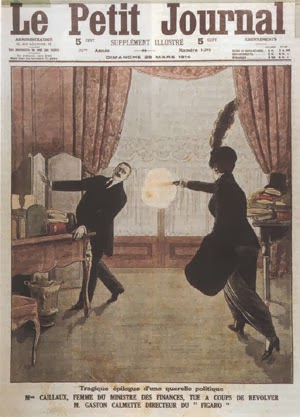

Mme. Caillaux and Gaston Calmette

On the evening of March 16, Henriette Caillaux, the wife of Joseph Caillaux, France's Minister of Finance and former Premier, went to the office of Gaston Calmette, the editor of Le Figaro, and asked to see him.  Le Figaro had been conducting a vigorous campaign against Caillaux, and had recently published a letter, apparently written by Caillaux to Henriette at a time when both were married to others, that suggested a close relationship.  When she was admitted to Calmette's office, Mme. Caillaux drew a pistol from her muffler and fired five shots.  Four of them struck Calmette, who died from his wounds.  M. Caillaux has resigned from the cabinet, and his wife is in custody.  At a hearing on March 24, she told the magistrate she knew of no other way to prevent the further publication of her private letters.


The Earl of Leitrim Reviewing a Contingent of Ulster Volunteers

The Irish home rule controversy in Great Britain approached crisis levels this month.  The introduction and apparently inevitable passage of the government's Home Rule bill, which this time will become law with or without the approval of the House of Lords, is fiercely opposed by Ulster Protestants and their Unionist supporters, who talk of civil war.  An armed militia, the Ulster Volunteers, appears ready to resist by force any attempt to subject the northern counties of Ireland to rule by a Dublin parliament.  King George V has expressed to Prime Minister Herbert Asquith the opinion that, while the people of Great Britain have expressed their approval of home rule in recent elections, they cannot be said to have approved the use of the British military to coerce the people of Ulster.  The bill introduced on March 9 represents an attempt at compromise.  It would allow each Ulster county to hold a plebiscite to exclude the county from home rule for a period of six years, during which time the people of Great Britain will have two additional opportunities to express their opinion in general elections.  This proposal has been rejected by the Unionists, Sir Edward Carson calling it a "sentence of death with a stay of execution for six years."  In a speech at Bradford on March 14, First Lord of the Admiralty Winston Churchill delivered a strong rebuttal, arguing that the Unionists, who claim to oppose coercion of the one-fifth of Ireland opposed to home rule, are in reality insisting on coercion of the other four-fifths.  He charged that the Unionists, by advocating armed resistance to an act of Parliament, "denounce all violence except their own.  They uphold all law except the law they choose to break."


General Sir Arthur Paget

General Sir Arthur Paget, the commander of British troops in Ireland, has been instructed to safeguard depots of arms and ammunition in Ulster, but has warned the government that moving troops from their base at the Curragh in County Kildare to northern Ireland would be provocative.  On March 18 he met in Westminster with Churchill, Secretary of State for War J.E.B. Seely, and General Sir John French, Chief of the Imperial General Staff.  Upon Paget's return to the Curragh, fifty-eight cavalry officers led by Brigadier General Hubert Gough declared their intention to resign from the army rather than participate in coercion of their fellow Britishers in Ulster.  Encouraged by French, Seely attempted to head off the resignations by giving written assurances that British troops would not be used in an attempt to coerce Ulster, assurances that Asquith repudiated when he learned of them.  By month's end, Seely and French had resigned their positions and Asquith had taken over the duties of Secretary of State for War.


Jose Lopez Portillo y Rojas

The head of the de facto government of Mexico, Victoriano Huerta, agreed this month to resume negotiations with John Lind, President Wilson's personal emissary, who has been at Veracruz since Huerta broke off talks last August.  On March 19 Mexican Foreign Minister Jose Lopez Portillo y Rojas met with Lind at the Veracruz home of a mutual friend.  Meanwhile, military action by the "Constitutionalists" against the Huerta government continued, with rebels under the command of Francisco "Pancho" Villa battling federal army forces at Torreon.


Giving In On the Tolls Issue

The Panama Canal tolls dispute between Great Britain and the United States appears close to resolution. Retracing a path he has trod frequently in the past year, President Wilson went to Capitol Hill on March 5 and asked a joint session of Congress to repeal the provision of the Panama Canal Act that provides free passage for American ships traveling between American ports.  Great Britain has objected to that provision, arguing that it violates the 1901 Hay-Pauncefote Treaty.  The president told Congress that, because the American position on the tolls issue had been questioned and misunderstood by other nations, "we ought to reverse our action without raising the question whether we were right or wrong."  He added a personal appeal, saying "I ask this of you in support of the foreign policy of the Administration.  I shall not know how to deal with other matters of even greater delicacy and nearer consequence if you do not grant it to me in ungrudging measure."  On March 31 the repeal bill passed the House by a vote of 247 to 162, but not without bitter opposition from members of both parties.  Speaker Champ Clark had previously announced his opposition, and Representative Joseph R. Knowland of California, the senior Republican member of the Interstate and Foreign Commerce Committee, took the floor to accuse the president of trying to get the United States to "surrender under foreign pressure" for the first time in its history.  The vote in the Senate is expected to be close.


Herman Rosenthal

In October 1912 New York Police Lieutenant Charles Becker was convicted of first degree murder and sentenced to death for conspiring to kill Herman Rosenthal, a small time hoodlum who was exposing Police Department corruption in interviews with a reporter for the New York World.  The World articles led to a meeting between Rosenthal and District Attorney Charles Whitman on July 15, 1912.  When Rosenthal left the meeting, he went to the Hotel Metropole on 43rd Street where he was gunned down on the sidewalk (see the August and October 1912 installments of this blog).  Last month the New York Court of Appeals (the state's highest court) affirmed the convictions of the gunmen who fired the shots that killed Rosenthal, but set aside Becker's conviction on the ground that the trial judge was biased and had conducted the trial in a highly prejudicial manner.  District Attorney Whitman has announced that he will try Becker again on the same charges, and a new trial is scheduled to begin May 6.  The convicted trigger men -- Jacob "Whitey Lewis" Seidencoffer, Louis "Lefty Louie" Rosenberg, Francisco "Dago Frank" Cirofici, and Harry "Gyp the Blood" Horowitz -- are scheduled to go to the electric chair next month, but Governor Glynn is considering a request for commutation or stay of execution pending the outcome of the second Becker trial.


 Leo Frank and His Wife at His Trial Last Year
 
Another murder trial, this one in Georgia, has resulted in the conviction of Leo Frank, superintendent of the National Pencil Company's factory in Atlanta, for the rape and murder last April of a fourteen-year-old factory employee, Mary Phagan.  The trial was conducted in an atmosphere of intense public anger at the brutal crime, reinforced in the Frank case by resentment of outsiders (Frank had moved to Atlanta from New York) and antisemitism.  Crowds demanding Frank's conviction filled the courtroom and demonstrated loudly outside the courthouse every day.  Prior to the announcement of the verdict the trial judge expressed concern for the jurors' safety in the event of a not guilty verdict; at the prosecutor's request Frank was removed from the courtroom and sent back to his cell to protect him from the mob.  When the guilty verdict was announced it was greeted with cheers so loud and prolonged that the judge was unable to hear the polling of the jury.  Although many observers believe that Frank was unable to receive a fair trial under these circumstances, the Georgia Supreme Court has denied his request for a new trial.  His execution by hanging has been scheduled for April 17.  This month his lawyers filed another motion for a new trial, this one supported by new evidence supporting Frank's alibi and pointing to Jim Conley, a Negro factory employee who was the principal trial witness against Frank, as the likely murderer. 


 Mississippi Senators John Sharp Williams . . .

. . . and James K. Vardaman

On March 19 the United States Senate took up a proposal to approve a woman's suffrage amendment to the United States Constitution and submit it to the states for ratification.  The vote was 35 (14 Democrats and 21 Republicans) in favor and 34 (22 Democrats and 12 Republicans) opposed.  Because a two-thirds vote is necessary, the proposal failed.  Before the final vote, two amendments were proposed by Democrats from Mississippi.  The first, submitted by Senator James K. Vardaman, would have added language allowing states to deny the vote to Negroes, effectively repealing the Fifteenth Amendment to the Constitution.  Vardaman's proposal was defeated by a vote of 19 to 48.  The second, offered by Senator John Sharp Williams, would have extended the suffrage to white women only.  It was defeated by a vote of 21 to 44.  When the unamended suffrage proposal came to a vote, both Vardaman and Williams were among the 34 opposed.  Meanwhile, state by state efforts to extend the suffrage to women continued.  A suffrage bill was passed by the Massachusetts House of Representatives on March 26, and similar measures went down to defeat in the Virginia House of Delegates on March 11 and in the Kentucky Senate on March 13.

The woman suffrage campaign also continues in Great Britain.  On March 9 police arrived in St. Andrew's Hall, Glasgow, to arrest suffragist leader Emmeline Pankhurst as she began a speech denouncing the government.  As the police approached the podium, they found that the flowers decorating the front of the stage concealed barbed wire.  Mrs. Pankhurst's supporters surrounded her and fought with the police, one of them firing blank shots from a revolver.  The police finally succeeded in dragging Mrs. Pankhurst from the hall and into a waiting taxicab, which took her to a police station.  Several policemen and suffragists sustained minor injuries in the melee, and one woman was taken to a hospital.


Eleanor Wilson

Miss Eleanor Wilson, 24, is the youngest of President Wilson's three daughters.  On March 13, the president announced her engagement to William G. McAdoo, the Secretary of the Treasury. This will be the second marriage for McAdoo, 50, whose first wife died in 1912.


Sikorsky's New Aeroplane

Another advance in the field of aviation was reported this month.  In Russia, Igor Sikorsky has designed and built an aeroplane that conducts regular flights over St. Petersburg with as many as sixteen people on board.  The machine has four engines, each generating 100 horsepower, and a wing area some five times that of ordinary biplanes.   The forward part of the fuselage contains cabins with electric lighting and large windows on the side and floor for observation and photography.


Marconi's Wireless Telephone

Advances in communication are also in the news.  Speaking in London on March 24, Guglielmo Marconi reported encouraging success with recent experiments in wireless telephony.  Extended conversations over distances up to 45 miles have been conducted in Italy, and Marconi says he hopes soon to carry on telephonic conversations between Ireland and London "if everything doesn't get smashed up over Ulster and prevent the experiment."   He predicted that with larger machines he will be able to talk by telephone across the Atlantic in the near future, perhaps as soon as six months from now.


George Westinghouse

George Westinghouse died on March 12 at the age of 67.  A Civil War veteran, he went on to become one of the leaders of American industry in the latter part of the nineteenth century.  He controlled thousands of patents, hundreds of which were for his own inventions, including the railroad air brake, the alternating current system of electricity generation, and systems enabling the use of natural gas for domestic and industrial fuel.  Other notable deaths this month included B.F. Keith, 68, owner of the vaudeville circuit that bears his name, who died March 26; and George W. Vanderbilt, 51, son of William H. Vanderbilt and grandson of Cornelius Vanderbilt, who died March 6 following an appendectomy.  Mr. Vanderbilt is best known for Biltmore, the estate he built in North Carolina.


March 1914 – Selected Sources and Recommended Reading

Contemporary Periodicals:
American Review of Reviews, April and May 1914
New York Times, March 1914

Books and Articles:
A. Scott Berg, Wilson
Philip Blom, The Vertigo Years: Europe, 1900-1914
Randolph S. Churchill, Winston S. Churchill: Young Statesman 1907-1914
Christopher Clark, The Sleepwalkers: How Europe Went to War in 1914
John Milton Cooper, Jr., Woodrow Wilson: A Biography
John Milton Cooper, Jr., The Warrior and the Priest: Woodrow Wilson and Theodore Roosevelt
Patrick Devlin, Too Proud to Fight: Woodrow Wilson's Neutrality
Charles Emmerson, 1913: The World Before the Great War
David Fromkin, A Peace to End All Peace: Creating the Modern Middle East, 1914-1922
Martin Gilbert, A History of the Twentieth Century, Volume One: 1900-1933
Doris Kearns Goodwin, The Bully Pulpit: Theodore Roosevelt, William Howard Taft, and the Golden Age of Journalism
Kermit L. Hall ed., The Oxford Companion to the Supreme Court of the United States
Richard F. Hamilton and Holger H. Herwig, Decisions for War, 1914-1917
Max Hastings, Catastrophe 1914: Europe Goes to War
August Heckscher, Woodrow Wilson: A Biography
Arthur S. Link, Woodrow Wilson and the Progressive Era, 1910-1917
Robert K. Massie, Dreadnought: Britain, Germany, and the Coming of the Great War
Margaret MacMillan, The War That Ended Peace: The Road to 1914
Kenneth Rose, King George V

Friday, February 28, 2014

February 1914

February 1914:  This month there are some clouds on the horizon in a mostly peaceful world. In Russia, the premier who resisted calls for action against Germany over the von Sanders affair is forced from office, and in Germany a new tax goes into effect designed to support expansion of the kaiser's military. Wilson rescinds the embargo on arms shipments to Mexico, and takes a step toward resolution of the dispute over Panama Canal tolls. Racial legislation in the United States continues to strain relations with Japan. In Great Britain, civil war is threatened as Irish home rule moves closer to final enactment.

*****
 

Premier Vladimir Kokovtsov ...

... and His Successor, Ivan Goremykin

Vladimir Kokovtsov became Russian premier and chairman of the Council of Ministers following the assassination of Pyotr Stolypin in 1911.  On February 12 he resigned and was replaced by former Premier Ivan Goremykin.  His departure was not unexpected. In December he fell out of favor with some in the government when he resisted calls for action against Germany following the assignment of General Otto Liman von Sanders to Constantinople as an "adviser" to the Ottoman army.  Goremykin, his replacement, is the candidate of the party that advocates a more aggressive stance in relations with Germany. 


Chancellor Theobald von Bethmann-Hollweg

In Germany, the Reichstag has voted to impose a new tax to support its ongoing military expansion.  Called the "Contribution to Defense" tax, it will raise more than $250,000,000 to support an increase in the German army and navy.  Despite its military purpose, the tax was supported by the Socialists, the dominant party in the Reichstag, because it will be paid primarily by the wealthy.  In another development in Germany, all members of the civil government of Alsace-Lorraine resigned at the end of January.  Their action was in direct response to the Zabern incident and its aftermath, which included the court-martial acquittals of the Army officers involved and the refusal of German Chancellor Theobald von Bethmann-Hollweg to resign despite losing a vote of censure in the Reichstag.


Walter Long

King George V opened the British Parliament on February 10.  In the speech from the throne, he counseled "a spirit of mutual concession" on the issue of home rule for Ireland, a theme that Prime Minister Asquith and Irish Party leader John Redmond echoed in the subsequent debate in the House of Commons.  Unionist Walter Long, former Chief Secretary for Ireland, responded for the opposition, warning of civil war if Ulster's demands were not satisfied.  He moved that the House's reply to the speech from the throne be amended to assert that "it would be disastrous for the House to proceed further with the Government for Ireland bill until the measure has been submitted to the judgment of the country."  His motion was defeated by a vote of 333 to 255.


Reconsidering Panama Canal Tolls

A source of controversy between the United States and Great Britain may be moving closer to resolution.  President Wilson let it be known early this month that he favors repeal of the provision of the Panama Canal Act that provides for free passage through the canal for American coastwise shipping, a provision to which Britain has objected as a violation of the 1901 Hay-Pauncefote Treaty providing for equal access to the canal by all nations.  The United States has defended the provision as no different from a subsidy.  The president, however, has now concluded that apart from the legalities, which are debatable, the United States is morally bound by the provisions of the treaty.  When the president's position became known, Senator Bristow of Kansas took to the floor of the Senate to object, suggesting that he was bowing to railroad interests.  He was immediately answered by Senator Henry Cabot Lodge, the ranking Republican on the Foreign Relations Committee, who supported the president, stating that Great Britain was not the only nation that objected to the discriminatory toll provision, and warning the Senate that the "perilous character" of the country's international relations as a result of the controversy might lead the United States to "serious loss or serious injury or wars or something like war."

President Wilson has appointed Colonel George W. Goethals governor of the Panama Canal Zone.  He will assume his new position on April 1.  Goethals is a logical and popular choice, having supervised the massive construction project since 1907, when President Roosevelt chose him to be its chief engineer.  

In 1903, shortly after the Isthmus of Panama was chosen as the site for a canal, the Roosevelt administration negotiated the Hay-Herran Treaty with Colombia.  The treaty provided for the establishment of a canal zone from ocean to ocean through Panama, then a Colombian province.  The treaty called for generous lease payments to Colombia, and Colombian commerce stood to benefit as much as that of any country from the existence of an inter-ocean canal.  Colombia, however, was emerging from a period of political unrest and civil war, and the treaty ran into political opposition.  Although it was ratified by the United States Senate, the Colombian Congress rejected it.  President Roosevelt responded swiftly and decisively.  In rapid succession, he sent a gunboat to the isthmus to support an ongoing revolution by Panamanian separatists, formally recognized Panama's independence, and entered into the Hay-Bunau-Varilla Treaty with the new nation.  To this day, Colombia resents the United States' role in the loss of Panama, resentment that is focused largely on Roosevelt himself.  (It is no accident that Roosevelt's current swing through South America does not include a visit to Colombia.)  Now, in anticipation of the opening of the canal, Secretary of State Bryan is in negotiations aimed at reaching a settlement with Colombia, a settlement that would presumably include the payment of reparations.  Roosevelt is known to consider the Canal the signature achievement of his presidency, and to feel strongly that the United States owes Colombia no reparations or apology, or anything else that could be construed as an admission of wrongdoing.  All things considered, it is probably just as well that he is in the Brazilian jungle, beyond the reach of newspapers and reporters.


Guns Being Packed in New Orleans for Shipment to Mexican rebels

On March 14, 1912, when President Francisco Madero was still in power in Mexico, President Taft, acting pursuant to a joint resolution of Congress, imposed an embargo on the shipment of arms to that country from the United States.  The joint resolution found that a condition of domestic violence existed in Mexico that was promoted by such shipments, and made them unlawful except under such limitations and exceptions as the president might prescribe.  Since then, Mexico's domestic violence has resulted in the very occurrence that it was hoped the embargo would prevent -- the overthrow and assassination of Madero.  Now that Mexico is under the dictatorial regime of Victoriano Huerta, the embargo is serving only to prevent the shipment of arms to rebels seeking Huerta's overthrow.  Making use of his authority to prescribe "limitations and exceptions," President Wilson on February 3 revoked the embargo in its entirety, noting that conditions in Mexico have "essentially changed" since it was imposed.  The president's hope is that resumption of the flow of arms and ammunition from the United States to Mexico will assist the rebels in their efforts to overthrow Huerta.


Attorney General James C. McReynolds

Hearings in Congress continued this month on proposed new anti-trust legislation designed to clarify and improve enforcement of the laws against monopolies and restraints of trade and to establish a trade commission to regulate competitive activity in interstate commerce.  Meanwhile, Attorney General McReynolds seems determined to demonstrate the continued relevance of the 1890 Sherman Act, which was used aggressively in the "trust-busting" campaigns of the Roosevelt and Taft administrations.  On February 11, in a sequel to last year's Supreme Court ruling that ordered the dissolution of the merger of the Union Pacific and Southern Pacific Railroads, the Department of Justice sued, again under the Sherman Act, to force divestiture of the Southern Pacific's leasehold interest in lines owned by the Central Pacific Railroad.


 A Drawing of the Aeroboat Designed by Glenn Curtiss for Mr. Wanamaker

The Panama-Pacific Exposition has announced a prize of $150,000 to be awarded next year to the aviator making the fastest trip around the world in ninety days or less.  The prescribed route begins in San Francisco and crosses the United States to New York, then north to Labrador, Greenland and Iceland, through Scotland and England to Europe, across Russia and Siberia with a stop in Japan, over to Alaska and down the Pacific coast to the starting point in San Francisco.  The total distance is in excess of 21,000 miles.  Several aviators have stated their intention to enter the race, which is to take place in 1915, the Exposition year.  The Aero Club of America is taking the lead in making the arrangements, with the cooperation of foreign aero clubs and governments along the route.

A somewhat less ambitious offer is on the table for this year.  In a competition sanctioned by the Aero Club of America and the Royal Aero Club of Great Britain, Lord Northcliffe has offered $50,000 for the completion of the first flight across the Atlantic Ocean.  An attempt to claim the prize has been announced by Mr. Rodman Wanamaker of Philadelphia, who is backing construction of an aeroboat designed under the supervision of Glenn H. Curtiss.  Carrying a wingspread of some eighty feet and powered by a 200 horsepower engine, it will be more than twice the size and power of the largest aeroplanes now in existence, and is expected to be capable of speeds up to 70 miles per hour.  It will carry two pilots and be able to make the trip in a single flight during the daylight hours of a single day, flying nonstop from St. John's, Newfoundland to the west coast of Ireland.  Three other giant flying boats are being constructed in Europe for the purpose of entering the competition.  To take advantage of the prevailing westerly winds, all the flights will originate in North America and make the transatlantic flight from west to east.  Inventor Orville Wright, whose patents were recently upheld by the Circuit Court of Appeals, says he will not allow Mr. Curtiss to build or fly the Wanamaker aeroboat, or any other aeroplane, in the United States without first obtaining a license from the Wright Company.

Another race, also sanctioned by the Aero Club of America, will be held this summer.  Open to aeroplanes equipped with pontoons for water landing, the race will start in New York Harbor at the Statue of Liberty, round the Boston Light in Boston Harbor, and return to New York Harbor without stopping (landing en route will result in disqualification).  Covering a distance of approximately 600 miles, it will be the longest air race ever held in the United States.


Illinois Governor Edward Dunne Signing the Suffrage Bill

Last June Illinois became the first state east of the Mississippi to grant women the right to vote.  Response has exceeded expectations, some 150,000 women having registered for the upcoming aldermanic elections in Chicago.  In other states, both houses of the New Jersey legislature approved a woman suffrage amendment to the state constitution this month, and on February 18 the suffrage movement suffered a setback when the Maryland House of Delegates rejected a similar amendment.  In Washington on February 3, the House Democratic caucus adopted a resolution stating that woman suffrage is a state and not a federal issue.


Helping Income Taxpayers in New York

March 1 is the deadline for filing returns under the new income tax law, and financial and banking houses have been occupied this month in assisting their clients with the necessary paperwork.  The law contains some unanticipated provisions.  One that made the front page of the New York Times this month is that social clubs such as the Union League, Metropolitan and University Clubs have learned that they will be required to file returns and pay any tax due if they are organized as corporations.  The old corporate excise tax law, which the income tax law replaces, exempted all corporations "not organized for profit."  The new income tax law specifies certain corporations that are exempt, such as labor and agricultural organizations, fraternal societies, chambers of commerce and the like, but does not specify social clubs and contains no blanket exclusion for non-profits.  The Times cites this as proof that the new law is "an almost inexhaustible mine of surprises."


Secretaries McAdoo and Houston at the Hearing in New York Last Month

This month Secretary of the Treasury McAdoo and Secretary of Agriculture Houston completed their hearings to determine the location of Federal Reserve Banks and the boundaries of Reserve Districts to be established under the new currency law.  The hearings were held in numerous cities across the country, ending with a sweep through the western states this month.  The secretaries returned to Washington on February 18, and their report is expected shortly.  Also expected shortly are the president's selections for appointment to the Central Reserve Board, which will oversee the activities of the Reserve Banks.


Bryan Catching Up on His Mail

Relations between the United States and Japan, already strained by California's anti-Japanese laws, worsened perceptibly this month.  An immigration bill pending in the House of Representatives proposes to restrict immigration by imposing a literacy test requirement.  The House of Representatives voted on February 2 to amend the bill to exclude all Asiatic immigrants, regardless of literacy.  The vote was rescinded the following day, but it adds to the impression in Japan that immigrants from that country are not welcome in the United States.  At last count, the Japanese government has sent three diplomatic notes to the United States protesting the California legislation.  Japanese Foreign Secretary Baron Makino, in his annual report to the Diet at the end of last month, reported that no reply had been received to the most recent of those notes, which was presented in August.  He said it might therefore be necessary to formulate "other plans for the solution of the question."  Members of the opposition party were vocal in their criticism of Makino and his government, contending that they had placed too much reliance on American good will.  Other recent irritants in Japanese-American relations involve the ongoing turmoil in Mexico.  They include the sale of surplus Japanese weapons to the Huerta regime and the dispatch of a Japanese cruiser to the west coast of Mexico, ostensibly to protect the interests of Japanese citizens there.


Slumber

The Westminster Kennel Club Dog Show is the longest running dog show in the United States.  This year it was held on February 25 at the Grand Central Palace in New York City.  The Best in Show prize went to Slumber, an Old English Sheep Dog.  Slumber is owned by Mrs. Taylor Morse.


 Dustin Farnum (left) as The Squaw Man

After a successful run on Broadway, The Squaw Man was released this month as a motion picture.  One of the first full-length feature plays to be produced on film, it is the first to be produced in Hollywood, California, an increasingly popular place for motion picture production.  Directed and produced by Cecil B. DeMille, it stars Dustin Farnum in the title role.  


Joshua Chamberlain During the Civil War

Major General Joshua L. Chamberlain died on February 24.  A college professor when the Civil War began, he joined the Union Army and commanded the 20th Maine at the Battle of Gettysburg.  The regiment's successful defense of its line at Little Round Top on the crucial second day of the battle helped prevent the Confederate attackers from turning the flank of the Union Army, and was a significant factor in the Union victory.   Chamberlain was awarded the Medal of Honor, and later served as President of Bowdoin College and Governor of Maine.


Senator Bacon

Another notable death this month was that of Senator Augustus O. Bacon of Georgia.  A Confederate veteran of the Civil War, he was elected to the Senate in 1894.  At the time of his death he was serving as Chairman of the Senate Committee on Foreign Relations.  The new chairman is Senator William J. Stone of Missouri.


February 1914 – Selected Sources and Recommended Reading

Contemporary Periodicals:
American Review of Reviews, March and April 1914
New York Times, February 1914

Books and Articles:
A. Scott Berg, Wilson
Randolph S. Churchill, Winston S. Churchill: Young Statesman 1907-1914
Christopher Clark, The Sleepwalkers: How Europe Went to War in 1914
John Milton Cooper, Jr., Woodrow Wilson: A Biography
John Milton Cooper, Jr., The Warrior and the Priest: Woodrow Wilson and Theodore Roosevelt
Patrick Devlin, Too Proud to Fight: Woodrow Wilson's Neutrality
Charles Emmerson, 1913: The World Before the Great War
David Fromkin, A Peace to End All Peace: Creating the Modern Middle East, 1914-1922
Martin Gilbert, A History of the Twentieth Century, Volume One: 1900-1933
Doris Kearns Goodwin, The Bully Pulpit: Theodore Roosevelt, William Howard Taft, and the Golden Age of Journalism
Max Hastings, Catastrophe 1914: Europe Goes to War
August Heckscher, Woodrow Wilson: A Biography
Arthur S. Link, Woodrow Wilson and the Progressive Era, 1910-1917
Robert K. Massie, Dreadnought: Britain, Germany, and the Coming of the Great War
David McCullough, The Path Between the Seas: The Creation of the Panama Canal, 1870-1914
Candice Millard, The River of Doubt: Theodore Roosevelt's Darkest Journey
Edmund Morris, Colonel Roosevelt
Scientific American, January 1, 2014, Civilian Airplanes 1914 [Slide Show], http://www.scientificamerican.com/article/aviation-civilian-airplanes-1914-slide-show/
Stephen W. Sears, Gettysburg

Friday, January 31, 2014

January 1914

The year 1914 opens with President Wilson in Pass Christian, Mississippi, on Christmas vacation.  The turmoil in Mexico still dominates his foreign policy concerns.  On the domestic front, trust legislation has risen to the top of the agenda.  Henry Ford announces a five dollar a day minimum wage for his employees.  Former and future felon James Michael Curley is elected mayor of Boston, replacing JFK's grandfather John F. ("Honey Fitz") Fitzgerald.  Former Confederate General and Kentucky Governor Simon Bolivar Buckner dies; his son (same name) will command American forces on Okinawa in World War II.  Orville, the surviving Wright brother, wins a big patent suit.  A civil government will take over in the Canal Zone, probably to be headed by Colonel Goethals.  Germany inaugurates wireless communication with the United States.  German courts exonerate the German Army in the Zabern incident, and the Kaiser again has trouble controlling his son the Crown Prince.  In England, Joseph Chamberlain announces his retirement from Parliament.  In China Yuan Shih-Kai decides he can rule without Parliament.  In Turkey, Enver Pasha becomes Minister of War.  A volcano erupts in Japan, and racial tension continues in South Africa between Europeans and Indian immigrants.


*****


The President with Mrs. Wilson at Pass Christian . . .

. . . and Boarding the U.S.S. Chester to confer with John Lind

President Wilson began the month of January at his temporary vacation residence in Pass Christian, Mississippi.  While there, he took advantage of his presence on the gulf coast to summon John Lind, his envoy to Mexico, to a meeting.  Lind was carried by the cruiser U.S.S. Chester (CL-1) from Veracruz to Pass Christian, where on January 3 the two conferred aboard ship.  The content of the discussions has not been disclosed, but the Navy Department announced on January 8 that United States Marines stationed at Panama would be relocated to American warships at Veracruz.  Although the Navy has said the redeployment is routine, one reason may be to have additional forces available for a landing on the Mexican coast should that become necessary.


 Mexican Refugees on the American Side of the Rio Grande

On January 10, Mexican "Constitutionalists," reinforced by Pancho Villa's rebel forces, captured the city of Ojinaga in the Mexican state of Chihuahua near the Texas border.  Federal forces fleeing across the border, some with their families, present a refugee problem for the American government.  For the time being, the refugees are in Presidio, Texas, and the plan is to move them to Fort Bliss, near El Paso.  The commander of American troops on the border, Brigadier General Tasker Bliss (no relation to the fort), has expressed concern about handling so many refugees, suggesting that they be sent instead to San Diego.


Nelson O'Shaughnessy

General Huerta's New Year's message to President Wilson required a response, but the Wilson administration wants to avoid anything that would imply recognition of the Huerta regime.  On January 7, American Charge d'Affaires Nelson O'Shaughnessy sent the following message to the Mexican Foreign Minister:  "I am instructed by my Government to transmit the greetings of the President of the United States to the Mexican people, as well as his earnest good wishes for the prosperity of the Mexican republic."


Huerta Defying Uncle Sam: The View From Mexico City

Mexico's financial situation is dire and getting worse.  On January 13, the Mexican government announced that it would default on the interest due on its domestic and foreign debt.  Two days later the government suspended payment on postal money orders and the Mexican Minister of Finance Adolfo de la Lama resigned in protest.  The amount currently in default on Mexican debt is in excess of $13,000,000.  European countries with substantial investments in Mexico are following developments there with concern, but seem content for the present to let the United States take the lead.  For its part, the United States is adhering to its policy of "watchful waiting."  The Huerta government in Mexico City continues, meanwhile, to denounce American imperialism.


Representative Henry Clayton

President Wilson returned to Washington on January 13.  On January 20 he addressed Congress again, this time in support of new anti-trust legislation.  Proposals before Congress are designed to improve the mechanism for enforcement of anti-monopoly laws and to respond to criticism that the Sherman Act's prohibition of combinations "in restraint of trade" gives insufficient guidance to businessmen.  The legislative effort will be managed in the House of Representatives by Representative Henry D. Clayton of Alabama, Chairman of the House Judiciary Committee, who abandoned plans to run for the Senate when President Wilson asked him to stay in the House so he could continue to manage this legislation.


Joseph E. Davies

"Trust" is a term originally used in connection with the management of personal estates.  In the last century, however, businessmen began using "voting trusts" to hold the stock and manage the affairs of interstate corporations, and in recent years "trust" has come to refer generally, if imprecisely, to large American corporations such as Standard Oil and American Tobacco.  The 1890 Sherman Act was designed to provide a tool for the federal government to control the competitive activities of such companies, and it has in fact been used successfully in recent years against several corporations, including the two just mentioned.  It has been criticized, however, for providing insufficient guidance to businessmen regarding competitive practices that are allowed and those that are not.  After the Supreme Court's recent Standard Oil decision, it was also criticized for injecting a "rule of reason" into the language of the Act, which on its face outlaws "[e]very combination ... in restraint of trade."  One suggested remedy is to enact legislation stating specific forbidden practices, such as interlocking directorates and price discrimination.  Another is to establish a federal commission with the power to examine and regulate particular practices as they appear.  The commission envisioned by the latter proposal would likely be an expanded version of the Commerce Department's Bureau of Corporations, presently headed by Commissioner of Corporations Joseph E. Davies.


The New Spirit of Cooperation

Perhaps in response to the increased focus on trust legislation, several large companies have recently agreed to remedies proposed by the Justice Department.  Settlements this month include the American Telephone & Telegraph Company's agreement to divest its interest in Western Union, and the agreement of the New York, New Haven and Hartford Railroad to sell its interests in trolley lines, steamship lines and the Boston & Maine Railroad.  Several leading bankers have resigned from corporate boards in response to interlocking directorate concerns.  Cases brought under the Sherman Act are still pending against the United States Steel Corporation, the International Harvester Company and the American Sugar Refining Company.


John Skelton Williams

On January 13, President Wilson named Assistant Secretary of the Treasury John Skelton Williams to be Comptroller of the Currency.  In addition to the traditional duties of that position, Williams will join Secretary of the Treasury McAdoo and Secretary of Agriculture Houston as the third ex officio member of the committee that is holding hearings to determine the number and locations of the Federal Reserve Banks to be established under the new currency law.


Governor Buckner

Simon Bolivar Buckner, a Lieutenant General in the Confederate army during the Civil War who served as Governor of Kentucky from 1887 to 1891, died on January 8.  Buckner was a graduate of West Point, where he became friends with Ulysses S. Grant.  When the Civil War broke out in 1861 he and Grant found themselves on opposite sides, and he was the recipient of Grant's famous "unconditional surrender" demand at Fort Donelson.  They renewed their friendship after the war, and when Grant died in 1885 Buckner was one of his pallbearers.


Henry Ford

Henry Ford, head of the Ford Motor Company, announced on January 5 that his company would make $10,000,000 in profit-sharing payments to its employees in 1914, and begin paying its workers a minimum wage of five dollars a day.  This is made possible by the popularity of the Model T automobile and the company's increased productivity resulting from the recent institution of the assembly line.  Ford also announced that the company would begin running its factory continuously, reducing the length of a shift to eight hours and operating three shifts a day, thereby providing employment for thousands of additional workers.  Boys and women, constituting about ten percent of Ford's work force, will not receive the profit sharing payments unless they are supporting families, but all employees will have the benefit of the minimum five dollar wage.


The New Mayor of Boston

Representative James Michael Curley, now serving his second term in Congress, was elected Mayor of Boston on January 13.  He succeeds John Francis ("Honey Fitz") Fitzgerald, who decided not to seek reelection due to health concerns.  The new mayor promises an honest and efficient administration for the City of Boston.


 Orville Wright

In 1906 Wilbur and Orville Wright were granted a patent for a "flying machine."  The heart of the invention was a method of controlling heavier than air machines in flight.  Claiming that the patent was invalid, rival manufacturer Glenn Curtiss refused to pay a royalty to the Wrights, and a lawsuit ensued.  On January 13, the Circuit Court of Appeals upheld a judgment in the Wrights' favor, leaving the Wright company the sole legal manufacturer of aeroplanes in the United States.  Earlier in the month Orville Wright took one of his machines to a field near Dayton, Ohio, and demonstrated what he calls an "automatic stabilizer."  He says this innovation makes flying "as nearly foolproof as anything can be," and he hopes "to see the day when it will be just as safe to board an aeroplane and take a long trip as it is at present to make a journey behind a locomotive."

As if in response to Wright's comment, the Daily Mail reported on January 28 that British government experts are considering plans for a new type of aircraft designed to carry ten passengers in addition to the pilot.  It is believed that such machines, manufactured in sufficient quantities, could be of vital importance in military operations.

*****

In the United States, 1913's most popular song was "When Irish Eyes Are Smiling."  It was written, and is sung here, by Chauncey Olcott (click to play):


Chauncey Olcott

*****


Joseph Chamberlain

In Great Britain, the January 6 edition of the Birmingham Post carried a letter from the Right Honorable Joseph Chamberlain announcing that he will not be a candidate for Parliament in the next election.  This brings to an end a remarkable political career.   A successful industrialist who entered politics as an outspoken radical, Chamberlain served as mayor of Birmingham from 1873 to 1876, when he was elected to Parliament as a member of the Liberal Party.  He served as President of the Board of Trade in the Gladstone government from 1880 to 1885.  In the home rule crisis of 1886 he led the "Liberal Unionists" out of the party to join the Conservatives in their opposition to home rule.  He has remained with the Unionists, serving as Secretary of State for the Colonies in the governments led by the Marquess of Salisbury and Arthur Balfour from 1895 to 1903.  His son Austen was Chancellor of the Exchequer in the last Unionist government.  Another son, Neville, is a member of the Birmingham City Council.


The Kaiser and Crown Prince Wilhelm

In the wake of the Zabern incident, in which German troops garrisoned in Alsace-Lorraine were accused of abusing the local (mostly French-speaking) residents, the Reichstag passed a vote of censure against the government for its handling of the affair.  The main culprit, Lieutenant Gunter von Forstner, was convicted by a court-martial and sentenced to forty-three days imprisonment.  On January 10, a separate court-martial acquitted the other officers involved, including Forstner's commanding officer Colonel Adolf von Reuter, and on the same day a court of appeals in Strasbourg reversed Forstner's conviction, holding that the disturbance was the fault of the local population and the inadequate protection afforded by the local police.  While the second court-martial was pending, German Crown Prince Wilhelm sent a telegram to Colonel von Reuter congratulating him on his "firm stand" in the matter.  When the Kaiser learned of the telegram, he stripped Wilhelm of his command of the "Death's Head" Hussars in Danzig and reassigned him to staff duty in Berlin.  This disagreement, the latest event is a long-running feud between the Kaiser and his heir, is reminiscent of the Kaiser's rebuke of his son in November 1911 after the Crown Prince, sitting in the Reichstag's visitors gallery, loudly applauded a speech criticizing the government's handling of the Agadir crisis.

The Kaiser celebrated his fifty-fifth birthday on January 27.  President Wilson sent birthday congratulations to the Kaiser, noting "the extent to which so many persons of German blood have contributed to the good citizenship and progress of the United States," and expressing "for myself and my countrymen a hearty wish for the continuation of the splendid progress and prosperity achieved by the German Empire during your reign."  On the same day the Kaiser sent a message to President Wilson announcing the opening of a new wireless transmitting station at Elvese, near Hanover.  The Kaiser's message was the first sent by direct wireless from Germany to the United States.  In his reply the President congratulated the Kaiser on "this additional tie of closer communications between the United States and Germany."  The wireless station in New Jersey that received the Kaiser's message is unable to transmit radiograms, so the President's reply was sent by cable.


Colonel Goethals

On January 27 President Wilson signed an executive order pursuant to the Panama Canal Act creating a civil government for the Canal Zone.  Secretary of War Garrison has notified Colonel George W. Goethals that it is the president's intention to appoint him governor.  This appears to have headed off an attempt by newly elected Mayor John Purroy Mitchel to appoint Colonel Goethals to the post of Police Commissioner of New York City.  Mitchel offered Goethals the job earlier in the month, and Goethals replied with conditions that could not be immediately met, including that he be given complete control of the Police Department.  Mayor Mitchel has submitted proposed bills to the state legislature designed to satisfy Colonel Goethals' conditions, but in response to an inquiry from Secretary Garrison, Colonel Goethals has stated he "will not retire [from the Army] as long as my services are needed."


Enver Bey

Enver Bey, now known as Enver Pasha since leading Turkish forces in the recovery of Adrianople from Bulgaria in the second Balkan War, was appointed Turkish Minister of War on January 4.  A leader of the "Young Turks" in their rise to power in 1908, Enver led the Ottoman defense of Libya in the Italo-Turkish War.  He was the military leader of the Young Turks last January when they overthrew the Grand Vizier and installed their own candidate.  That candidate, Mahmud Shevket Pasha, was in turn assassinated in June.  He was succeeded by the current Grand Vizier, Said Halim Pasha.


Sun Yat-Sen (Front Row, Sixth from Left, Hands on Knees) With Supporters in Japan

On January 11 President Yuan Shih-Kai issued a decree dissolving the Chinese Parliament.  Observers consider it unlikely that it will reconvene as long as Yuan Shih-Kai remains in power.  Sun Yat-Sen, leader of the opposition Kuomintang Party, remains in exile in Japan.


Residents of Sakura who Fled the Eruption Viewing the Devastation from Kagoshima

Sakura is a volcanic island in Kagoshima Bay, on the southern coast of the Japanese island of Kyushu.  The volcano that forms the island, dormant for over a hundred years, began to erupt on January 11 and continued for days, destroying three towns, killing hundreds and rendering twenty thousand residents homeless.  The city of Kagoshima, across the bay, suffered damage in the violent earthquake that accompanied the eruption.


 Prime Minister Louis Botha

There is racial strife in the Union of South Africa, the British dominion created in 1909 by the merger of Cape Colony, Natal, Transvaal and the Orange Free State.  The Boer-led government of the Union, still headed by its first prime minister Louis Botha, discriminates between white Europeans (primarily English and Boers) and natives of India who have immigrated to South Africa to work in the Rand mines.  Because the immigrants are citizens in good standing of British India, the official discrimination violates the policy of the British Empire that the citizens of all its dominions are to be granted full rights of citizenship throughout the Empire.  Last year the young lawyer Mohandas Gandhi led a strike and protest march, resulting in his arrest and imprisonment.  The controversy is limited to discrimination against Indian immigrants: no one is arguing that black African natives are entitled to equality with whites.


January 1914 – Selected Sources and Recommended Reading

Contemporary Periodicals:
American Review of Reviews, February and March 1914
New York Times, January 1914

Books and Articles:
A. Scott Berg, Wilson
H.W. Brands, The Man Who Saved the Union: Ulysses Grant in War and Peace
Randolph S. Churchill, Winston S. Churchill: Young Statesman 1907-1914
Christopher Clark, The Sleepwalkers: How Europe Went to War in 1914
John Milton Cooper, Jr., Woodrow Wilson: A Biography
John Milton Cooper, Jr., The Warrior and the Priest: Woodrow Wilson and Theodore Roosevelt
Patrick Devlin, Too Proud to Fight: Woodrow Wilson's Neutrality
Charles Emmerson, 1913: The World Before the Great War
David Fromkin, A Peace to End All Peace: Creating the Modern Middle East, 1914-1922
Martin Gilbert, A History of the Twentieth Century, Volume One: 1900-1933
Doris Kearns Goodwin, The Bully Pulpit: Theodore Roosevelt, William Howard Taft, and the Golden Age of Journalism
Max Hastings, Catastrophe 1914: Europe Goes to War
August Heckscher, Woodrow Wilson: A Biography
Arthur S. Link, Woodrow Wilson and the Progressive Era, 1910-1917
Peter T. Marsh, Joseph Chamberlain: Entrepreneur in Politics
Robert K. Massie, Dreadnought: Britain, Germany, and the Coming of the Great War
David McCullough, The Path Between the Seas: The Creation of the Panama Canal, 1870-1914
Candice Millard, The River of Doubt: Theodore Roosevelt's Darkest Journey
Edmund Morris, Colonel Roosevelt
Michael Perman, Struggle for Mastery: Disfranchisement in the South 1888-1908
Richard B. Sherman, The Republican Party and Black America From McKinley to Hoover, 1896-1933