Tuesday, September 30, 2014

September 1914

In September 1914, the World War is in its second month.  Millions of men are in combat in Europe and Africa, on the high seas and the coast of China.  The German invasion of France is turned back at the Marne, and four years of bloody stalemate on the Western Front begin.  Austria-Hungary, which started the war determined to punish Serbia for the assassination of the Archduke Franz Ferdinand, follows its embarrassing defeat in Serbia with another defeat in Galicia.  The German East Asia Squadron continues its voyage across the Pacific toward South America, as Japanese and British forces attack the German concession on the Shantung (now Shandong) Peninsula and occupy Tsingtao (now Qingdao, but still the home of Tsingtao Beer).  Foreshadowing a new era in naval warfare, a single German submarine sinks three British cruisers in the North Sea.  In Mexico, despite Huerta's ouster, the revolution isn't over, as Pancho Villa declares war on the new government of Venustiano Carranza.  In the Vatican, the Roman Catholic Church names a new Pontiff.  In the United States, former President Roosevelt publishes an article in The Outlook summoning Americans to their "twofold duties" in light of the World War, and Secretary of State William Jennings Bryan continues to pursue his goal of world peace through the adoption of "cooling off" treaties.


*****


General von Kluck

At the beginning of September, seven German armies were battling six French armies and a British Expeditionary Force in northern France, in the border regions of Alsace-Lorraine, and in the Ardennes Forest.  General Helmuth von Moltke, Chief of the General Staff, was in overall command of the German armies.  The right wing of the German attack was the First Army, commanded by General Alexander von Kluck, who had just turned his army's axis of advance away from Paris and toward the southeast to pursue the retreating French Fifth Army and to prevent a gap, already opening between his army and the adjacent Second Army, from growing.


General Joffre

General Maunoury

Meanwhile, General Joseph Joffre, in command of all French forces, made changes to meet the rapidly evolving military situation.  On September 3 he replaced General Charles Lanrezac, commander of the French Fifth Army, with General Franchet d'Esperey.  Using units transferred by rail from the south, he also created a new Sixth Army under the command of General Joseph Maunoury, which he positioned north of Paris.


General Gallieni

The German attack and steady approach of the German Army has had political ramifications in Paris.  At the end of August the government fled Paris for Bordeaux and President Poincare formed a new cabinet.  Rene Viviani continued as premier, Theophile Delcasse resumed his former post as Minister of Foreign Affairs, and Alexandre Millerand replaced Adolphe Messimy as Minister of War.  One of Messimy's last acts before leaving the Ministry of War was to appoint General Joseph Gallieni Military Governor of Paris.

When von Kluck turned the German First Army to the southeast, he exposed his flank to Gallieni's Paris garrison and Maunoury's newly formed Sixth Army, which attacked on September 6.  Gallieni commandeered every vehicle in Paris, including the city's entire complement of taxicabs, to rush troops to the front to join the battle (click to play):


*****


Lieutenant Colonel Hentsch

As von Kluck turned to meet the French attack from the west and the Second Army approached the Marne River to the south, the gap between the two German armies widened, and the British Expeditionary Force and French Fifth Army attacked.  At this point in the battle, von Moltke sent a member of his staff, Lieutenant Colonel Richard Hentsch, on a tour of the German army headquarters with authority to order withdrawal if it appeared advisable.  When he reached the Second Army headquarters, its commander, General Karl von Bulow, advised retreat.  Hentsch acquiesced, then proceeded to First Army headquarters where he ordered von Kluck to withdraw and close the gap between the two armies.


General von Falkenhayn

The First and Second German Armies retreated across the Aisne River where they established defensive positions on high ground along the Chemin des Dames, with the German line extending from there eastward to the Meuse River north of Verdun.  On September 14, dissatisfied with von Moltke's failure to achieve the swift victory envisioned by the Schlieffen Plan, the Kaiser replaced him as Chief of the General Staff with General Erich von Falkenhayn, the Minister of War.  Since then, each of the opposing armies has made unsuccessful attempts to turn its enemy's flank, extending the battle front northward from the Chemin des Dames toward the Channel coast.

As the German Army advanced through Belgium last month, the Belgian government abandoned Brussels and moved to Antwerp.  Pursuing the Schlieffen Plan, the German Army left Antwerp behind as it swept into northern France.  Unwilling to leave a potential enemy stronghold in his rear, General Falkenhayn has now turned his attention to Antwerp.  A German assault on the city began with an artillery bombardment on September 29.


General von Rennenkampf

At the end of August, the German Eighth Army won a decisive victory on the eastern front when it attacked and destroyed the Russian Second Army at the battle of Tannenberg.  The Russian First Army, commanded by General Paul von Rennenkampf, was advancing to the north of the Masurian Lakes, but failed to reach the battle in time to be of assistance.  Beginning on September 5, Hindenburg's Eighth Army, now reinforced by units transferred from the Western Front, attacked Rennenkampf's left (southern) flank.  German forces in the north mounted a simultaneous counteroffensive, forcing Rennenkampf's right wing to fall back.  Threatened with encirclement, Rennenkampf conducted a fighting retreat, withdrawing his army to forts on the Russian side of the border.

To the south the Russian Army was faring better.  From August 26 to September 11, the Russian and Austro-Hungarian armies were locked in battle in Galicia and southern Poland.  As the Austrian First Army advanced northward into Poland, the Russian Third and Eighth Armies attacked from the east into Galicia.  The Austrian forces around Lemberg were pushed back and the Russian Fifth Army attacked into a growing gap between those forces and the Austrian First Army to the northwest.  The battle ended in a decisive defeat of the Austrian Army, which retreated 100 miles to the west.  On September 7, before the battle was over, Russia formally annexed Galicia.


S.M.S. Scharnhorst, Admiral von Spee's Flagship

The German East Asia Squadron, rendered homeless by the outbreak of war, continued its journey across the Pacific this month.  By September 7 the squadron was at Christmas Island, where it was rejoined by the light cruiser S.M.S. Nurnberg.  Admiral von Spee had sent Nurnberg to Honolulu to use the neutral cable facilities there to advise the German Naval Staff of his intentions, and to Fanning Island to cut the British cable between the Fiji Islands and Hawaii.  When Nurnberg brought news from Honolulu that German Samoa had been occupied by troops from New Zealand, Spee decided to take his ships there.  He reached Samoa on September 14 but found no targets of opportunity and decided not to risk a landing.  Hearing the local wireless station broadcasting his position, he took his squadron away to the northwest to deceive the British as to his intentions.  Once over the horizon he turned and continued his easterly voyage, proceeding to Bora-Bora in the French Society Islands.  There the squadron spent several days taking on supplies, revealing its German identity only as it sailed away.  When the squadron approached Tahiti on September 22, the French garrison there had been alerted.  Its coal supplies had been destroyed and its navigation aids removed, and it fired on the approaching German ships until its shore batteries were silenced by German gunfire.  Continuing eastward from the Society Islands, Spee's squadron reached the undefended island of Nuku Hiva in the French Marquesas on September 26, where it remains at month's end.

As Admiral von Spee and his squadron were traversing the Pacific, S.M.S. Emden, detached from the squadron at the Marianas, was in the Indian Ocean attacking British shipping.  On September 22 it shelled the city of Madras, on the southeast coast of India.  Japanese and British forces, meanwhile, were attacking the German leased territories on the Shantung Peninsula, where last month they imposed a blockade of Tsingtao and its harbor at Kiau-Chau Bay.  Ignoring Chinese government protests, Japanese troops landed at Lung-kow, on the north shore of the peninsula, on September 2.  British troops from Australia and India landed in support of the Japanese on September 23, and on September 28 Japanese troops occupied Tsingtao.


H.M.S. Aboukir

When the war began, British cruisers and destroyers were assigned to patrol the "Broad Fourteens," an area of the southern North Sea named for its generally consistent depth of fourteen fathoms, primarily for the purpose of guarding against attacks on transports carrying British Army forces to France.  On September 22, three British armored cruisers, H.M.S. Aboukir, H.M.S. Cressy and H.M.S. Hogue, were on patrol when they were attacked and sunk by a single submarine, the German U-Boat U-9.  1450 lives were lost.

On September 18, King George V gave royal assent to the Government of Ireland Act and the Welsh Church Act.  The first grants home rule to Ireland through the creation of an Irish Parliament; the second disestablishes the Anglican Church in Wales.  Another piece of legislation, the Suspensory Act, postpones the effective date of both pieces of legislation for at least twelve months due to the outbreak of war.  Parliament was prorogued the same day.


Former President Roosevelt

Theodore Roosevelt's name no longer appears on the masthead of The Outlook, but the magazine remains a conduit for the former president to communicate his ideas to the public.  The September 23 issue includes a lengthy article by Roosevelt entitled "The World War: Its Tragedies and Its Lessons."  In it, the former president expresses his gratitude that his country, "alone among the great civilized powers," is "unshaken by the present worldwide war."  He says the war presents Americans with a "twofold duty," first to guard against any "similar disaster" befalling the United States, and second, to be prepared to "act as an instrument for the achievement of a just peace" and to promote international agreements to minimize the chance of a "recurrence.of such a world-wide disaster."

Mid-term elections will be held in most states in November. Maine, which holds its election in September, is the exception, giving rise to the belief that "as Maine goes so goes the nation."  On September 14 the normally Republican-leaning state chose the Democratic candidate for governor, Portland Mayor Oakley C. Curtis, over the incumbent Republican William T. Haines.  All three incumbent members of Congress (three Republicans and one Democrat) were reelected.


Secretary Bryan, Ambassadors and Cabinet Members at the Signing Ceremony

As war rages in Europe, Secretary of State William Jennings Bryan's attention remains fixed on the goal he has pursued since assuming office last year: ending war through the universal adoption of "cooling off" treaties.  By the latest count, he has entered into or is negotiating such treaties with some thirty countries.  At a treaty signing ceremony on September 15, he and the ambassadors of Spain, France, Great Britain and China signed treaties committing the signatories, in the event of a dispute between the parties, to refrain from declaring or waging war until a period of time has elapsed during which attempts are to be made to resolve the dispute by means short of war.  Germany and Austria-Hungary have rejected Bryan's proposals, saying they are unwilling to surrender the advantage of being prepared for war when international conflicts arise.


Pancho Villa

The new president of Mexico, Venustiano Carranza, came to power last month as the leader of the Constitutionalists.  His rise to power was aided by Francisco "Pancho" Villa, who won military victories in northern Mexico that were instrumental in driving President Victoriano Huerta from power, and by Emiliano Zapata, who was active against Huerta in the south.  Carranza entered Mexico City in triumph on August 19.  While he and Villa had a common goal in getting rid of Huerta, they were never allies, and on September 23 Villa declared war on the Carranza regime.

Huerta's departure has hastened the end of the American occupation of Veracruz.  On September 15, President Wilson ordered that the American troops there be withdrawn.


Pope Benedict XV

The College of Cardinals met at the Sistine Chapel on September 3 and chose a new Pope to succeed Pope Pius X, who died last month.  Cardinal Giacomo della Chiesa, the Archbishop of Bologna, is of noble blood, a son of the Marchese della Chiesa.  He is fifty-nine years old, young for a Pope, and has been a Cardinal only since May of this year.  His selection is thought to reflect the desire of the Cardinals for a long papacy like those of Pius X's two predecessors, Pius IX and Leo XIII, whose successive papacies continued for more than fifty-seven years.  The new Pope has chosen to take the name Benedict XV in honor of the Eighteenth Century Pope Benedict XIV, the last archbishop of Bologna to become Pope.  The new Pope is expected to make the restoration of peace his primary goal.


September 1914 – Selected Sources and Recommended Reading

Contemporary Periodicals:
American Review of Reviews, October and November 1914
New York Times, September 1914

Books and Articles:
A. Scott Berg, Wilson
Philip Blom, The Vertigo Years: Europe, 1900-1914
Randolph S. Churchill, Winston S. Churchill Volume II: Young Statesman, 1907-1914
Winston S. Churchill, The World Crisis 1911-1918
Christopher Clark, The Sleepwalkers: How Europe Went to War in 1914
John Milton Cooper, Jr., Woodrow Wilson: A Biography
John Milton Cooper, Jr., The Warrior and the Priest: Woodrow Wilson and Theodore Roosevelt
Patrick Devlin, Too Proud to Fight: Woodrow Wilson's Neutrality
Vincent J. Esposito, ed., The West Point Atlas of War: World War I
David Fromkin, A Peace to End All Peace: Creating the Modern Middle East, 1914-1922
Martin Gilbert, The First World War: A Complete History
Martin Gilbert, A History of the Twentieth Century, Volume One: 1900-1933
Martin Gilbert, Winston S. Churchill Volume III: The Challenge of War, 1914-1916
Kermit L. Hall, ed., The Oxford Companion to the Supreme Court of the United States
Richard F. Hamilton and Holger H. Herwig, Decisions for War, 1914-1917
Max Hastings, Catastrophe 1914: Europe Goes to War
August Heckscher, Woodrow Wilson: A Biography
Holger H. Herwig, The Marne, 1914: The Opening of World War I and the Battle that Changed the World
Godfrey Hodgson, Woodrow Wilson's Right Hand: The Life of Colonel Edward M. House
John Keegan, The First World War
Arthur S. Link, Woodrow Wilson and the Progressive Era, 1910-1917
Margaret MacMillan, The War That Ended Peace: The Road to 1914
Robert K. Massie, Dreadnought: Britain, Germany, and the Coming of the Great War
Robert K. Massie, Castles of Steel: Britain, Germany, and the Winning of the Great War at Sea
Sean McMeekin, July 1914: Countdown to War
Michael S. Neiberg, Dance of the Furies: Europe and the Outbreak of World War I 
Kenneth Rose, King George V
J. Lee Thompson, Never Call Retreat: Theodore Roosevelt and the Great War
George Malcolm Thomson, The Twelve Days: Two Weeks in Europe's Fatal Summer
Barbara W. Tuchman, The Guns of August
Barbara W. Tuchman, The Proud Tower: A Portrait of the World Before the Great War
Barbara W. Tuchman, The Zimmermann Telegram

Thursday, August 28, 2014

August 1914


It's August 1914.  A crisis that might have led to a third Balkan War has instead exploded into a continent-wide, and then a world-wide, conflict.  By the end of the month Russia, France and Great Britain are at war with Germany and Austria-Hungary.  Because those nations rule much of the globe, the war extends beyond Europe to Africa, Asia and the Pacific, and colonial troops are on their way to assist their mother countries in the battles raging on the continent.  Germany invades Belgium, Russia invades East Prussia, and Great Britain sends an army across the Channel to join the French and Belgians.  Two German warships escape the British in the Mediterranean.  Japan joins the war, and the German East Asia Squadron flees across the Pacific.  British ships attack the German High Seas Fleet in the North Sea.  Austrian ships bombarding the coast of Montenegro are attacked by British and French naval forces from Malta. The Austro-Hungarian Army gets its nose bloodied in its first attack on Serbia.  The United States declares its neutrality and begins a two and a half year struggle to define what that means.  Pope Pius X dies of heart disease in the Vatican and Mrs. Wilson succumbs to Bright's Disease in the White House.  The President appoints Attorney General McReynolds to the United States Supreme Court, where he will gain a reputation for being racist, sexist, anti-Semitic and reactionary.  The Panama Canal is officially opened to commercial traffic.


*****


Germans Celebrate the Declaration of War . . .


. . . and See Their Soldiers Off to the Front

Fears of a continent-wide European war were realized this month.  Germany's ultimatum to Russia on the last day of July was followed by a declaration of war on August 1 and a German demand that France declare its neutrality.  The French cabinet responded by ordering mobilization.  German troops entered Luxembourg on August 2.  On August 3, Germany severed diplomatic relations with France and issued an ultimatum to Belgium demanding free passage of its army through that country.  In a personal message to King George, Belgium's King Albert appealed for assistance from Great Britain in defending its independence and neutrality.


Sir Edward Grey

On August 3, British Foreign Minister Sir Edward Grey addressed the House of Commons.  He read King Albert's plea for assistance and asked the members to consider whether it would be wise for Britain to abandon its traditional policy of opposing domination of the European continent by a single power.  He also warned that Britain's "moral position" would be at risk if it stood by and allowed the subjugation of Belgium and France. Among his concerns is the arrangement made with the French to divide naval responsibilities, pursuant to which France concentrated its fleet in the Mediterranean while the Royal Navy undertook the defense of the English Channel and Atlantic coasts of France.  It would be dishonorable, Grey suggested, for Great Britain under these circumstances to fail to come to France's aid in a war with Germany.


 The German Army Enters Belgium . . .


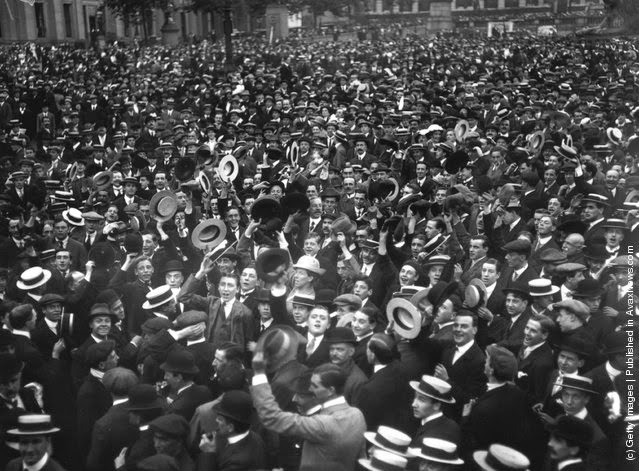
. . . and Britons Celebrate the Declaration of War in Trafalgar Square

German troops crossed the Belgian frontier on the morning of August 4.  Chancellor Bethmann-Hollweg spoke the same day in the Reichstag, admitting that Germany's action violated international law but insisting that "necessity knows no law."  The Reichstag responded by approving war credits.  The vote was unanimous: even the Social Democratic Party, the largest in the Reichstag and previously opposed to war, supported the measure, Hugo Haase, the party's leader, declaring that "we will not desert our Fatherland in its hour of need."  The British government responded by issuing an ultimatum to Germany demanding that it cease its invasion by midnight German time (11:00 P.M. in London).  As the deadline expired, British Foreign Secretary Sir Edward Grey looked out the window of the Foreign Ministry at the gas lamps being lit on the street below and was heard to say "The lamps are going out all over Europe.  We shall not see them lit again in our lifetime."


Lord Kitchener

Field Marshal Horatio Herbert Kitchener, Earl Kitchener of Khartoum, is Great Britain's highest ranking military officer and greatest war hero.  On August 4, he was brought into the British cabinet as Secretary of State for War.  Between August 12 and August 17, a British Expeditionary Force formed under the command of General Sir John French was landed on the French coast and deployed on the left flank of the French army.  The Canadian Government has been advised by the British War Office that the 21,000 Canadian troops on their way to England will be sent into the firing line as soon as they arrive.  On August 28, Lord Kitchener announced in the House of Lords that Indian troops would also be employed.


German Troops in Liege

The German army occupied the city of Liege on August 6, but the forts surrounding the city held out until August 17, delaying the German timetable.  The Belgian government withdrew to the coastal city of Antwerp on August 17, and on August 20 German troops occupied Brussels. As the German Army advanced through Belgium, it was delayed further by the necessity to reduce the forts around Namur, in a siege that lasted from August 20 to 24, and by battles fought on August 21 with the French at Charleroi and on August 23 and 26 with the British at Mons and Le Cateau.  The confusingly named General French wanted to pull his British Expeditionary Force out of the line, but was overruled by Lord Kitchener, who crossed the channel and ordered the BEF commander to continue to support the French Army.  At month's end German forces were on French soil but the Allies appeared to be withdrawing in good order.


 French Soldiers Cheered as They March Off to War

The French plan for war against Germany, called Plan XVII, was implemented on August 6 with an offensive in Alsace.  Mulhouse was captured on August 8, but recaptured by the Germans on August 13.  An offensive into Lorraine that began on August 14 failed, as did an attack in the Ardennes Forest a few days later, due in part to the necessity of withdrawing French forces to meet the growing threat posed by the German attack in the north.

As this summer's diplomatic crisis unfolded, it was unclear where Italy stood.  A member of the Triple Alliance with Germany and Austria-Hungary, her relations with Austria-Hungary have been strained by territorial disputes going back to the wars of Italian unification.  On August 1, immediately following Germany's declaration of war on Russia, the Italian government notified Germany and Austria-Hungary that it did not regard its membership in the Triple Alliance as requiring it to come to their assistance in the present circumstances. On August 3 it issued a formal declaration of neutrality, relieving France of the necessity of defending another frontier.  Italy remains under intense pressure from Germany and Austria-Hungary to come to their assistance, including promises of territorial compensation.


General Alexander Samsonov

The Schlieffen Plan, devised in 1905 by German General Alfred von Schlieffen to fight a two-front war against Russia and France, assumed that Russia would be slow to mobilize and that Germany could and should therefore seek a quick victory over France before concentrating its attack on the Eastern Front.  This month, however, as the German Army moved through Belgium and into France in accordance with Schlieffen's plan, the Russians mobilized quickly and attacked the Germans with two armies in East Prussia.  The First Army, commanded by General Pavel von Rennenkampf, advanced to the north of the Masurian Lakes and on August 20 inflicted a defeat on the German Eighth Army, under the command of General Maximilian von Prittwitz.  Prittwitz proposed to retreat to the Vistula, but was overruled by the overall German commander, General Helmuth von Moltke, who replaced Prittwitz with General Paul von Hindenburg and Hindenburg's deputy, General Erich Ludendorff.  Under its new command, the Eighth Army attacked to the south and destroyed the Russian Second Army near Tannenberg on August 30 before the First Army, separated from the Second by the lakes, could join the battle.  General Alexander Samsonov, the commanding general of the Second Army, walked into the woods after the battle and shot himself.


Serbian Marshal Radomir Putnik

War is also raging in the Balkans, where it all started.  Austria-Hungary was already at war with Serbia when the month began, and the two-front nature of its strategic challenge was underscored when it declared war on Russia on August 6.  On August 7, Montenegro declared war on Austria-Hungary, and the next day Austrian warships bombarded Antivari, a Montenegrin seaport.  They were cut off and attacked on August 16 by an Anglo-French naval force that succeeded in sinking one of the Austrian ships and driving the other away, but was forced by the end of the month to return to Malta, leaving the Adriatic in Austrian hands.  On August 12, the Austro-Hungarian army invaded Serbia by crossing the Drina River from Bosnia, but was met in the vicinity of Cer Mountain by Serbian forces under the command of Marshal Radomir Putnik and turned back with heavy losses.  By month's end, the Austrians had retreated back across the Drina and Serbian forces had crossed the Sava River, west of Belgrade, to occupy the Hungarian town of Zemun.


H.M.S. Amphion

The first shots in the naval war were fired on August 5 when the British cruiser H.M.S. Amphion sank a German minelayer in the English Channel.  The next day, the Amphion struck a mine and sank, killing or wounding 132 British sailors and twenty-seven German crewmen from the minelayer who had been rescued by the Amphion the previous day.

With the onset of war, transatlantic sailings of German vessels have been cancelled.  Further isolating Germany, on August 5 a British cable steamer in the North Sea and a British cruiser in the Atlantic Ocean east of the Azores located and severed a total of seven telegraph cables connecting Germany with North America and with other European nations.

Germany is not the only nation whose international trade has been affected by the outbreak of war.  The sudden unavailability of merchant ships to transport grain and other commodities has caused export trade in the United States to come to a virtual standstill.  Legislation is under consideration for the United States Government to provide war risk insurance and to purchase and operate merchant vessels, including German ships, that are now effectively embargoed in American ports   The situation is most acute at Gulf Coast ports such as Galveston and New Orleans, where elevators and storage facilities are filled to capacity with grain bound for South and Central America.  The legislation is opposed by private shipowners who object to government participation in the shipping business.  Government ownership and operation of steamship lines, however, is not entirely unprecedented: the Panama Railroad Company, which operates ships as well as the railroad, is controlled by the Government.  Another complication may be more serious.  Under the Declaration of London the transfer of an enemy ship to a neutral flag after the outbreak of war is recognized as valid only if the new owner can demonstrate that the transfer was not made in order to avoid capture.  It might be difficult, and certainly awkward, for the United States Government to try to make that case in an Allied prize court.


The View from the Goeben: British Ships In Pursuit


Goeben (left) and Breslau at the Straits

Among the colonial forces expected to fight in the Allied cause are Algerians to be brought across the Mediterranean to join the French Army.  When war broke out, the first and most urgent mission of the French Navy was to escort and protect troop ships ferrying those troops between Algeria and Marseilles, a mission facilitated by Italy's decision to remain neutral but complicated by the absence of two French dreadnoughts that were absent from the Mediterranean escorting the French President and Prime Minister on their visit to St. Petersburg.  Also of concern was the presence in the Mediterranean of two German warships, the battle cruiser SMS Goeben and light cruiser SMS Breslau, under the command of Admiral Wilhelm Souchon.  The principal task of the British Mediterranean Fleet, under the command of Admiral Sir Archibald Berkeley Milne, was to assist the French Navy and in particular to watch Goeben and Breslau.  As they were doing so, the British missed two opportunities to attack and destroy the German ships: once on August 4 because Great Britain's declaration of war had not yet taken effect; and again on August 6, as the German ships were in port in Messina, because it would have violated Italian neutrality.  Successfully blocking Souchon's exit from Messina west to Algeria, the British allowed the Germans to escape to the east, where they reached the entrance to the Dardanelles on August 10.  As a neutral, Turkey could not allow passage of German ships through the straits, but that difficulty was overcome by transferring the ships to the Turkish Navy, a solution viewed as appropriate retribution for Britain's refusal at the end of July to allow British shipyards to deliver two new battleships to Turkey.  Goeben and Breslau, still manned by German crews but flying the Ottoman flag and bearing their new names of Jawus Sultan Selim and Midilli, were transferred to the Ottoman Navy on August 16.  A week later, Admiral Souchon was named Commander-in-Chief of the Turkish Navy.


British Sailors Watching a German Cruiser Sink at the Battle of Heligoland Bight

The end of the month saw the first major naval battle of the war in Europe.  The German High Seas Fleet is stationed at Heligoland Island, Wilhelmshaven, and in other harbors in the Heligoland Bight, the southeastern corner of the North Sea.  On August 28, British cruisers and destroyers under the command of Commodore Reginald Tyrwhitt and submarines under the command of Commodore Roger Keyes attacked German ships during their regular patrols.  The attack was supported by additional cruisers under the command of Vice Admiral David Beatty.  The support of Beatty's battle cruisers proved crucial to the outcome, but the failure of the Admiralty to keep the British commanders informed of the presence of friendly forces resulted in confusion and near-tragedy.  The German response was also uncoordinated, however, and at the end of the day the Germans had suffered significant losses: three light cruisers and one destroyer sunk and three other light cruisers damaged.


Premier Okuma Shigenobu

Premier Okuma Shigenobu of Japan, the principal naval power in the Pacific, announced on August 5 that if the war was carried into Pacific waters Japan would assist Great Britain in accordance with the Anglo-Japanese Naval Agreement of 1902. On August 16, Japan presented an ultimatum to Germany demanding that it withdraw from China, including the surrender of the leased territories of Kiau-Chau, on the Shantung Peninsula in the Yellow Sea.  It gave Germany one week to answer.  When the deadline expired on August 23 without a response, Japan declared war.  A declaration of war against Austria-Hungary followed on August 25.  Two days later, Japanese and British naval forces blockaded Tsingtao, the principal city of the leased territories.


Vice Admiral Count Maximilian von Spee

The only substantial German naval force outside European waters is the East Asia Squadron, based when war broke out at Tsingtao.  Commanded by Admiral Count Maximilian von Spee in the armored cruiser SMS Scharnhorst, it includes another armored cruiser, SMS Gneisenau, and three light cruisers: Emden, Leipzig and Nurnberg.  When war broke out, the squadron was dispersed in various locations in the Western Pacific.  Because likely Japanese hostility made it impossible for him to return to Tsingtao, Admiral Spee ordered his squadron to concentrate at Pagan Island in the Northern Marianas, a German colony.  After dispatching Emden on a commerce raiding mission in the Indian Ocean, he took his squadron east, arriving at Eniwetok Atoll in the Marshall Islands (another German colony) on August 20.  On August 22 he proceeded to Majuro Atoll, on the far eastern edge of the Marshall Islands, where he learned that Japan had declared war on Germany.  He was joined at Majuro by additional ships that had escaped Tsingtao ahead of the arrival of the Japanese fleet.  Deciding that the west coast of South America, in addition to being a relatively hospitable region for obtaining coal and other supplies, was also a promising area for attacking Allied shipping, he took his squadron in that direction.  At month's end, he was on an easterly course, out of touch with the world somewhere in the vastness of the Pacific Ocean.

Further demonstration of the global nature of this war came on August 26, when British and French forces captured the German colony of Togoland on the Atlantic coast of Africa.


*****


Ellen Axson Wilson

With her husband and daughters at her side, Mrs. Woodrow Wilson died in the White House on August 6.  She was suffering from Bright's Disease.  For months she had worked for passage of a slum clearance bill for the District of Columbia.  On the morning of the day she died, she told her husband that this was her last wish, and before death came news was brought to her bedside that Congress had passed the bill.


 Secretary of State Bryan

The United States issued a formal Declaration of Neutrality on August 4.  On August 5, invoking its status as a signatory to the Hague Convention, it tendered its good offices as a mediator to the warring nations.  Other than non-involvement in military operations, the precise meaning of United States neutrality remains to be determined.  For example, two American corporations have contracts to build submarines for the British Government to be delivered in sections.  The administration has been advised that, while delivery of completed submarines would be unneutral under international law, delivery of unassembled parts would not.  Secretary of State Bryan has nevertheless persuaded President Wilson to ban the delivery, arguing that it would violate the spirit of neutrality.  Bryan's notion of neutrality goes even further.  He believes that its "spirit" requires a ban on all loans to belligerent nations on the ground that "money is the worst of all contrabands because it commands everything else."  Accordingly, on August 15, the State Department responded to an inquiry from J.P. Morgan & Co., following a request by the French Government for a loan, by saying that in the judgment of the Government "loans by American bankers to any foreign nation which is at war is inconsistent with the true spirit of neutrality."

President Wilson provided additional insight into his own thinking when he issued a statement to the American people on August 19.  He gave Americans a "solemn word of warning" that "the United States must be neutral in fact as well as in name during these days that are to try men's souls," and that "we must be impartial in thought as well as in action, must put a curb upon our sentiments as well as upon every transaction that might be construed as a preference of one party to the struggle before another."


S.S. Ancon Entering the Canal

The Panama Canal was formally opened to world commerce on August 15.  The Panama Railroad steamship Ancon was the first ship through, making the transit from the Atlantic to the Pacific in ten hours.

The ongoing revolution in Mexico reached another milestone this month as the provisional president of Mexico, Antonio Carvajal, stepped down on August 15.  The victorious Constitutionalist forces, led by Venustiano Carranza, entered Mexico City without opposition on August 19.


James C. McReynolds and Thomas W. Gregory

President Wilson nominated Attorney General James Clark McReynolds to the United States Supreme Court on August 19.  McReynolds will fill the vacancy caused by the death last month of Justice Horace Lurton.  Thomas Watts Gregory has been appointed to succeed McReynolds as Attorney General.  Gregory has been serving as a Special Assistant Attorney General with the principal responsibility of supervising anti-trust litigation against the New Haven Railroad.


Pope Pius X

Pope Pius X died on August 20.  Born Giuseppe Sarto in 1835, he was elected pope in 1903 when the front-runner, Cardinal Mariano Rampolla, was vetoed by Cardinal Jan Puzyna de Kosielsko on behalf of Emperor Franz Joseph of Austria-Hungary, exercising a power traditionally granted to Catholic monarchs to have their say in papal elections.  The outbreak of the war, which greatly distressed the Pope, is believed to have hastened his death.


August 1914 – Selected Sources and Recommended Reading

Contemporary Periodicals:
American Review of Reviews, September and October 1914
New York Times, August 1914

Books and Articles:
A. Scott Berg, Wilson
Philip Blom, The Vertigo Years: Europe, 1900-1914
Randolph S. Churchill, Winston S. Churchill Volume II: Young Statesman, 1907-1914
Winston S. Churchill, The World Crisis 1911-1918
Christopher Clark, The Sleepwalkers: How Europe Went to War in 1914
John Milton Cooper, Jr., Woodrow Wilson: A Biography
John Milton Cooper, Jr., The Warrior and the Priest: Woodrow Wilson and Theodore Roosevelt
Patrick Devlin, Too Proud to Fight: Woodrow Wilson's Neutrality
David Fromkin, A Peace to End All Peace: Creating the Modern Middle East, 1914-1922
Martin Gilbert, The First World War: A Complete History
Martin Gilbert, A History of the Twentieth Century, Volume One: 1900-1933
Martin Gilbert, Winston S. Churchill Volume III: The Challenge of War, 1914-1916
Kermit L. Hall, ed., The Oxford Companion to the Supreme Court of the United States
Richard F. Hamilton and Holger H. Herwig, Decisions for War, 1914-1917
Max Hastings, Catastrophe 1914: Europe Goes to War
August Heckscher, Woodrow Wilson: A Biography
Holger H. Herwig, The Marne, 1914: The Opening of World War I and the Battle that Changed the World
Godfrey Hodgson, Woodrow Wilson's Right Hand: The Life of Colonel Edward M. House
John Keegan, The First World War
Arthur S. Link, Woodrow Wilson and the Progressive Era, 1910-1917
Margaret MacMillan, The War That Ended Peace: The Road to 1914
Robert K. Massie, Dreadnought: Britain, Germany, and the Coming of the Great War
Robert K. Massie, Castles of Steel: Britain, Germany, and the Winning of the Great War at Sea
Sean McMeekin, July 1914: Countdown to War
Michael S. Neiberg, Dance of the Furies: Europe and the Outbreak of World War I 
Kenneth Rose, King George V
George Malcolm Thomson, The Twelve Days: Two Weeks in Europe's Fatal Summer
Barbara W. Tuchman, The Guns of August
Barbara W. Tuchman, The Proud Tower: A Portrait of the World Before the Great War
Barbara W. Tuchman, The Zimmermann Telegram


Thursday, July 31, 2014

July 1914

July 1914 will become known to history as the month of the July Crisis.  Looking back from the vantage point of the Twenty-first Century, it is hard to find a more consequential month, in the Twentieth, than this one.  The month begins with the reaction to the June 28 assassination of the Archduke Franz Ferdinand and his wife in Sarajevo; it ends with ultimatums and mobilizations that plunge Europe into a catastrophic conflict that will continue for over four years and change the world forever.  After the assassination, Austria-Hungary quickly determines that Serbia is to blame.  Like Russia in another July crisis a century later, Serbia denies responsibility for the "outrage" and calls for an investigation.  An Austrian ultimatum and an unsatisfactory Serbian response are followed by a declaration of war against Serbia.  By month's end, Russia, Serbia's patron, and Germany, Austria-Hungary's ally, have mobilized, and in England First Lord of the Admiralty Winston Churchill has ordered the Royal Navy's First Fleet (soon to be redesignated the Grand Fleet) to its war station in the Orkney Islands, where it will command the North Sea.  As preparations for war continue, much of the public's attention is elsewhere.  In London, the King makes an unsuccessful personal attempt to resolve the Irish Home Rule question.  In Paris, Mme. Caillaux is acquitted and M. Jaures is slain.  In Mexico, General Huerta resigns the presidency and leaves for Jamaica.  In the United States, President Wilson's emissary Colonel House returns home after two months in Europe. But as the month comes to an end, a sudden realization that war is imminent causes markets to collapse in London, New York, and other financial capitals.

*****


"A Chain of Friendship" (from the Brooklyn Eagle)

Weeks of diplomatic maneuvering that followed the June 28 assassination of Archduke Franz Ferdinand and his wife culminated on July 23 in an Austro-Hungarian ultimatum to Serbia, followed by a declaration of war on July 28.  Russian general mobilization ensued, followed by a German ultimatum to cease.  Russia will almost certainly refuse, and France is expected to stand by its ally.  At month's end, all Europe seems on the road to war.


Count Alexander Hoyos

Not long after the Archduke's assassination, Austrian authorities satisfied themselves through interrogation of Princip and others that the assassins were part of a conspiracy originating in Belgrade.  Rather than take action against Serbia immediately, however, the Austrian government decided to ascertain the degree of Germany's support.  On July 4, Foreign Minister Berchtold sent his Chief of Staff, Count Alexander Hoyos, to Berlin to deliver two notes in person.  One was a memorandum prepared before the assassination reviewing international threats to Austria-Hungary and its common interests with Germany, with an addendum prepared after the assassination arguing that good relations with Serbia were no longer possible.  The second was a personal note from Emperor Franz Joseph to the Kaiser asserting that the assassination was the result of a "well-organized conspiracy ... whose threads extend to Belgrade" and that there was no longer any possibility of conciliation between Austria-Hungary and Serbia.  It concluded that "the policy pursued by all European monarchs of preserving peace will be at risk as long as this hotbed of criminal agitation in Belgrade remains unpunished."  In Berlin on July 5, Hoyos gave copies of the notes to Count Laszlo Szogyenyi, the Austrian Ambassador to Germany, who took them to Potsdam and handed them to the Kaiser while Hoyos stayed in Berlin and met with German Undersecretary of State Arthur Zimmermann (Secretary of State Gottlieb von Jagow was in Italy on his honeymoon).  That evening the Kaiser conferred with Zimmermann, Chancellor Theobald von Bethmann-Hollweg, and senior German military officers.  The next morning, July 6, the Kaiser left for a tour of Scandinavia on his yacht.  That afternoon, Bethmann and Zimmermann met with Hoyos and Szogyenyi in Berlin.  Bethmann gave Hoyos the German government's formal reply to its notes, assuring him that, whatever Austria decided to do, it could be confident that Germany would stand by its side as an ally.


Baron Vladimir Giesl von Gieslingen

On July 10, Baron Giesl von Gieslingen, the Austro-Hungarian minister to Serbia, returned to Belgrade after an extended stay in Vienna.  Nikolai Hartwig, Russia's minister in Belgrade and a long-time advocate of a strong line against Austria-Hungary, took the occasion of Giesl's return to call on him at the Austrian Embassy and offer Russia's formal condolences for the death of the Archduke and Duchess.  Among other things, he denied rumors (nevertheless later confirmed) that the Russian Embassy, alone among foreign embassies in Belgrade, had not lowered its flag to half-mast during the memorial service for the Archduke.  While he and Giesl were conversing, Hartwig suffered a heart attack and died.  Despite Hartwig's prior poor health and the lack of any evidence to implicate the Austrians, many Serbs and Russians suspect foul play, and the ambassador's sudden death has served to inflame anti-Austrian sentiment in both countries.


Count Istvan Tisza

Germany advised Austria-Hungary that any punitive action against Serbia should be carried out swiftly.  The internal politics of the Dual Monarchy, however, made that impossible.  No action could be taken without the concurrence of Count Istvan Tisza, Minister-President of Hungary.  After the assassination, Tisza initially opposed war with Serbia, fearing that annexation of all or part of Serbia would diminish the power of Hungary within the Empire.  In a meeting of the Joint Ministerial Council on July 7, it was agreed that there would be no annexation of Serbian territory and, again at Tisza's insistence, that any attack on Serbia would be preceded by an ultimatum and declaration of war.  In another meeting on July 14, it was determined that an ultimatum would be drafted and submitted to the Council for its approval on July 19.  The Council also decided that presentation of the ultimatum would be delayed until July 23 so that it would not coincide with the visit of French President Poincare and Prime Minister Viviani to St. Petersburg, scheduled for July 20-23.


Sergei Sazonov

The Council of Ministers considered it important to keep its plans secret until the ultimatum was delivered.  Despite its efforts, however, the information leaked out through diplomatic channels.  On July 18, two days before the arrival of the French President and Prime Minister in St. Petersburg, Russian Foreign Minister Sergei Sazonov learned of Austria's intentions when he returned from the countryside and read a telegram from Nikolai Shebeko, the Russian Ambassador to Austria-Hungary.  When he showed the telegram to the Tsar the next day, the Tsar read it and wrote in the margin, "In my opinion a State should not present any sort of demands to another, unless, of course, it is bent on war."


Austro-Hungarian Foreign Minister Count Leopold Berchtold

On June 19, the same day the Tsar was reading and annotating the Shebeko telegram in St. Petersburg, the Austrian Ministerial Council met in Vienna to review the draft ultimatum.  The draft alleged that "the history of the past few years, and particularly the painful events of the 28th of June, have proved the existence of a subversive movement in Serbia, whose object it is to separate certain portions of its territory from the Austro-Hungarian Monarchy."  It further alleged that this movement, "which came into being under the very eyes of the Serbian government," has "found expression outside of [Serbia] in acts of terrorism, in a number of attempted assassinations, and in murders."  A number of demands followed, including that Serbia issue an official condemnation of propaganda directed against Austria-Hungary, suppress publications spreading such propaganda, enact measures to prevent smuggling of weapons and explosives across the Serbian frontier, and take action against individuals implicated in the June 28 conspiracy and other individuals who have taken action and made statements indicating "hostility towards the Austro-Hungarian Monarchy."  Points 5 and 6 demanded that Austria-Hungary be allowed to participate in the investigation and suppression of subversive movements in Serbia.  The Council approved the text as drafted, and directed that it be presented to the Serbian government on June 23.


President and Tsar in St. Petersburg

President Poincare and Prime Minister Viviani of France arrived in St. Petersburg on July 20.  Unbeknownst to the Austrian government, its plan to keep the ultimatum secret until after their visit had failed.  The leaders of the French and Russian governments therefore had an opportunity to consult directly on a common course of action.  On July 21, while the Tsar was entertaining the French visitors, Foreign Minister Sazonov warned Friedrich Pourtales, Germany's ambassador to Russia, that "there must be no talk of an ultimatum."  Sazonov and Poincare agreed before the French leaders' departure that they would send substantially identical messages to Vienna warning that they would not tolerate a humiliation of Serbia.  Accordingly, on July 23 Sazonov instructed Shebeko to warn the Austrian government against taking "measures incompatible with the dignity of Serbia"; and early in the morning of July 24, at sea shortly after leaving St. Petersburg, Prime Minister (also Foreign Minister) Viviani instructed the French ambassador in Vienna that "no avenue must be neglected" to prevent any action by Austria-Hungary that might "be considered a violation of [Serbia's] sovereignty or her independence."  By the time those warnings were received in Vienna, Ambassador Giesl had already delivered the ultimatum in Belgrade.  The deadline for a response was 6:00 p.m. on Saturday, July 25.


French Ambassador to Russia Maurice Paleologue


Foreign Minister Sazonov at His Desk

On Friday morning, July 24, the Austro-Hungarian ambassador to Russia, Count Friedrich Szapary, arrived at Foreign Minister Sazonov's office to deliver a copy of the ultimatum his government had sent to Serbia the previous day.  Sazonov reviewed the text and told Szapary that Serbia could never agree to allow the participation of Austrian officials in the investigation of the assassination.  Angry, he accused Austria of "setting Europe ablaze" and told Szapary that other European nations, particularly France and Great Britain, would also consider Austria's stance to be nothing less than "unjustified aggression."  He rejected Szapary's argument that Austria-Hungary was acting to vindicate the "monarchical principle," saying "the monarchical idea has nothing to do with this."  After Szapary left, Sazonov called a meeting of the Council of Ministers for that afternoon.  At the meeting, the Council approved Sazonov's plan to order a "partial mobilization" of the military against Austria-Hungary only.  That evening, Sazonov received the German ambassador, Friedrich Pourtales, and told him that Russia would "not leave Serbia to settle her differences with Austria alone," and would consider Austrian aggression against Serbia a reason to "make war."  Later, he received the French ambassador, Maurice Paleologue, and reported his conversation with Pourtales.  He also informed the ambassador of the decisions the Council of Ministers had made earlier that day, including the decision to order partial mobilization against Austria-Hungary.

The next day, the Council of Ministers met again, this time with the Tsar presiding.  The Tsar approved Sazonov's partial mobilization plan and authorized the immediate institution of a "Period Preparatory to War," a step just short of mobilization that included enhanced powers for military authorities, recall of reservists, concentration of troops and equipment, mining of harbors, and heightened security at magazines and supply depots.


Nikola Pasic

Five minutes before the July 25 deadline expired, Serbian President Nikola Pasic presented himself at the Austro-Hungarian legation in Belgrade and handed Ambassador Giesl the Serbian response to the ultimatum.  While some of the responses were conditional or asked for more information, most of Austria-Hungary's demands were agreed to.  Russia's support, however, had emboldened Serbia to resist the most objectionable parts.  In response to Paragraph 6, the response stated: "The [Serbian] Government considers it its duty as a matter of course to begin an investigation against all those persons who have participated in the outrage of June 28th and who are in its territory. As far as the cooperation in this investigation of specially delegated officials of the [Austro-Hungarian] Government is concerned, this cannot be accepted, as this is a violation of the constitution and of criminal procedure. Yet in some cases the result of the investigation might be communicated to the Austro-Hungarian officials."  When Ambassador Giesl received the response and saw that it was not an unconditional acceptance of Austria-Hungary's demands, he handed Pasic a previously drafted letter stating that he and his staff would leave Belgrade that evening.


First Lord of the Admiralty Winston Churchill

The harsh Austrian ultimatum and Serbia's refusal to acquiesce unconditionally made European governments realize for the first time that a continent-wide war was a distinct possibility.  On Sunday, July 26, the day Russia's "Period Preparatory to War" took effect, the German government issued a statement warning other powers not to interfere with Austria's action against Serbia.  On the same day, Great Britain's First Lord of the Admiralty, Winston Churchill, ordered the ships of the British First and Second Fleets, coming off maneuvers and due to return to peacetime status, to remain on alert and concentrated at Portland.  On July 28, he ordered the First Fleet, comprising the bulk of Britain's naval strength, to get under way and proceed to its war station at Scapa Flow.


Conrad von Hoetzendorf

On Tuesday, July 28, Emperor Franz Joseph signed Austria-Hungary's declaration of war against Serbia.  The next day, Austrian gunboats in the Danube began bombarding Belgrade and Minister of War Conrad von Hoetzendorf ordered the Austrian army to prepare for a two-front war.  Actual commencement of military operations, however, had to await the return of soldiers from harvest leave.


Tsar Nicholas II

On July 29, in response to the Austrian declaration of war against Serbia, Tsar Nicholas ordered general mobilization, then changed his mind and ordered partial mobilization against Austria-Hungary only.  The same day, messages from the Tsar to Kaiser Wilhelm and from the Kaiser to the Tsar, each employing an intimate form of address ("Willy" and "Nicky") and pleading for an avoidance of war, crossed paths.  The Tsar's message to Wilhelm read "An ignoble war has been declared to a weak country.  The indignation in Russia shared by me is enormous.  I foresee that very soon I shall be overwhelmed by the pressure brought upon me and be forced to take extreme measures which will lead to war.  To try to avoid such a calamity as a European war I beg you in the name of our old friendship to do what you can to stop your allies from going too far."  The Kaiser's message to Nicholas warned that "military measures on the part of Russia which could be looked upon by Austria as threatening would precipitate a calamity we both wish to avoid, and jeopardize my position as mediator which I readily accepted on your appeal to my friendship and my help." 


Russian Minister of War Vladimir Sukhomlinov

The crisis peaked as the month drew to a close.  On July 30, under pressure from Minister of War Vladimir Sukhomlinov and senior members of the Russian military, Tsar Nicholas changed his mind again and ordered general mobilization.  On July 31, Germany proclaimed a state of "Imminent Danger of War" throughout the German Empire and issued an ultimatum demanding that Russia halt its mobilization.  In another message to Nicholas, Kaiser Wilhelm said he had "authentic news of serious preparations for war" by Russia, and told the Tsar that "the peace of Europe may still be maintained by you, if Russia will agree to stop its military measures."  Following Germany's ultimatum and war preparations, the neighboring nations of Belgium, Switzerland and the Netherlands mobilized to protect their frontiers and maintain their neutrality.  In Great Britain, First Lord of the Admiralty Winston Churchill informed the builders of two dreadnoughts under construction in British shipyards, about to be completed and delivered to the Turkish Navy, that the Government could not allow Turkey or any other foreign government to take possession of them.


Depositors Outside the Bank of England

As a European war appeared increasingly likely in the last week of July, a financial crisis exploded across Europe, threatening a collapse of the world banking system.  Depositors lined up at banks to withdraw their funds and holders of paper currency lined up to exchange their notes for gold.  On Friday, July 31, the London Stack Exchange, faced with a flood of sell orders and few if any buyers, remained closed for the first time in its history.  Other exchanges throughout the world, including the New York Stock Exchange, also closed.


A Cartoon in the Irish World

The seriousness of the Irish Home Rule question was underscored this month when King George V intervened on behalf of the monarchy in what until now has been considered a mainly political issue.  It was announced on July 18 that the King would cancel his planned review of the fleet, and on July 20 he convened a conference at Buckingham Palace in an attempt to broker a resolution.  The Nationalists were led by John Redmond and John Dillon, the Unionists by Unionist (Conservative) Party leader Andrew Bonar Law and Sir Edward Carson.  The conference ended without agreement on July 24.


Nationalist Leaders Redmond and Dillon Arriving at Buckingham Palace

*****


Mme. Caillaux on Trial

Henriette Caillaux, the second wife of former French Premier Joseph Caillaux, was tried this month for the murder of Le Figaro editor Gaston Calmette following the magazine's publication of private letters between herself and her husband written when both of them were married to others.  She claimed that she had not planned to kill Calmette, only to teach him a lesson, but had been overwhelmed by passion.  She told the court the shooting was an accident: "It is terrible how these revolvers go off when they begin shooting -- one can't stop them!"  The trial began July 20.  It ended on July 28, the day Austria-Hungary declared war on Serbia, when after deliberating less than an hour the jury returned a verdict of not guilty.  In the courtroom the verdict was greeted with stunned silence, except for a small group of Mme. Caillaux's supporters in the back of the room who erupted in cheers.  Thousands demonstrated in the streets for hours after the verdict, shouting "murderess," "assassin" and "down with Caillaux."

With the conclusion of the Caillaux trial, the French public was able for the first time in weeks to turn its attention to the growing international crisis.


Jean Jaures

No sooner was the Caillaux trial over than France was shocked by another murder.  Jean Jaures, the leader of the French Socialist Party, returned on July 30 from a conference of the Socialist International in Brussels at which he and Hugo Haase, the leader of the Socialist Party in Germany, along with other European socialist leaders, pledged international solidarity in their opposition to war and resolved that if their countries declared war they would call general strikes to deprive their governments of the ability to conduct military operations.  The day after Jaures returned to Paris, as he was dining in a Paris cafe, he was shot and killed by a nationalist fanatic, Raoul Villain.


Raoul Villain

*****


Colonel House

Colonel Edward M. House, who was sent to Europe in May as a representative of United States President Woodrow Wilson, left England on July 21 to return home.  Sir William Tyrell, British Foreign Minister Sir Edward Grey's private secretary, caught up with House just before he sailed and delivered a message from Grey stating that recent developments had left him gravely concerned about the Austro-Serbian situation.  By the time Colonel House landed in Boston on July 29, Austria-Hungary was at war with Serbia.


 Francisco Carvajal

General Victoriano Huerta resigned the presidency of Mexico on July 15.  After a leisurely journey from Mexico City to Puerto Mexico, Huerta boarded a German steamer, which set sail for Kingston, Jamaica during the night of July 20.  He was replaced by Minister of Foreign Relations Francisco Carvajal, who took office as provisional president.  The real power in Mexico appears to be held by the leader of the Constitutionalists, Venustiano Carranza, and other rebels, including Pancho Villa and Emiliano Zapata, who, while not quite allies of Carranza, have until now been working toward the same goal, the ouster of Huerta.  The political situation in Mexico is far from settled, but with the departure of Huerta it may have taken a step toward resolution.  Meanwhile, the occupation of Veracruz by the United States continues.


Justice Lurton

United States Supreme Court Justice Horace Lurton died on July 12.  Prior to serving on the Supreme Court, Lurton served as a judge on the Sixth Circuit Court of Appeals, where he became a good friend of his fellow judge, William Howard Taft.  After Taft became president, Lurton was his first Supreme Court appointment.

Former President Roosevelt has announced his resignation from the board of editors of The Outlook, the magazine to which he has been a frequent contributor since leaving the presidency in 1909.  He says he wants to have more time to devote to politics.  As the month draws to a close, President Wilson's attention is riveted on his wife, whose health has taken a turn for the worse.


Walter Brock After Winning the Hendon-Paris-Hendon Race

On July 11, American aviator Walter Brock won the air race from the Hendon Aerodrome outside London to Paris and back. His actual flying time was seven hours three minutes and six seconds.  Six competitors began the race; only two completed it.  All the others landed safely except Lord John Carbery, who was forced down in the English Channel on the return leg and was rescued by a British steamer. 


Collins and Harlan

The international news is grim, but much American popular music is lighthearted.  This month Arthur Collins and Byron Harlan recorded "The Aba Daba Honeymoon," written by Arthur Fields and Walter Donovan (click to play):


July 1914 – Selected Sources and Recommended Reading

Contemporary Periodicals:
American Review of Reviews, August and September 1914
New York Times, July 1914

Books and Articles:
A. Scott Berg, Wilson
Philip Blom, The Vertigo Years: Europe, 1900-1914
Randolph S. Churchill, Winston S. Churchill Volume II: Young Statesman, 1907-1914
Winston S. Churchill, The World Crisis 1911-1918
Christopher Clark, The Sleepwalkers: How Europe Went to War in 1914
John Milton Cooper, Jr., Woodrow Wilson: A Biography
John Milton Cooper, Jr., The Warrior and the Priest: Woodrow Wilson and Theodore Roosevelt
Patrick Devlin, Too Proud to Fight: Woodrow Wilson's Neutrality
David Fromkin, A Peace to End All Peace: Creating the Modern Middle East, 1914-1922
Martin Gilbert, The First World War: A Complete History
Martin Gilbert, A History of the Twentieth Century, Volume One: 1900-1933
Martin Gilbert, Winston S. Churchill Volume III: The Challenge of War, 1914-1916
Richard F. Hamilton and Holger H. Herwig, Decisions for War, 1914-1917
Max Hastings, Catastrophe 1914: Europe Goes to War
August Heckscher, Woodrow Wilson: A Biography
Godfrey Hodgson, Woodrow Wilson's Right Hand: The Life of Colonel Edward M. House
John Keegan, The First World War
Arthur S. Link, Woodrow Wilson and the Progressive Era, 1910-1917
Margaret MacMillan, The War That Ended Peace: The Road to 1914
Robert K. Massie, Dreadnought: Britain, Germany, and the Coming of the Great War
Robert K. Massie, Castles of Steel: Britain, Germany, and the Winning of the Great War at Sea
Sean McMeekin, July 1914: Countdown to War
Michael S. Neiberg, Dance of the Furies: Europe and the Outbreak of World War I
Kenneth Rose, King George V
Charles Seymour ed., The Intimate Papers of Colonel House
George Malcolm Thomson, The Twelve Days: Two Weeks in Europe's Fatal Summer
Barbara W. Tuchman, The Guns of August
Barbara W. Tuchman, The Proud Tower: A Portrait of the World Before the Great War
Barbara W. Tuchman, The Zimmermann Telegram